
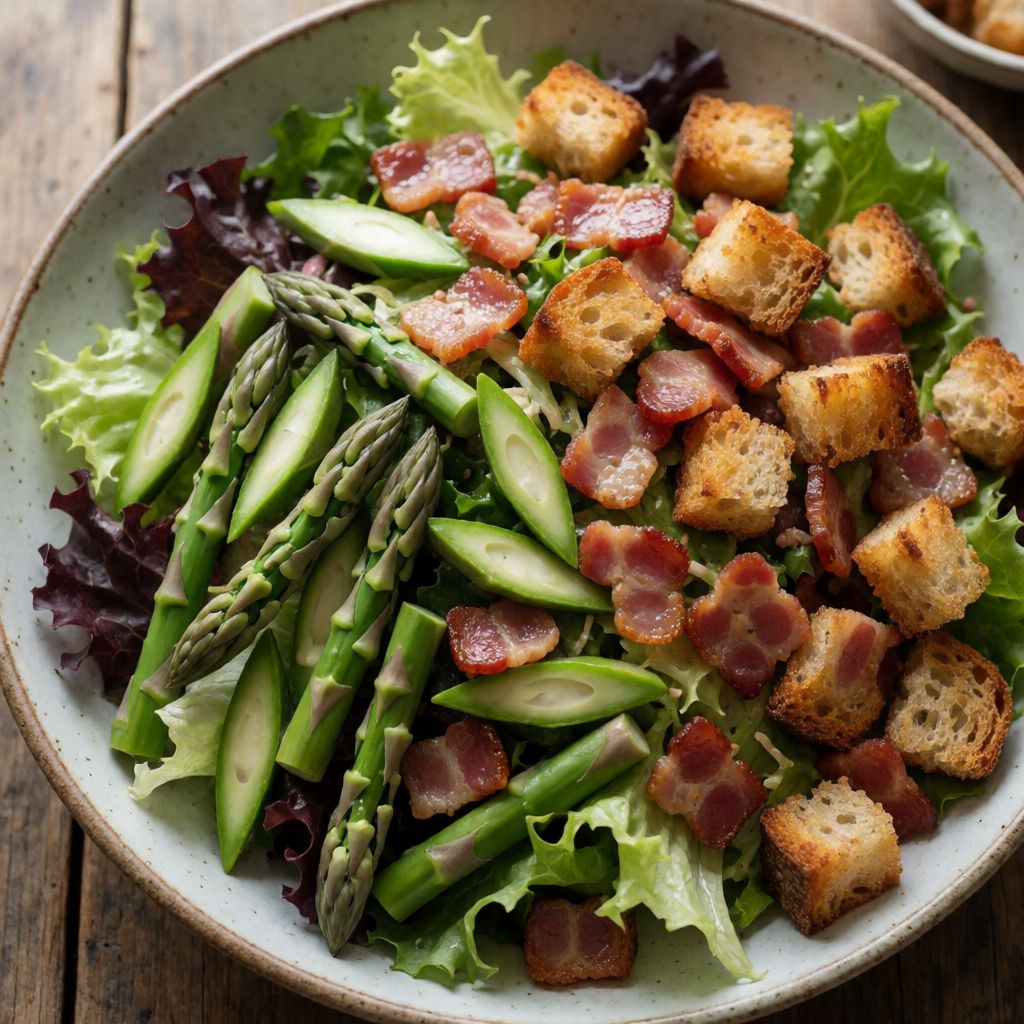
 AI photo
French Country Salad
A hearty French-style salad with poached eggs, crispy bacon, croutons, asparagus, green beans, potatoes and a creamy mustard dressing.
Labels are worked out automatically from the ingredients and can be wrong. Check the packaging if it matters to you.
Ingredients
- 4 pcs Eggs
- 2 tbsp Apple cider vinegar
- 4 pcs Bacon omit for a vegetarian version
- 2 tsp Butter
- 2 pcs Bread cut into cubes, a crusty loaf works well
- 200 g Asparagus cut into smaller pieces
- 200 g Green beans haricots verts
- 250 g Lettuce
- 1 pcs Red onion thinly sliced into rings
- 350 g Potatoes boiled and halved
- 50 g Black olives
- 1 bunch Chives finely chopped
- Salt
- Black pepper freshly ground











For the dressing
- 2 tsp Dijon mustard
- 2 tsp Honey
- 1 tsp Apple cider vinegar
- 1 tbsp Olive oil
- 2 tbsp Mayonnaise




Steps
Poach the eggs: bring a pan of water to the boil and crack each egg into its own small bowl.
Once the water boils, add the apple cider vinegar and remove the pan from the heat. Stir the water in a circle with a whisk to create a vortex in the centre.
Pour an egg into the centre of the vortex, return the pan to the heat and cook for about 3 minutes. Carefully lift the egg out with a slotted spoon and set on a plate — repeat with the remaining eggs.
Prepare the salad vegetables: fry the bacon slices in a pan until crisp, then drain on paper towel.
Add 1 tsp butter to the pan with the bacon fat and fry the bread cubes until crisp, season with salt and pepper, then set aside.
Add another 1 tsp butter to the pan and quickly fry the asparagus for just a minute.
Boil the green beans for 2 minutes, then immediately rinse in ice water to stop the cooking.
Arrange the salad on plates with the red onion, green beans, potato halves, asparagus, bread cubes, bacon pieces and olives.
Serve with the poached eggs, drizzle the dressing over the salad in small amounts, and finish with a sprinkle of chives.
Creamy mustard dressing: mix the Dijon mustard, honey, apple cider vinegar, olive oil and mayonnaise, season with salt and pepper to taste.
Instead of poached eggs you can use soft-boiled eggs: boil the eggs in a pan of boiling water for 8 minutes, until the yolk is still slightly runny.
Peel the eggs and carefully cut them into quarters with a sharp knife.
This is not really a salad, it's an inventory of a larder laid out on a plate — the kind of thing a farmer's wife in the Dordogne put together because she had a bit of everything and nothing enough of one thing. Composed salad, the French call it, and the word "composed" is doing real work: nothing here is dressed together and tossed, everything sits where you put it, so each bite can be a different combination. That's the whole point and the whole risk. A tossed salad forgives you. A composed one shows every mistake.
What decides whether it works is restraint with the dressing and discipline with your pan. You pour the mustard-honey-mayonnaise mix "in small amounts" for a reason — drown the plate and you've made coleslaw, not a composition. And every hot element — bacon, croutons, asparagus — comes out of the same pan in sequence, bacon fat first, because that fat is flavour you paid for with the bacon and you're not throwing it down the sink.
The egg is the one genuine piece of technique in the whole thing. Poaching is not hard, it's just unforgiving of hesitation — the vortex isn't a chef's flourish, it's what keeps the white wrapped around the yolk instead of trailing off into ragged threads through the water. If that feels like more fuss than a weeknight deserves, a soft-boiled egg does the same job — a yolk that runs when you cut it — with none of the vortex-watching. Nobody will mark you down for it.
Start with the vinegar in the poaching water — some say it's there to flavour the egg, no, it isn't, you'd never taste two tablespoons in a pan of water. It's there because acid speeds up the setting of egg white protein, so the white firms up fast around the yolk before it has time to drift apart into strings. The vortex does the same job from a different angle: spinning water wraps the white around itself by centrifugal force. Skip both and you get a sad, feathered thing that still tastes fine and looks like a jellyfish. Your water should be at a gentle boil, not a rolling one — a hard boil just beats the egg apart before it can set, bubbles are not your friend here.
The bacon, fried first, is really there to make fat, not just itself. That fat is what you fry the bread cubes in, and later the asparagus — it's a French habit with a peasant logic: nothing in the pan is wasted, the flavour of the meat gets spread across three ingredients instead of locked into one. If you're going vegetarian and skip the bacon, use butter from the start and don't feel you've lost much — you've lost a background note, not the dish.
Potatoes boiled and halved, asparagus barely touched in the hot pan for "just a minute" — that minute is doing something specific: asparagus goes from raw-grassy to just cooked startlingly fast, and past that point it turns grey and loses its snap, so faster is the right instinct, not laziness. The green beans get the opposite treatment — into ice water the second they're out of the boil — and that's not about flavour either, it's about stopping residual heat from carrying on cooking them after you've taken them off the heat. You're chasing a colour and a bend: they should bend, not snap, and they should stay the bright green of a bean, not the khaki of an overcooked one.
Bread — any crusty, dense loaf will do, the test is whether it holds its shape as a cube in hot fat. A soft sandwich loaf collapses into greasy crumbs; you want something with a tight enough crumb to fry into a crouton rather than disintegrate. In Britain a day-old sourdough end or a baguette heel from the freezer does exactly this job, and honestly works better once it's slightly stale — stale bread has less water in it, so it crisps instead of steaming in the pan.
Olive oil in the dressing: "any oil with no smell of its own" is the wrong description for olive oil specifically, because here you want the smell — it's there to be tasted, not to disappear, so don't substitute a neutral oil and expect the same dressing. Mayonnaise and honey against the sharpness of mustard and vinegar is just balancing acid with fat and sweetness, the same arithmetic behind every vinaigrette, just with a thicker, creamier result because of the mayonnaise.
And the patience bit, because it's real here: this dish has four or five small cooking jobs that each take two minutes, and the only way to get a warm plate at the end is to have everything else — the lettuce, onion, olives, chives — already sitting arranged and waiting. If you start slicing onion while the asparagus is in the pan, the asparagus loses its minute and turns grey while you're not looking. Lay it all out before you light the hob. That's not fussiness, that's just how a dish with this many small, fast, sequential steps survives an ordinary kitchen with one hob and one pan.