
 AI photo
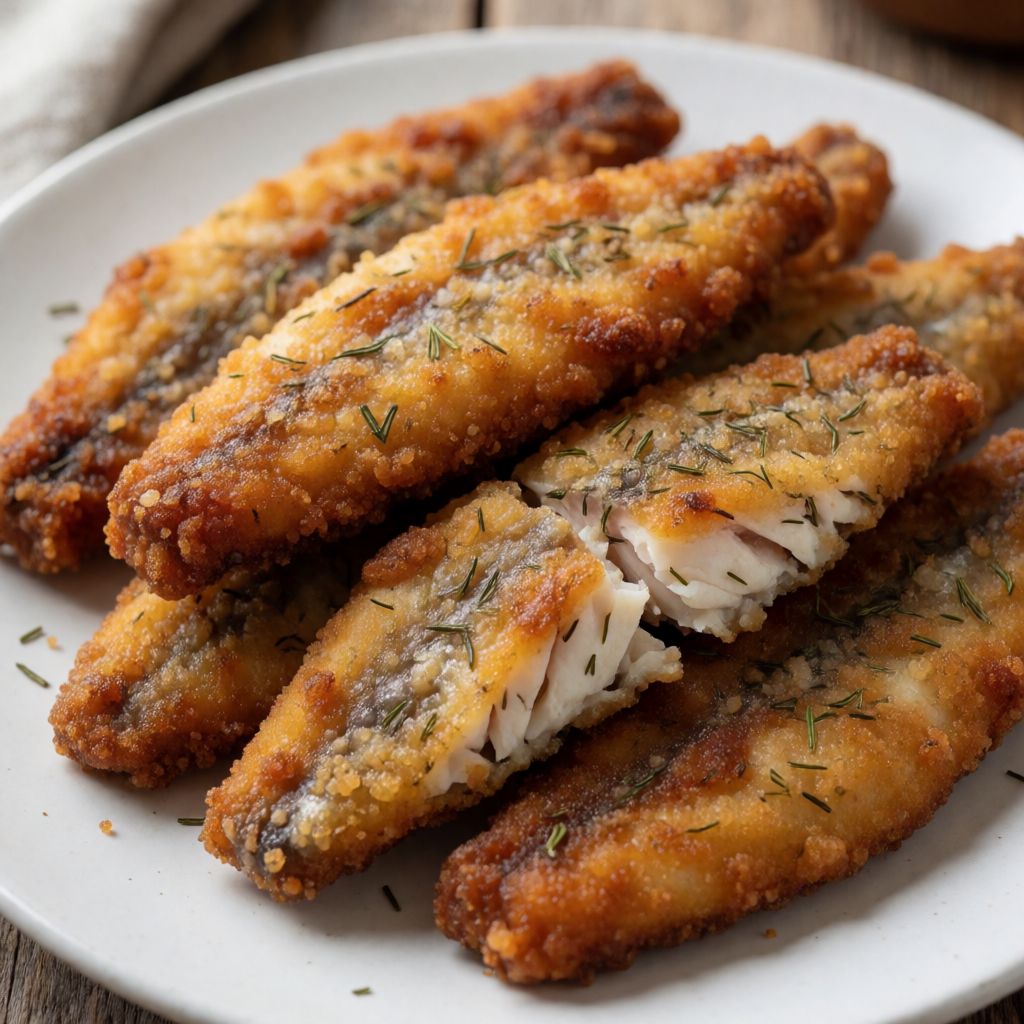
Fried Pickled Herring
A tangy classic: herring coated in mustard and dill, pan-fried, then chilled in a sweet-sour marinade.
Labels are worked out automatically from the ingredients and can be wrong. Check the packaging if it matters to you.
Ingredients
- 500 g Herring
- ½ pcs Lemon finely grated zest
- 2 tbsp Mustard
- 1 tsp dried dill
- 100 ml rye flour
- 1 tsp butter for frying
- 400 ml apple cider vinegar
- 400 g sugar
- 100 ml apple juice
- 100 ml water
- 5 pcs cloves
- 5 pcs allspice whole
- 10 pcs black pepper
- 1 pcs onion cut into wedges
- salt
- black pepper freshly ground
- 1 pcs rye bread
- 20 g butter for the bread
- 1 pcs red onion cut into rings
- 1 pcs apple cut into small cubes
- 1 bunch chervil

















Steps
Trim off the dorsal fin from the herring fillets if it hasn't been removed already.
Mix the finely grated lemon zest, mustard and dill, and spread this mixture on the inside of the herring, then fold the fillets back together.
Mix the rye flour with salt and pepper and coat the herring fillets in this mixture.
Fry the herring fillets in butter in a pan over medium heat on each side until golden.
3 minPut the vinegar, apple juice, sugar, water, cloves, allspice and black pepper into a saucepan and bring to the boil until the sugar dissolves.
4 minRemove the saucepan from the heat and let the marinade cool to room temperature.
Put the fried herring and onion into a container with a lid, pour over the marinade, cover and refrigerate for at least 1 day, preferably longer, before serving.
1440 min
This is a dish built on contradiction, and that's exactly why it works. You fry the herring — proper high-heat, crust-forming frying — and then you drown that crust in a hot vinegar marinade and send it to the fridge for a day. Everything the frying achieved, the marinade seems to undo. But it doesn't undo it, it transforms it. The crust stops being about crunch and starts being about texture against the cure: a slight resistance before the fish gives way, soft and tangy underneath. Think of it as a cousin to escabeche or rollmops, except the Russian hand adds spice — clove, allspice, mustard, dill — instead of just sour bite.
What decides whether this dish works isn't the frying, though that's where most people will worry. It's the marinade and the wait. A herring fried for three minutes and eaten warm is just a fried fish fillet with a mustard note — fine, but not this dish. The point only arrives after twenty-four hours in the fridge, when the vinegar has had time to push through the crust, soften the fish from the outside in, and marry with the clove and allspice so the sourness stops being sharp and starts being rounded. Rush that step and you've made pickled herring's clumsy, half-formed cousin.
Start with the herring itself. You want fillets, skin removed or on depending on what your fishmonger gives you, but crucially: fresh, not the tinned or jarred pre-pickled kind sold as "pickled herring" on British supermarket shelves — that's already been through someone else's vinegar bath and won't take this one properly, the flesh will be too soft to hold a fry. If raw herring isn't easy to find — and in the UK it often isn't, outside a proper fishmonger or a Scandinavian deli — mackerel is the honest substitute: similarly oily, similarly built to survive an acid cure.
The dorsal fin removal in step one isn't fussiness — any stray bone left in a thin fillet becomes the thing your tongue finds before anything else, and it ruins the first bite for whoever gets it. Run your thumb along where the fin sat; if you feel a ridge of small bones, they need to come out, tweezers or fingers, before the fish goes anywhere near the pan.
The lemon zest, mustard and dill mixture spread inside the folded fillet is doing two jobs at once: flavour, obviously, but also a kind of internal seasoning that the exterior marinade can't reach on its own, because once the fillet is folded shut, that paste is sealed inside and the acid has to work from both directions — in from the paste, out from the surrounding vinegar — to actually season the middle of the fish. Skip the fold and you get a fillet seasoned only on the outside, bland in the centre.
Rye flour for the crust is traditional and matters more than it looks like it should: it's coarser and nuttier than wheat flour, it browns differently — toastier, less neutral — and it's a crust robust enough to survive a day submerged in vinegar without turning to paste, which a finer wheat-flour coating would do. If you haven't got rye flour, a mix of plain flour with a spoon of fine polenta or oat flour gets you closer than plain flour alone, but don't expect quite the same backbone.
Butter for frying is traditional here too, but it's not without risk on a home hob: butter burns at a lower point than neutral oils, and if your pan runs hot, you'll get bitter flecks in the crust before the fish is even coloured. Some say only butter gives the right flavour — no, because what butter actually gives you is a narrower margin for error, not a better one. A splash of neutral oil alongside it, any oil with no smell of its own — sunflower, groundnut, something that won't fight the fish — buys you room to keep it hot without scorching, and you lose nothing the marinade won't layer back on top of anyway.
The marinade's sugar and vinegar in near-equal volume tells you this isn't meant to be savagely sour — it's a sweet-sour balance closer to a Scandinavian pickle than a British one, which might surprise anyone used to malt vinegar pickles from a jar. The whole spices — clove, allspice, black pepper — go in whole and stay whole because ground spice would cloud the liquid and turn bitter over a day's steeping; whole spice releases slowly, which is exactly the pace this dish runs on.
On the wait: a day minimum, and the recipe is honest that longer is better. This is not a step you can shortcut with more vinegar or a hotter marinade — acid penetration through fish flesh happens on its own clock, pushed by concentration and time together, and heat alone won't speed it without cooking the fish into mush. If you're in a rush, you haven't got this dish yet; you've got fried herring with a vinegar bath standing next to it. Patience here isn't a virtue, it's an ingredient, the same as the fish.
For serving, rye bread and butter are non-negotiable in spirit even if the exact loaf isn't — any dense, dark, slightly sour bread will do the same job, which is giving the vinegar and oil something to sit on and something to cut against. Red onion rather than white or brown for its gentler, less aggressive bite raw; apple in small cubes for a clean sweetness that doesn't compete with the marinade's own sugar; chervil for its soft aniseed note, and if you can't find it, a little fresh dill or even flat parsley with a pinch of fennel seed gets you in the right direction without copying the dish's own dill paste twice over.