
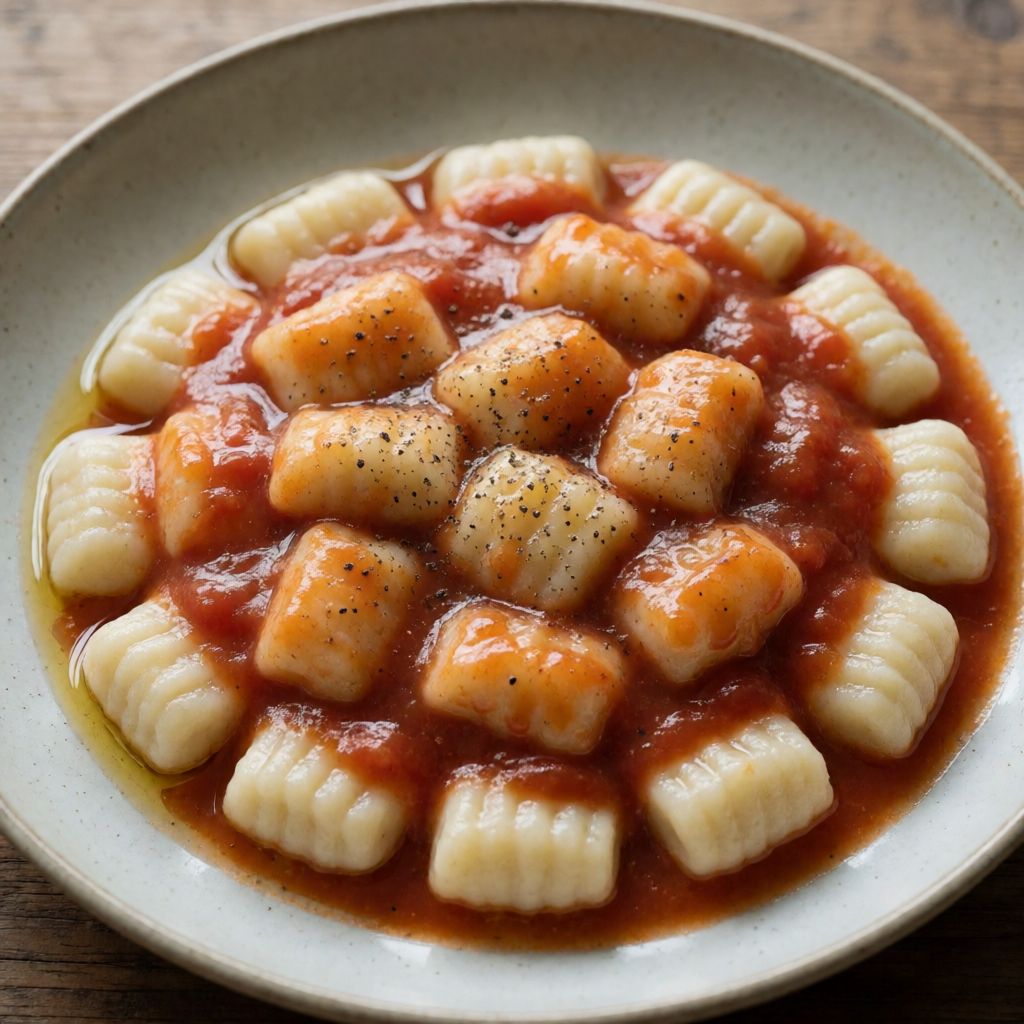
 AI photo
Gnocchi with Tomato Sauce
Soft potato gnocchi simmered in a simple garlic and basil tomato sauce, finished with grated parmesan.
Labels are worked out automatically from the ingredients and can be wrong. Check the packaging if it matters to you.
Ingredients
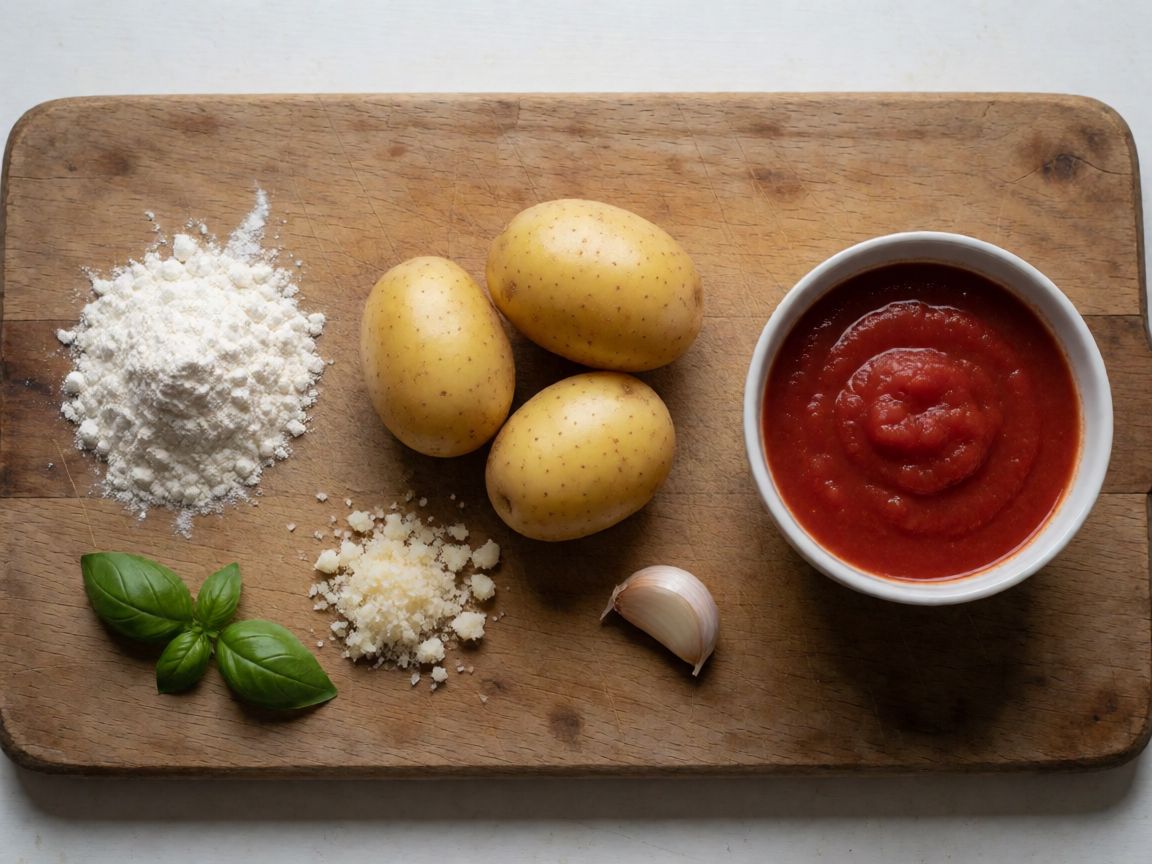
- 50 g Plain flour
- 3 pcs Potatoes
- 1 pinch Salt
- 1 pinch Black pepper
- 400 ml Tomato passata
- 3 tbsp Olive oil
- 1 clove Garlic
- Basil to taste
- Parmesan to taste









Steps
Boil the potatoes in a pan until tender, then remove from the heat and leave to cool.
Fry the chopped garlic in a little olive oil in a pan.
Add the tomato passata and simmer the sauce with salt and basil.
20 minPeel the cooled potatoes, mash them through a potato ricer, and season with salt.
Add black pepper to the potato mixture and start kneading the dough.
Mix the flour into the potato mixture and knead into a smooth, pliable dough.
Shape thin ropes of dough and cut them into pieces about 1 centimetre long.
Bring water to the boil, salt it, and cook the gnocchi.
When the gnocchi float to the surface, remove them with a slotted spoon and transfer to the sauce.
Fry the gnocchi with the sauce in a pan for a few minutes, then serve with grated parmesan.
Gnocchi is a dumpling built on a contradiction: you want potato for softness, but potato is mostly water, and water is the enemy of dough. Everything in this recipe is a negotiation with that water. Get it wrong and you get glue; get it right and you get something that feels like a cloud with a bit of chew left in it, for four people, in about an hour of mostly waiting.
That's why the potatoes are boiled whole, skin on, and why step one ends with "leave to cool" rather than "drain and use." Some say you can peel and cube the potatoes first to speed things up — no, because the cut flesh takes on cooking water like a sponge, and that extra water has to be matched with extra flour later, and extra flour is what turns a gnocco from pillow to bullet. Boiling the potato in its jacket keeps the water out; the skin is doing a job, not decoration.
The ricer is not fussiness either. Mash by hand or blend it, and you tear the potato's starch cells open, releasing more starch and more stickiness — again, more flour needed to compensate, again a denser dumpling. The ricer shreds the flesh into fine strands with minimal bruising. If you don't own one, a fine sieve and the back of a spoon gets close; a food processor does not, however tempting it looks.
Potatoes: pick a floury, starchy variety — Maris Piper or King Edward, the ones that fall apart when you boil them for a roast, not the waxy salad ones that hold their shape. Waxy potatoes resist the ricer and resist flour uptake, and you end up adding more just to get the dough to come together, which brings back the density problem. Boil them whole and unpeeled so the water stays mostly outside, where it belongs. They're done when a knife goes in without resistance — not a timer, a fork going in and meeting nothing — and then they need to cool enough to handle, because a hot potato releases steam into the dough as you knead, and that's water you didn't account for.
Flour: plain flour here is working as glue and nothing else, so you want the least amount that still holds the dough together. Fifty grams against three potatoes sounds thin, and it is meant to — more flour buys you an easier-to-handle dough and a tougher bite, less flour buys you a softer gnocco that's harder to shape. If your potatoes turn out wetter than expected (you'll feel it — the mash sticks to your hands instead of just coating them), you add flour a spoonful at a time, not all at once, judging by feel rather than following the number on the page. The flour is a lower bound, like the time; the dough tells you when it's enough, and "smooth, pliable, no longer sticking" is the sign, not a clock.
Garlic and olive oil: the oil here is doing flavour work as well as frying work, so use a decent olive oil, something with a bit of its own character, unlike, say, a neutral vegetable oil, which would leave the sauce flatter. Fry the garlic gently — you want it turning pale gold and fragrant, not browning hard, because burnt garlic turns bitter and that bitterness doesn't cook out once the passata goes in. If you don't have fresh garlic, garlic powder is a poor substitute in flavour but better than nothing; it just needs adding with the passata rather than frying, since it has nothing to fry.
Passata: this is sieved, cooked tomato, already smooth — it's the Italian answer to wanting a sauce without the hour of simmering down whole tinned tomatoes. If you only have chopped tinned tomatoes, blend them first or accept a chunkier sauce and a slightly longer simmer to cook off the extra water they carry. Twenty minutes is the lower bound again — you're watching for the sauce to thicken from "pourable like juice" to "coats the back of a spoon," not clocking out the moment the timer rings.
Basil and parmesan: basil to taste because dried and fresh behave differently — fresh added near the end keeps its scent, dried can go in earlier since it has less volatile oil left to lose. Parmesan at the table, not in the pan, because its flavour is sharpest raw and grated fresh; pre-grated stuff from a tub has usually lost a good deal of that to time and air, so if that's what you have, use more of it, not less.
The gnocchi cooking itself: a wide domestic pan with plenty of salted water does the job a kazan would do for other things — there's nothing special needed here beyond enough room that the gnocchi aren't crowded and don't stick to each other or the pan base. Floating is the sign, not a minute count: that's the dumpling's density changing as the inside sets and traps air, becoming lighter than the water around it. Pull them out with a slotted spoon the moment they float, because the water that's cooking them is also, slowly, dissolving them — a little extra time in there and they go soft at the edges, past the point of holding together when you toss them in the sauce.
Last thing, and it's a small one but it's the one people skip because it looks optional: step ten, frying the gnocchi in the sauce. Skip it and you've got boiled dumplings sitting next to sauce rather than married to it. A minute or two over the heat you used for the sauce lets the surface starch of the gnocchi grab the tomato instead of letting it slide off onto the plate. That's patience again, just a shorter dose of it — the whole dish, from boiling the potato to this final toss, is really one long lesson in not rushing water out of where it needs to leave slowly.