
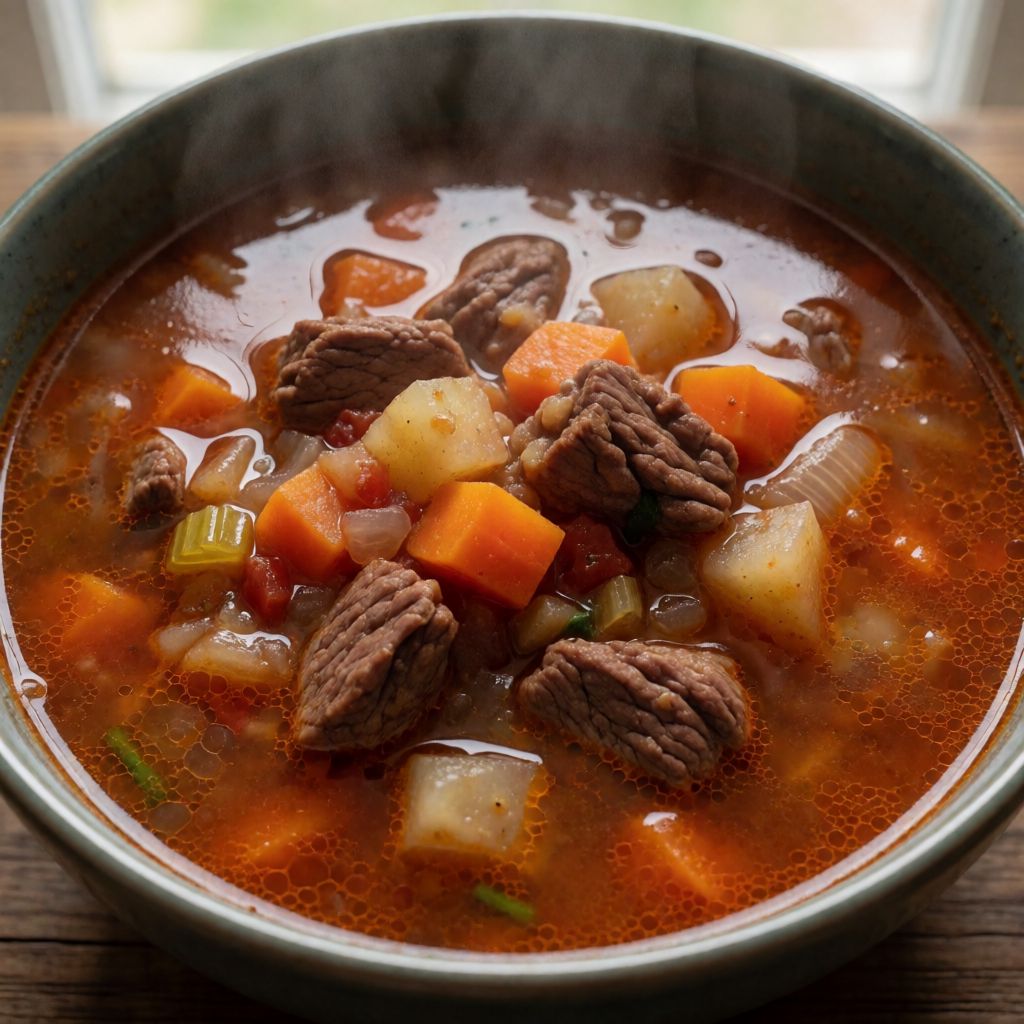
 AI photo
Goulash Soup
A hearty beef and vegetable soup with paprika, tomatoes and a dollop of crème fraîche.
Labels are worked out automatically from the ingredients and can be wrong. Check the packaging if it matters to you.
Ingredients
- 100 g Bacon diced
- 2 pcs Onion finely chopped
- 2 clove Garlic finely chopped
- ½ pcs Celeriac diced
- 3 pcs Carrot diced
- 500 g Beef shoulder cut into roughly 2x2 cm cubes
- 2 tbsp Paprika
- 1 l Stock
- 3 tbsp Tomato paste
- 6 pcs Potato diced
- 1 pcs Red pepper cut into thin strips
- 400 g Tinned chopped tomatoes
- 1 tsp Cumin
- 1 tbsp Olive oil for frying
- Salt to taste
- Black pepper to taste
- 100 ml Crème fraîche
- 1 bunch Chives finely chopped
- 1 bunch Parsley finely chopped
















Steps
Fry the bacon in a large pot until crispy, remove and drain on kitchen paper. Add butter and olive oil to the pot with the bacon fat and fry the onion, garlic, celeriac and carrot for a few minutes over medium heat.
Add the beef shoulder and fry until browned.
5 minAdd the cumin, paprika, salt and pepper, return the bacon to the pot and stir for about a minute, then add the stock, tomato paste and tinned tomatoes.
Cover with a lid and let simmer for 2-3 hours.
150 minAdd the potato and red pepper strips and cook for a further 20 minutes, until the potato is tender. Season with salt and pepper to taste.
20 minServe the soup with a spoonful of crème fraîche and herbs.
This is not Hungarian gulyás dressed up for a bowl — it's the soup that happens when you take the stew's logic and just add more water and let the whole thing go longer and looser. The meat still gets browned, the paprika still gets its moment in hot fat before any liquid touches it, but the end point isn't a thick clinging sauce, it's something you can eat with a spoon and mop with bread, where the beef has gone soft enough to fall apart against your tongue without you chewing for it.
What decides whether it works is patience with the simmer, and nothing else really. Two to three hours sounds like a lot for beef shoulder cubed small, but shoulder is a working muscle — full of collagen, laced through with connective tissue — and that tissue only turns to soft gelatine slowly, at a bare simmer, never a boil. Rush it and you get grey, tight, chewy cubes swimming in a soup that tastes fine but eats like a disappointment. There is no shortcut here. You can walk away, you can read a book, you cannot speed it up by turning the hob higher.
Start with the bacon, because it's doing two jobs at once: flavouring the fat that everything else fries in, and giving you a salty, smoky crumb to scatter back in near the end for contrast. Any streaky, smoked bacon works; if you only have unsmoked, that's fine too, you just lose a layer of flavour you'll need to find elsewhere — a bit more black pepper, maybe a splash of something smoked if you have it. Don't skip draining it on paper — the point of frying it first and removing it is so it doesn't go soft and sad sitting in liquid for two hours; it goes back in at the very end, crisp edge still just about intact.
The vegetable base — onion, garlic, celeriac, carrot — is there to build sweetness and body before the meat ever arrives, which is just the French mirepoix logic wearing Hungarian clothes: soften alliums and roots in fat until their sharp edges round off, so the whole pot has something underneath the beef and paprika besides water. Celeriac can be swapped for parsnip or simply more carrot if you can't find it — the point is a mild, earthy root, not the specific vegetable.
Beef shoulder is the right cut because it's cheap for a reason that works in your favour here: it's full of connective tissue that a quick-cooking method would leave tough, but given the two to three hours at a gentle simmer, that same tissue breaks down into gelatine and makes the soup silky rather than just wet. Chuck or shin do the same job. Do not reach for a "nicer" lean cut like sirloin thinking you're upgrading the dish — lean meat has nothing to break down, so long cooking just dries it out and toughens it further, the opposite of what you want.
Paprika and cumin are the spine of the flavour, and quality matters more than quantity: paprika loses its colour and perfume sitting in a cupboard for a year, so if yours smells of cardboard rather than fruit and smoke, use more of it or accept a muddier soup — there's no technique that fixes stale spice. Tomato paste and tinned tomatoes both go in for acidity and depth, not as the backbone; if you're short on one, lean harder on the other rather than skipping both, because the acid is what stops the soup tasting flat and one-note after two hours of simmering fat and meat.
Potato goes in late, in the last twenty minutes, for a simple reason: it cooks fast and falls apart if it sits in a bubbling pot for two hours, turning the whole soup starchy and cloudy instead of clear-ish with distinct pieces. Doneness isn't a timer here either — push a knife or fork into a cube, and if it slides in with no resistance, it's done; the clock is just there so you're not stabbing potatoes every ninety seconds.
On a domestic hob, a "wide pan instead of a kazan" means your simmer will want to catch at the bottom more than in a deep, heavy pot — so keep the heat at the gentlest bubble you can hold, a lid ajar if your lid seals too well and traps too much steam, and check it now and then rather than trusting it to look after itself for three hours unsupervised, the way it might in a proper thick-walled pot. A splash more stock or water if it's reducing too fast is not a failure, it's just reading the pot. Finish with crème fraîche and herbs at the table, not in the pot — stirred in early, the fat and heat will split it, and you'll get little curdled flecks instead of a cool, rich ribbon through each bowl.