
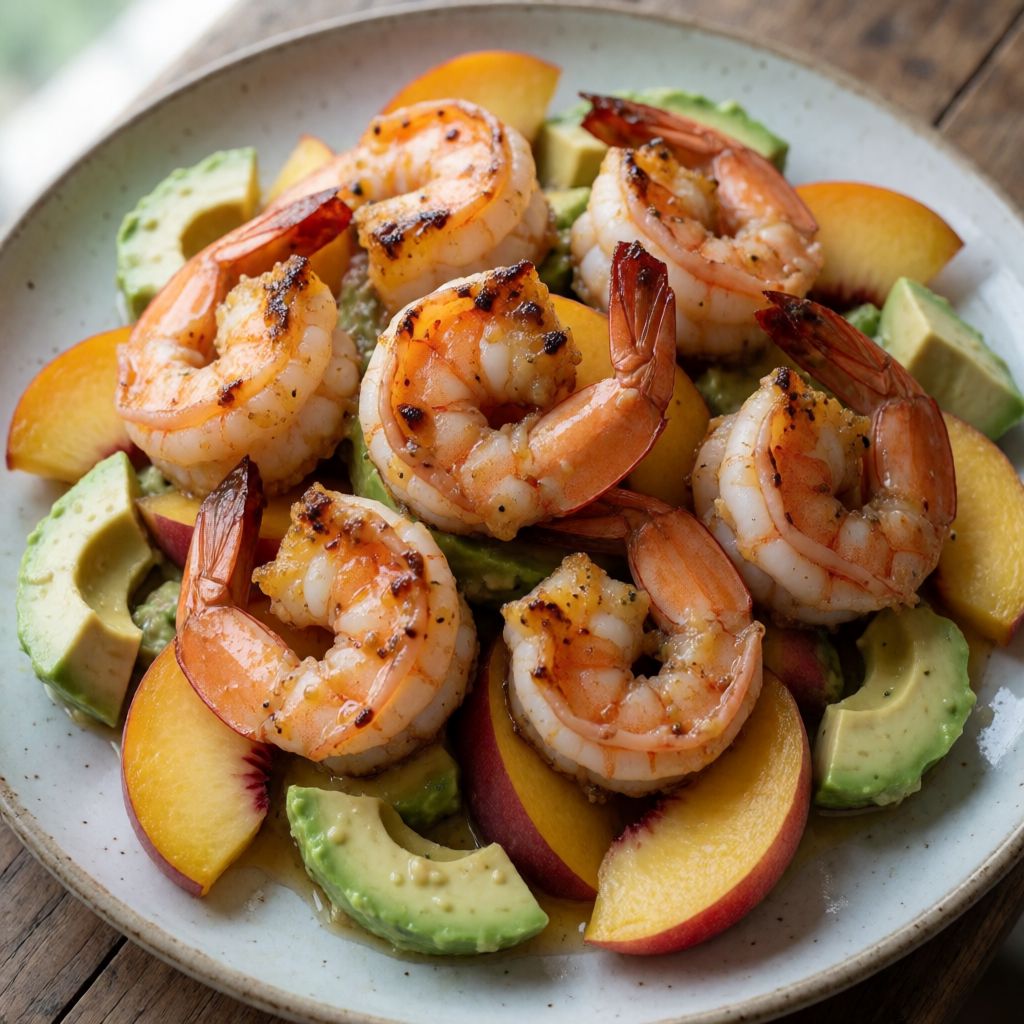
 AI photo
Grilled Garlic Prawns with Nectarine and Avocado Salad
Smoky garlic-grilled prawns with charred nectarines, avocado and a light elderflower dressing over spinach and rocket.
Labels are worked out automatically from the ingredients and can be wrong. Check the packaging if it matters to you.
Ingredients
- 400 g Prawns peeled
- 3 clove Garlic
- 1 tsp Smoked paprika
- 1 tsp Honey
- 3 pcs Nectarine cut into wedges
- Salt
- Black pepper freshly ground
- 2 tbsp Olive oil
- 2 pcs Bread slices
- 1 clove Garlic
- 2 tbsp Olive oil
- 3 tbsp Olive oil
- 1 tsp Dijon mustard
- 2 tbsp Elderflower cordial
- 1 tbsp Apple cider vinegar
- Salt
- Black pepper freshly ground
- 100 g Spinach
- 100 g Rocket
- 2 pcs Avocado diced
- 25 g Pine nuts toasted
- 1 bunch Basil fresh
- Salt
- Black pepper freshly ground






Steps
Marinate the prawns with oil, garlic, smoked paprika, honey, salt and pepper for at least 15 minutes.
15 minThread the prawns onto skewers and grill on both sides until cooked through.
Grill the nectarines until char marks appear.
Rub the bread with garlic, brush with oil and grill on both sides until crisp.
Mix the elderflower dressing and toss it with the spinach and rocket.
Top with the prawns, nectarines and avocado, and scatter over the torn grilled bread, basil, pine nuts, salt and pepper.
This isn't really a prawn dish with fruit thrown in for decoration — it's a sugar-and-smoke dish where the prawns, the nectarine and the bread all go onto the same hot metal for the same reason: caramelisation. Honey and paprika on the prawns, natural sugar in the nectarine flesh, starch in the bread crust — put any of these over real heat and they brown before they overcook, and that browning is the entire flavour budget of the dish. Everything else — the spinach, the avocado, the elderflower dressing — is there to be cool, bitter, soft or sharp against that.
What decides whether it works is restraint with the grill. Prawns go rubbery the moment the proteins seize past a certain point, and that point arrives fast — we're talking a couple of minutes a side over a hard, dry heat, not a slow warm-through. You're watching for colour and curl: pink going slightly golden at the edges where the marinade's sugars catch, flesh curling into a loose C rather than a tight O. A tight curl means you've gone too far and there's no undoing it.
Some say you need a barbecue or a griddle pan for proper char marks. You don't — you need a pan that gets genuinely hot and dry, and the nerve to leave it alone for a minute before you touch anything. A wide non-stick frying pan on your strongest ring, wiped almost dry of oil, will mark a nectarine wedge just as well as cast iron; what char marks actually need is contact and stillness, not a specific pan.
Start with the prawns themselves. Peeled, raw, not pre-cooked — pre-cooked prawns have already gone through their one window of tenderness and grilling them again just pushes them further into rubber. If your fishmonger or freezer aisle only has cooked ones, you can still make this, but treat the grill time as warming, not cooking: seconds, not minutes, just enough to pick up char and the marinade's smoke.
The marinade is small but doing three different jobs. Garlic for savoury depth, honey for sugar that browns, smoked paprika for a smoke flavour you're not actually generating over a domestic hob. This is worth being honest about: a kazan or a coal grill gives you real smoke as a by-product of fat hitting fire; your frying pan or electric grill pan gives you none of that, so the paprika is standing in for the fire you don't have. Don't skip it thinking it's just colour — on a flat in a UK kitchen, it's doing the job your equipment can't.
Fifteen minutes marinating is a floor, not a target — it's long enough for the surface of the prawn to pick up seasoning, not long enough to start "cooking" it the way citrus-heavy marinades can. If you've got the time, an hour in the fridge does no harm and lets the honey and garlic actually penetrate rather than sit on the surface.
Any neutral oil with no smell of its own will do for brushing and grilling — a light rapeseed oil instead of olive oil for the actual high-heat contact, saving your better olive oil for the dressing where its flavour actually gets tasted rather than burned off. Olive oil has a lowish smoke point for genuinely hard grilling; it's the classic ingredient here, but if your extra virgin starts smoking and turning acrid in the pan, that's your cue it's the wrong tool for that particular job, not a failure on your part.
For the bread: stale, firm, day-or-two-old bread grills far better than soft fresh sliced bread, because it holds structure under direct heat instead of just steaming into mush. Rubbing it with raw garlic after grilling — not before — is the old trick for getting pungency without burning the garlic itself; burnt garlic turns bitter fast, and there's no coming back from that once it's happened.
The elderflower cordial in the dressing is an unusual, very British touch — it's a cheap, familiar bottle in most kitchens here, used for lemonade, repurposed as a sweetener that's gentler and more floral than honey or sugar syrup would be in a vinaigrette. Mustard is the emulsifier holding oil and vinegar together rather than letting them split in the bowl; if you've no Dijon, any sharp, smooth mustard works on the same principle — it needs to be able to bind fat and acid, not necessarily taste of Dijon specifically.
Pine nuts toasted, not raw — raw pine nuts are flat and a bit waxy; a dry pan over the fire until they go gold (watch them, they go from pale to burnt in the time it takes to answer the phone) brings out an oil and bitterness that raw ones simply don't have. Almonds, flaked and toasted the same way, are a reasonable stand-in if pine nuts are pricier than you fancy — the criterion is a small, oily nut that toasts rather than a specific one.
This feeds four as a light main, which in a Sunday-roast household might read as a starter course rather than the week's dinner — it's a warm-weather, outdoor-grilling kind of dish, built for when the idea of a roast feels like too much heat in too small a kitchen.