
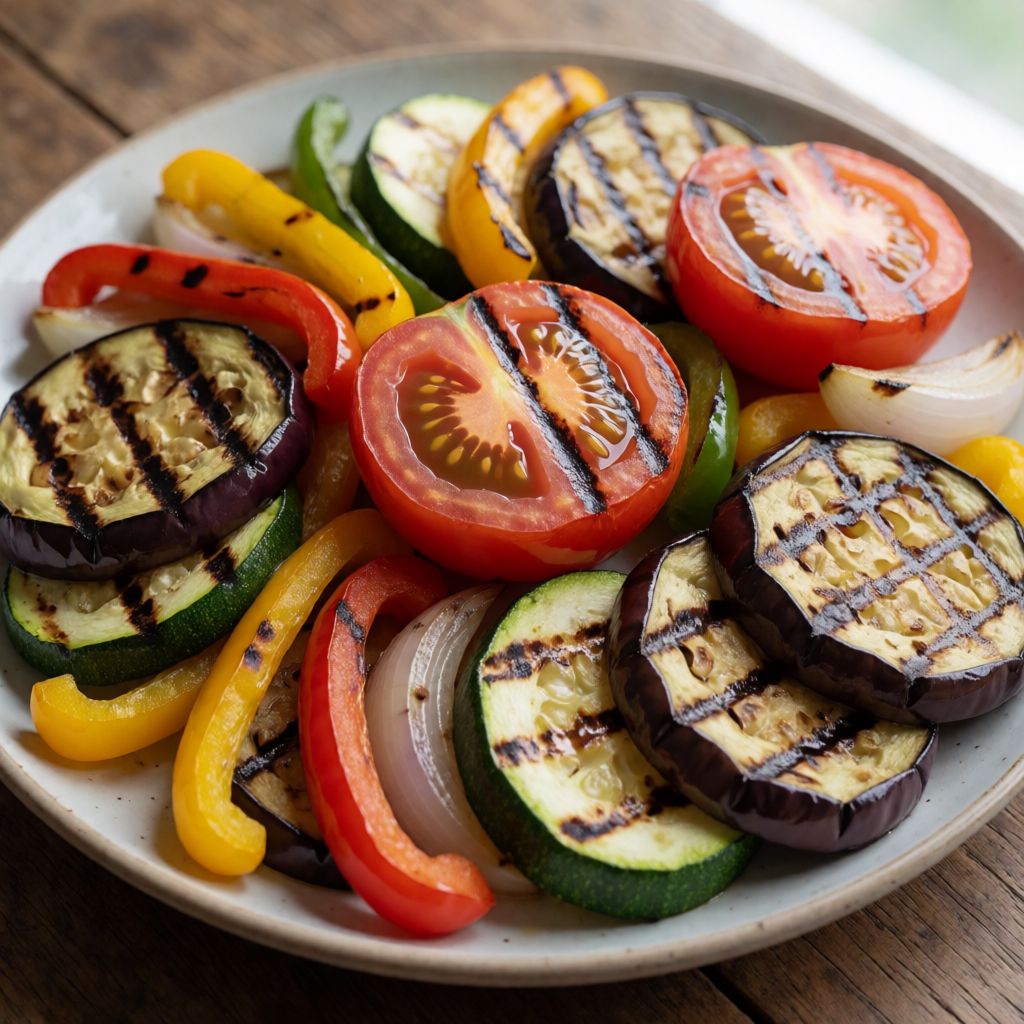
 AI photo
Grilled Vegetables with Fragrant Marinade
A colourful mix of grilled vegetables tossed in a smoky, tangy marinade.
Labels are worked out automatically from the ingredients and can be wrong. Check the packaging if it matters to you.
Ingredients
- 2 pcs Tomato halved
- 1 pcs Courgette sliced
- 1 pcs Garlic
- 2 pcs Bell Pepper cut into quarters
- 1 pcs Onion
- 1 pcs Aubergine sliced
- ½ package Asparagus
- 1 pcs Fennel sliced
- 2 pcs Corn
- 5 tbsp Olive Oil
- 2 tbsp Apple Cider Vinegar
- 1 tsp Smoked Paprika
- Salt
- Black Pepper freshly ground









Steps
Mix the marinade and prepare all the vegetables.
Brush all the vegetables with the marinade. First, grill the corn cobs for 30 minutes over indirect heat. Place the whole garlic and potatoes on indirect heat too, to the side, away from the coals where the temperature is lowest.
30 minTowards the end, grill the vegetables that need direct heat — just 3–5 minutes on each side.
5 minIndirect heat
Keep the potatoes, corn and other vegetables that should become well softened inside on indirect heat for 30 minutes.
30 minDirect heat
Grill the vegetables over direct heat for 3–5 minutes on each side, until grill marks appear and they are lightly softened with a bit of crunch.
4 min
This is a dish built on a split, not a list. Half the vegetables want slow, surrounded heat — the kind that turns corn's sugars dark and sweet without burning the kernels. The other half want a hard, fast kiss of flame that leaves stripes and a bit of bite still in the middle. Get that split wrong — pile everything over the coals at once — and you end up with charred pepper skin sitting next to a raw-centred corn cob, and you'll blame the recipe instead of the heat.
Indirect heat means the food is near the fire but not over it — on a barbecue, coals banked to one side, lid down, so the box becomes an oven. On a UK gas or electric grill pan, you don't have that option; the honest substitute is your actual oven, roasting tray, fan setting hot enough that a hand held near the open door for a second feels like stepping into a greenhouse. Direct heat is the opposite: vegetable sitting right on the hot metal or over the flame, contact-browning in minutes, nothing gentle about it.
Some say vegetables on a grill all cook the same way because "they're just vegetables." No — because a corn cob is mostly water locked in a tight husk of sugar and starch, and it needs time for that water to steam the kernel soft from inside before the outside chars. A slice of courgette is almost all water and almost no structure; put it anywhere near the same heat for the same time and it collapses into a wet rag. The split between indirect and direct heat in this recipe isn't tradition for tradition's sake — it's two different physics problems being solved in the same session, side by side, because that's what an actual barbecue lets you do: one fire, two zones.
The marinade is five tablespoons of olive oil, two of vinegar, a teaspoon of smoked paprika, salt, pepper — and its job is not flavour alone. Oil coats the cut surface so the vegetable doesn't dry out and seize onto the hot metal; the acid in the vinegar keeps the colours brighter and starts breaking down surface fibres so the grill marks form faster, before the inside overcooks. Any neutral oil with no personality of its own does the oil's job — sunflower, a plain rapeseed oil, which the UK happens to grow a lot of and which is cheaper and just as functional as "proper" olive oil here. Smoked paprika is doing what the coals themselves should be doing if you had real wood smoke; it's a workaround for a gas grill or an oven, not a decoration, so if you've got genuine charcoal and good smoke already, you can use less, or none.
The vegetables split naturally into two camps by water content and structure. Corn, garlic, and anything you want "well softened inside" — the recipe mentions potatoes too, though none are listed in the ingredients here, which is worth noting if you're shopping from this list rather than memory — go on indirect heat because they need time for heat to travel to the centre without the outside burning first. Tomato, courgette, aubergine, pepper, onion, fennel, and asparagus go on direct heat because they're thin or already soft enough that the outside and inside finish close together; stripes and a little crunch is the whole ambition, not deep cooking.
On a London balcony or a flat with no garden, a kazan-style open fire isn't realistic, and neither is true indirect barbecue heat most of the time. A griddle pan on the hob gives you the direct side honestly — hot ridges, short contact, real marks. For the indirect side, your oven does the job better than pretending a frying pan can replicate smouldering coals: tray in a hot oven, door shut, garlic and corn left to soften properly while you handle the quick stuff on the stovetop. It's not the same dish as one cooked over real coals in a garden, and there's no point claiming otherwise — but it solves the same physics problem with the tools you actually have.
Onion is listed whole with no cut specified; treat it like the pepper — quartered or thick-ringed — so it goes on direct heat without falling through to become onion soup in the coals. Asparagus is the one that punishes hesitation: it's thin enough to go from raw to dried-out in the gap between checking your phone and checking the grill, so give it the shortest end of that three-to-five-minute range and watch it, not the clock.
This feeds four as a side, which in practice means it sits next to something from the actual Sunday roast rather than replacing it — a tray of smoky, vinegar-bright vegetables doing the job a tray of roast parsnips usually does, same oven, same afternoon of pottering about while something else rests. The patience you spend here isn't hard patience — it's the same patience as basting a joint: you're not watching every second, you're checking in, and the vegetable tells you when it's ready if you bother to ask it.