
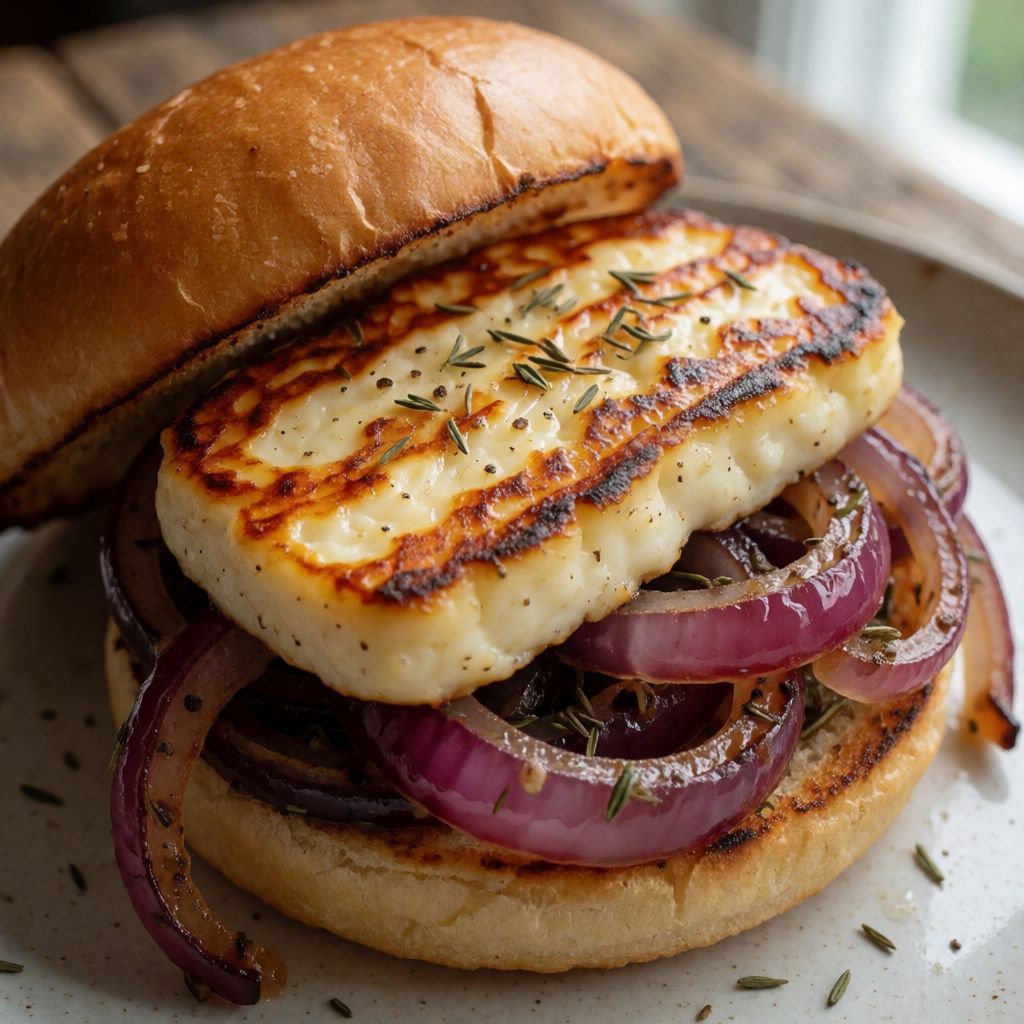
 AI photo
Halloumi Burger
A griddled halloumi burger with sweet softened red onions, chilli mayo, avocado and cucumber.
Labels are worked out automatically from the ingredients and can be wrong. Check the packaging if it matters to you.
Ingredients
- 2 pcs Red onion thinly sliced into rings
- 1 tsp Dried thyme
- 1 tbsp Olive oil
- 10 g Butter
- Salt
- Black pepper freshly ground
- 2 tbsp Mayonnaise
- 1 tsp Sriracha
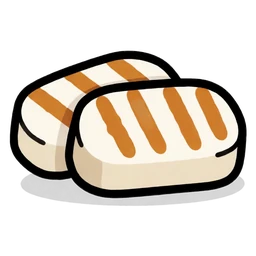
- 200 g Halloumi
- 4 pcs Burger bun
- 125 g Mixed salad leaves
- 0.25 pcs Cucumber sliced
- 1 pcs Avocado sliced
- 1 bunch Basil fresh








Steps
Heat the olive oil in a saucepan over medium heat, add the butter and let it melt.
Reduce the heat slightly and add the red onion to the pan.
Fry, stirring, for a few minutes.
Then cover with a lid and leave the onion over low heat for 10-15 minutes to sweat gently until soft, without colouring.
15 minIt should not burn or brown.
Season with thyme, salt and black pepper to taste.
Mix the mayonnaise with the sriracha and season with salt and black pepper to taste.
Warm the burger buns in the oven or on the grill.
Slice the halloumi and fry in a pan with olive oil until golden on both sides.
Spread each bun with the chilli mayo and assemble the burgers with avocado, salad leaves, basil, soft onions, cucumber and halloumi.
A halloumi burger is really two separate pieces of cooking wearing one bun: a long, patient onion that turns sweet, and a short, violent sear on the cheese that turns it from squeaky rubber into something you'd actually fight someone for. Get those two temperatures right and the rest — mayo, leaves, avocado — is just furniture.
The onion is cooked low and covered, not fried hard. That's the whole trick, and it's worth naming because people assume "frying onions" means colour and noise. Here you want the opposite: onion that goes soft and translucent while staying pale, sweated rather than browned, because browning here would mean bitterness and a burnt-sugar edge that fights the sriracha mayo instead of backing it up. The lid isn't decoration — it traps steam, so the onion cooks in its own moisture instead of drying out and catching on the pan. Low heat is the whole mechanism: if the pan's hot enough to colour the onion in five minutes, it's too hot to let it go soft in fifteen.
Halloumi is the opposite job entirely. It's a brined cheese with a high melting point and almost no fat that runs out, which is why it survives a hot pan without collapsing into a puddle like mozzarella would. You want that pan properly hot and the frying fast — the point is a crust, not a cook-through, because the inside is already "done" straight out of the packet. Some people salt halloumi before frying, out of habit from other cheeses; don't bother, it's salty enough from the brine already, and extra salt just draws out moisture that stops the crust forming.
Red onion specifically, not white, because red onion has a milder sulphur bite to begin with and a better sugar-to-acid balance once it softens — it sweetens without needing the long caramelisation a white onion wants. Thinly sliced matters here too: thick rings take longer to collapse and you'll be tempted to turn the heat up to hurry them, which is exactly the shortcut that browns them. If red onion isn't in the fridge, a shallot works on the same logic — mild, sweetens fast, doesn't need colour to taste good.
Olive oil plus butter is a small bit of kitchen economics, not fussiness: butter alone burns before the onion's soft, because its milk solids scorch at a lower temperature than oil does; oil alone gives you none of butter's flavour. Together, the oil raises butter's effective burning point and the butter gives the sweated onion a background richness. Any neutral oil with no smell of its own does the oil's job — sunflower, a bland vegetable oil, nothing that argues with the butter.
Halloumi itself is a cheese built for this exact situation: Cypriot, made so it holds its shape under heat, originally because it needed to survive storage and travel without refrigeration — firmness was a preservation strategy before it was a texture people chased for its own sake. If you can't get halloumi, paneer behaves similarly under heat for the same reason — low melt, firm structure — though it's blander, so lean harder on the chilli mayo to carry flavour. A UK supermarket will have halloumi near the Mediterranean cheeses or sometimes oddly in the "free-from" or deli aisle; don't buy the pre-sliced grill packs if you can avoid it, they're often cut thin and dry out fast in a hot pan.
The chilli mayo is doing the job bought burger sauce does in a fast-food burger, except you control the heat: sriracha brings vinegar sharpness as well as chilli, so it cuts the richness of fried cheese and butter-sweated onion instead of just adding more fat to fat. If sriracha isn't to hand, any vinegar-forward hot sauce does the same job — the acid matters more than the specific chilli.
Warming the buns isn't about making them "nicer" in some vague sense — a cold bun straight from the bag is slightly stale-tasting and goes soggy faster against warm fillings, because it hasn't got any structural toughness from a bit of dried crust. A minute under a hot broiler or in a dry pan firms the surface just enough to hold up to avocado and mayo without collapsing by the third bite.
Patience is the one ingredient not listed on the card: the onion's fifteen minutes is a floor, not a target, and if you rush it with higher heat you'll get coloured, slightly bitter onion that tastes like a different dish. Everything else here is quick — the halloumi is minutes, the assembly seconds — so the onion is where the whole burger either becomes something worth the bun, or doesn't.