
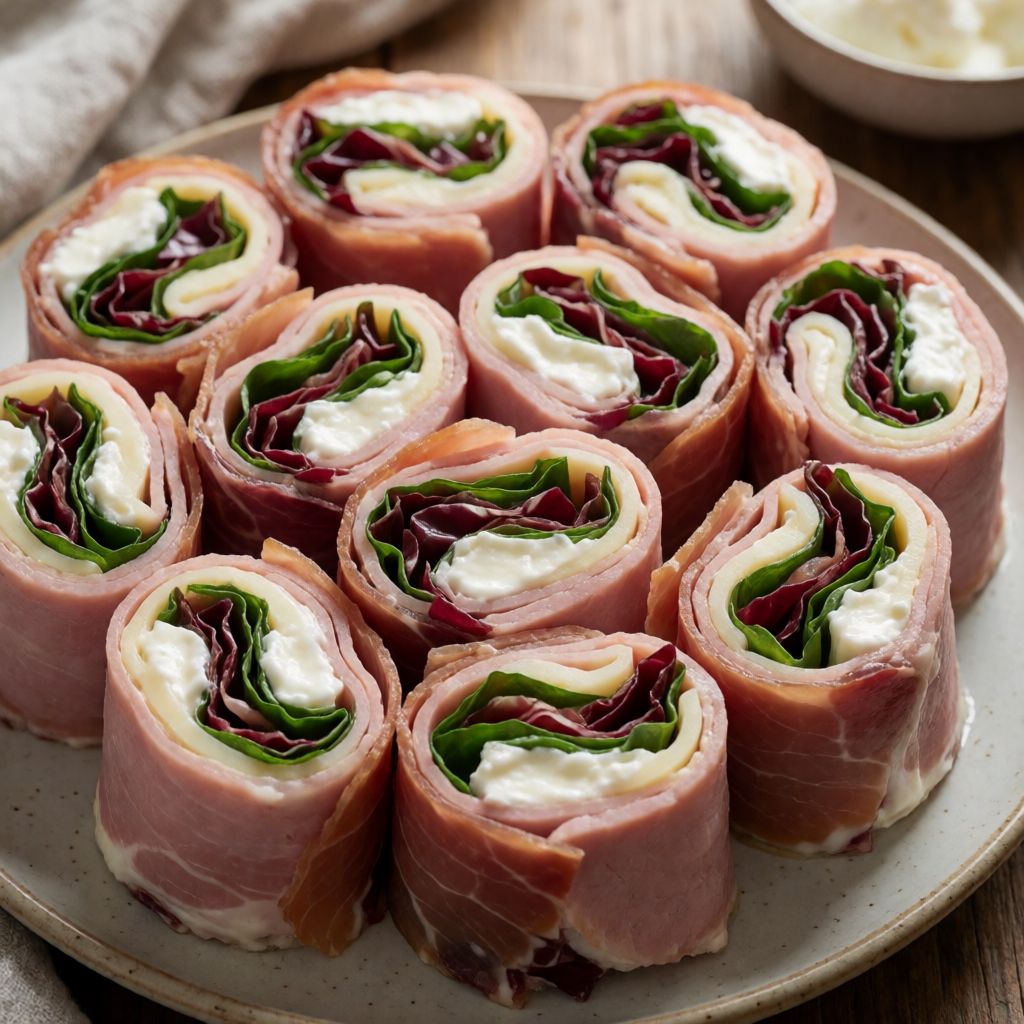
 AI photo
Ham and Prosciutto Roll-Ups
A colourful antipasto of ham and prosciutto rolls filled with cheese, tomato and olives, served as a starter.
Labels are worked out automatically from the ingredients and can be wrong. Check the packaging if it matters to you.
Ingredients
- 6 pcs Ham
- 6 pcs Prosciutto
- 1 package Mozzarella
- 6 pcs Provolone
- Rocket to taste
- Radicchio to taste
- Grana Padano to taste
- Tomato to taste
- 6 pcs Cherry Tomatoes
- 6 pcs Green Olives, pitted
- Black Olive Paste to taste
- Capers to taste
- Oregano to taste
- Olive Oil to taste
- Salt to taste
- White Pepper to taste













Steps
Lay out 6 slices of ham on the work surface, cut 6 slices of mozzarella, place them on top and spread with black olive paste.
Add thin slices of tomato, season with salt and oregano, place a julienne of radicchio on top, season with salt and drizzle with olive oil.
Roll everything up and secure with a skewer through a cherry tomato, then place in the fridge.
Repeat the process with prosciutto, using provolone, tomato, rocket, capers and a green olive.
On a serving plate, arrange the rolls in a circle, alternating ham and prosciutto, and form a nest of rocket and radicchio in the centre.
Top with shavings of Grana Padano, dust with white pepper and drizzle with olive oil.
Keep in the fridge for at least 1 hour before serving.
60 min
What was changed
Provolone Provolone was used in place of the generic stretched-curd cheese, since it is the version UK shops actually sell.
This isn't cooking, it's assembly — which is exactly why it's unforgiving. No heat to hide behind, no reduction to fix a mistake. What decides whether this works is the same thing that decides a good Sunday roast plate: the quality of what you bought, because there's nowhere for a bad ingredient to go but straight onto the tongue.
You're making two rolls, really. One built on ham and mozzarella, soft and mild, carried by the sharpness of olive paste and the bitter snap of radicchio. One built on prosciutto and provolone, saltier, sharper, needing the brine of capers and olive to answer it. The two aren't the same roll with different wrapping — they're a deliberate contrast, mild against sharp, and that's why you alternate them on the plate rather than grouping by type. Eat them side by side and you taste the difference properly, the way you'd want contrast between potatoes and gravy, not a plate of one note.
The fridge rest at the end isn't about safety, it's about structure. A warm roll is a floppy roll — the fat in the ham and the mozzarella need to firm up before you slice or bite, or everything unrolls on the plate like a bad parcel. An hour is the minimum; the roll needs to decide it's a roll, not a loose pile.
Start with the ham and prosciutto, because they're not interchangeable despite looking similar in a British supermarket chiller. Cooked ham is wet-cured, mild, almost sweet — it needs a partner with some punch, which is why it gets the olive paste. Prosciutto is dry-cured, already intensely salty and savoury on its own, so it's paired with capers and olive rather than anything that competes for salt. If you can't get proper prosciutto crudo, don't reach for more cooked ham as a substitute — use a well-cured air-dried bacon or a Serrano-style ham, something with that same dry, concentrated character. The test is: does it taste of itself even cold and thin-sliced, or does it need salt added to come alive? If the latter, it's the wrong cut for this role.
Mozzarella and provolone split the same way. Mozzarella is young, wet, mild — a canvas. Provolone is aged, firmer, sharper, closer to a hard cheese that can hold its own against salty cured meat. Don't swap them for convenience; a soft cheese on the prosciutto roll goes bland, a sharp cheese on the ham roll fights the olive paste instead of supporting it. If provolone isn't on the shelf, a mild Cheddar or Emmental gets you the firmness without the wrong flavour fighting back. Grana Padano at the end is doing a different job entirely — it's not melted, not rolled, just shaved raw over the top for a last hit of salt and umami, so buy a wedge and shave it yourself; the pre-grated bags in the chiller are drier and won't shave into those thin curls.
Radicchio and rocket are bitter greens, and bitterness here is not decoration — it's the thing that stops the whole plate tasting like a child's picnic of ham and cheese. Without it you've got fat and salt and nothing to cut through either. If you can't find radicchio, a bitter leaf like chicory or even a handful of watercress will do the same job; iceberg or butterhead lettuce won't, because they bring crunch but no bitterness, and crunch isn't what's missing.
The black olive paste and the capers are both salt-and-brine shortcuts — the kind of thing that, historically, poorer households along the Mediterranean coast used to make a little meat and cheese taste like a feast, because olives and capers are cheap and meat isn't. That's worth knowing before you decide to skip them as "extra": they're not garnish, they're the seasoning the dish is built around. No olive paste on hand — mash pitted black olives with a touch of olive oil and you've made your own. Capers have no real substitute worth using; chopped gherkin is close in sharpness but brings sweetness that doesn't belong here, so use it only if genuinely stuck.
On the olive oil: "to taste" here means something with no smell of its own getting in the way of the cured meats — a light, fairly neutral olive oil, not the heavily peppery, grassy extra virgin you'd save for dipping bread. A strong oil will argue with the oregano and the olive paste rather than carrying them. White pepper at the end rather than black is a texture choice as much as flavour — it disappears into the pale cheese and oil rather than sitting as visible dark flecks, which matters when the whole point of this plate is how clean it looks before anyone touches it.
One more honest note for a British kitchen: this needs no hob and no oven, which makes it one of the few starters that doesn't fight you for space on a Sunday when the roast has claimed every ring and the oven for the afternoon. Make it the hour before, while the joint rests, and it'll sit happily in the fridge until you need a cold plate on the table.