
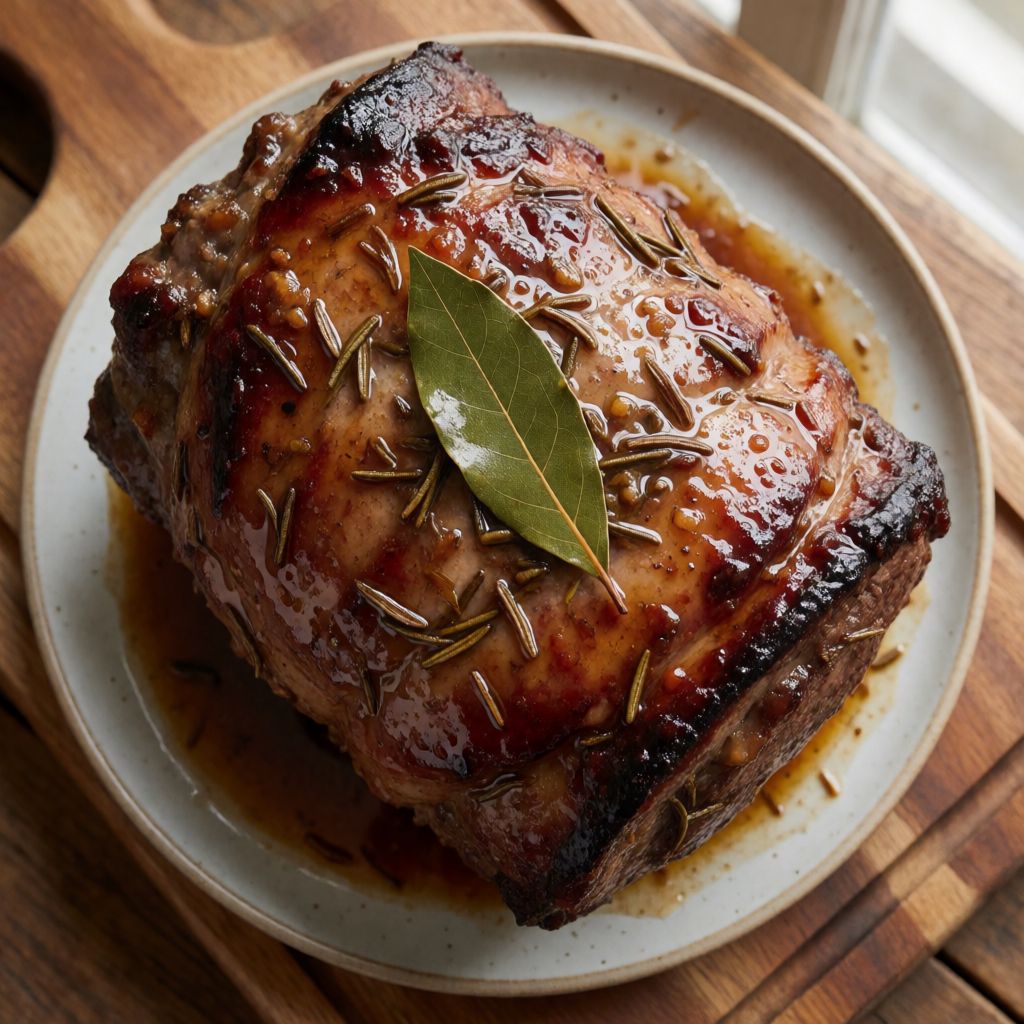
 AI photo
Honey-Glazed Roast Veal
A tender veal fillet roasted with garlic, rosemary and bay, finished with a brandy and acacia honey glaze.
Ingredients
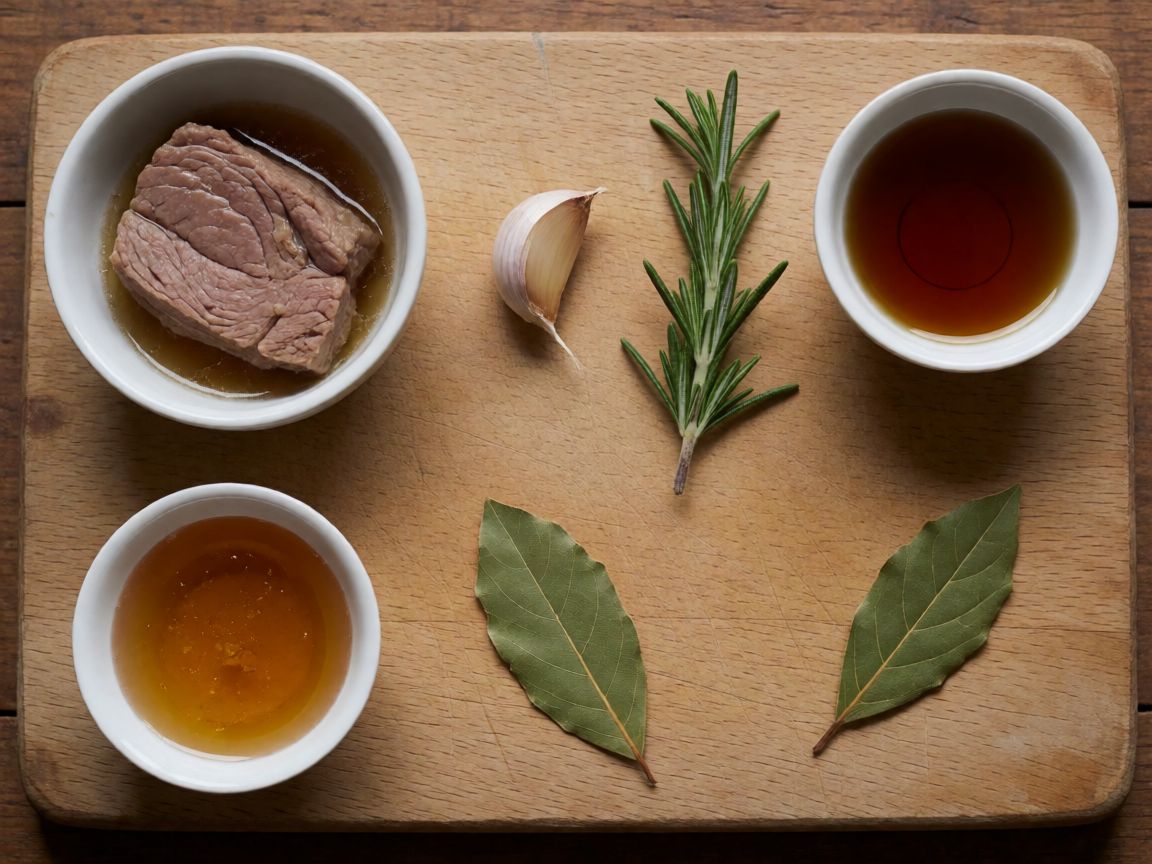
- 800 g veal fillet
- 1 clove garlic
- 1 pcs rosemary
- 1 pcs bay leaf
- 250 ml brandy
- 1 tbsp acacia honey
- olive oil to taste
- salt to taste
- black pepper to taste








Steps
Sear the veal fillet, tied with kitchen string, in a pan with olive oil until browned on all sides.
10 minTransfer the meat to a roasting tin greased with olive oil, add the bay leaf, rosemary and garlic clove.
5 minPour in the brandy mixed with the honey.
2 minSeason with salt and black pepper and roast in an oven preheated to 200°C for 45 minutes, turning at least once. Doneness: 63°C at the centre (medium).
45 minServe with mashed potatoes or a mixed leaf salad.
Here's what this dish actually is, underneath the fancy name: a tied fillet of veal, browned hard in a pan, then finished in the oven inside its own puddle of brandy and honey. It's a borrowed cousin of the Sunday roast — someone, probably French, decided a lean little fillet needed a lacquer instead of a crust of fat, and that's the whole idea in one sentence.
What decides whether it works is not the clock, it's the thermometer. A veal fillet is lean — almost no marbling, no fat cap to baste itself — so the gap between "medium" and "shoe leather" is narrow and it closes fast. The recipe gives you the number that matters: 63°C at the centre. That's not an arbitrary round figure. Below about 55°C the muscle fibres (actin) haven't tightened yet and the meat stays loose and wet; push much past 65–70°C and those same fibres clamp down and wring the juice out like a sponge. Medium, here, is the narrow window before the clamp shuts. Forty-five minutes is a guess based on a particular oven and a particular piece of meat — your oven dial lies by ten degrees in either direction, that's just how domestic ovens are — so the real instruction is: check the centre, not the timer.
Veal fillet is the expensive, slightly apologetic cut in a British butcher's case — not because it's rare in nature, but because British farming has always leaned toward beef cattle raised to full size, and veal (meat from a young calf) never built the same demand here that it has in France or Italy. That's economics, not magic: fewer calves slaughtered young, fewer cuts on the shelf, higher price. If you can't find it or don't want to pay for it, pork fillet (tenderloin) takes the glaze just as well and is far more forgiving of a few extra minutes in the oven, because it carries a touch more fat. A beef fillet works too, though it will taste bolder and less delicate — fine, just a different dish wearing the same glaze.
Garlic, rosemary and bay are doing a slow job, not a fast one. They don't flavour the meat by sitting next to it — they flavour the juices that pool in the tin, and those juices then glaze back onto the surface as it roasts. That's why they go in after the sear, not during it: thrown into a screaming-hot pan, rosemary just burns and turns bitter, garlic scorches and turns acrid. Let them steep gently in the brandy-and-honey liquid instead, where the heat is lower and slower, and they release oil rather than ash.
The brandy is not there to get anyone drunk, and no, flambéing or roasting doesn't burn off all the alcohol — that's another kitchen myth, repeated mostly because it's reassuring. Some of it evaporates, most of the flavour and the sugar stay. Its real job is to dissolve the browned bits stuck to the pan from the sear (the fond, if you want the word for it) and to thin the honey so it can coat the meat rather than sit on top of it like syrup. If you don't want alcohol in the pan, apple juice with a splash of cider vinegar gets you a similar balance of sweetness and sharpness, though you'll lose some of the caramel-edged flavour that brandy's own sugars bring when they cook down.
Acacia honey is specified for a reason worth keeping: it's one of the mildest honeys, almost floral, and it won't argue with the meat the way a dark, resinous honey (heather, chestnut) would. Its sugar is what caramelises on the surface in the oven heat, building the glaze. Any light, mild honey will do the same chemistry — clover, wildflower — just taste it first; if it already has a strong personality, it'll end up as the dominant flavour of the whole dish instead of a supporting one.
Use an oil with no flavour of its own for the sear — a plain olive oil or any neutral oil with a reasonably high smoke point, not an extra virgin one, which turns bitter and smoky at searing heat. Salt goes on just before the pan, not hours earlier; salted too early with nothing to balance it, a lean cut like this will weep moisture it can't afford to lose. Pepper has nowhere to burn once it's in the oven, so timing it matters far less.
The string isn't decoration either. A fillet left untied tends to splay slightly as it heats, going from a tidy cylinder to an uneven lump, which means the thick part stays underdone while the thin part overshoots your 63°C. Tying it keeps the shape even, so the heat gets in at roughly the same rate all the way round — the same reason a butcher ties a joint for the Sunday roast. And once it comes out of that oven, give it a few minutes before you cut the string and slice. The recipe doesn't say so, but the meat does: cut it straight from 63°C and the juice runs out onto the board instead of staying in the slice. A little patience here costs you nothing and saves everything the glaze was for.