
 AI photo
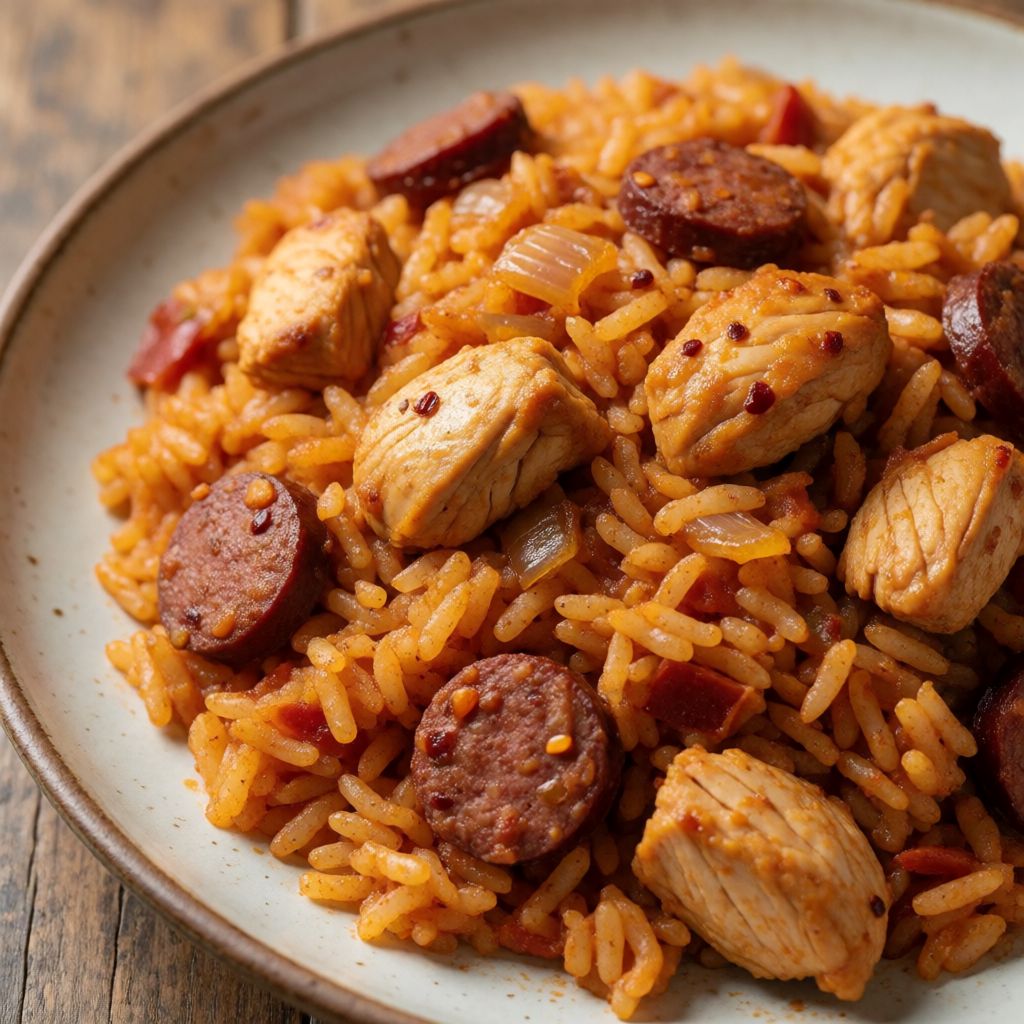
Chicken and Chorizo Jambalaya
A spiced one-pot rice dish with chicken, chorizo and prawns, finished with lime and parsley.
Labels are worked out automatically from the ingredients and can be wrong. Check the packaging if it matters to you.
Ingredients
- 250 g Chicken breast diced
- 100 g Chorizo diced
- 1 pcs Onion finely chopped
- 3 clove Garlic finely chopped
- 1 tsp Chilli flakes
- 0.5 tsp Ground cloves
- 1 tsp Paprika
- 1 tsp Dried thyme
- 1 tsp Oregano dried
- 1 pcs Bell pepper finely chopped
- 3 pcs Celery sticks finely chopped
- 3 tbsp Tomato paste
- 400 g Canned chopped tomatoes
- 300 g Basmati rice
- 600 ml Stock
- 125 g Prawns
- 1 pcs Lime juice and finely grated zest
- 0.5 tsp Hot sauce to taste
- 2 tbsp Olive oil
- Salt
- Black pepper freshly ground
- 1 bunch Parsley finely chopped
- 2 pcs Spring onions finely chopped















Steps
Heat the olive oil in a large pan, add the chicken and chorizo, and fry on all sides until golden brown.
Add the onion, garlic, chilli flakes, ground cloves and paprika, lower the heat and cook until the onion is soft.
Add the thyme, oregano, bell pepper, celery, tomato paste, chopped tomatoes and raw basmati rice.
Pour in the stock, bring to the boil, cover and simmer gently for 15 minutes.
Turn off the heat and let the pan stand covered for 15 minutes, or until the rice is tender.
Finally, stir in the prawns, lime juice and zest, and season with salt, pepper and hot sauce to taste.
Serve with extra hot sauce for those who like it, chopped parsley, spring onion and lime wedges.
Jambalaya is a one-pan rice dish, and that single fact decides everything about how you cook it. The rice isn't a side you boil separately and spoon on afterwards — it goes in raw, straight into the pan, and from that point on it's drinking in everything around it: the fat rendered from the chorizo, the tomato, the stock, whatever the chicken has given up. That's the whole trick of the dish. You're not seasoning rice at the end, you're building a liquid the rice will cook inside, so the flavour comes from within the grain rather than sitting on top of it.
What decides whether it works is restraint with liquid and patience with heat. Chorizo is cured and smoked, so it already carries salt and fat — render it first and that fat becomes your cooking medium, no need to be generous with the olive oil later. The browning of chicken and chorizo at the start isn't about colour for its own sake: those catches on the bottom of the pan are flavour, and if you rush them with too much heat you get grey meat and a bitter black crust instead of a brown one you can lift with the vegetables.
Chorizo here is doing a job sausage can't: it's cured and smoked, so as it renders it throws colour, smoke, and paprika oil straight into the fat the rice will later cook in. If you haven't got chorizo, you want something that brings its own seasoning and fat when it melts — a smoked bacon lardon works, though you lose the paprika note, so add a touch more paprika to compensate. Don't reach for fresh sausage; it won't render the same way and you'll just get bland fat.
The spice list — chilli flakes, cloves, paprika, thyme, oregano — looks long but splits into two jobs. Chilli and paprika are the backbone, there from the start so their oils bloom in the fat with the onion. Cloves are the odd one in: half a teaspoon is there for a dark, warm background note, not to taste "of clove" — if it's too assertive to your nose, halve it again, it's forgiving. Thyme and oregano go in a beat later with the vegetables because dried herbs lose their edge if they fry too long in hot fat — they want the gentler heat of the simmer that follows, not the browning stage.
Celery and bell pepper, together with the onion, are the backbone the French call a mirepoix and Louisiana cooks call "the trinity" — three vegetables that soften down to a sweet, textured base rather than a mush. Chop them finely and evenly and they'll cook at the same rate; leave the celery in thick chunks and it'll still have a raw, stringy bite when the onion's gone soft, so match the sizes to each other, not to the recipe photo.
Tomato paste plus canned chopped tomatoes is the liquid's backbone — the paste for concentrated savoury depth (it needs a minute in the hot pan to lose its tinned, slightly metallic edge, which is why it goes in with the rice rather than at the very end), the chopped tomatoes for volume and acidity. Basmati is the right rice because its long grain stays separate rather than clumping — a risotto rice like arborio would turn this creamy and wrong, a short-grain pudding rice would turn it to glue. If basmati isn't in the cupboard, any long-grain white rice will behave the same way; just don't use anything labelled "easy-cook" or parboiled, which needs a different ratio of liquid and won't take up flavour the same way.
Prawns and lime go in right at the end, off the heat, because prawns need almost nothing — a minute or two of residual warmth is enough to turn them pink and just firm, and any longer in a hot pan toughens them into rubber. The lime's job is to cut through all that rendered fat and smoke with something bright and sharp at the very last moment, which is also why its zest and juice are kept back rather than cooked in with the tomatoes, where the acid would've just dissolved into the general simmer and you'd lose the lift.
A note on quantity: this feeds four as a main course, not as a starter spooned out thin, and it's a dish that genuinely improves given a few minutes to settle once the lid comes off — don't rush straight to the table the second you lift it. Let it catch its breath, stir through the parsley and spring onion, and only then serve. That's not tradition for tradition's sake — it's just rice continuing to even itself out after a good steam.