
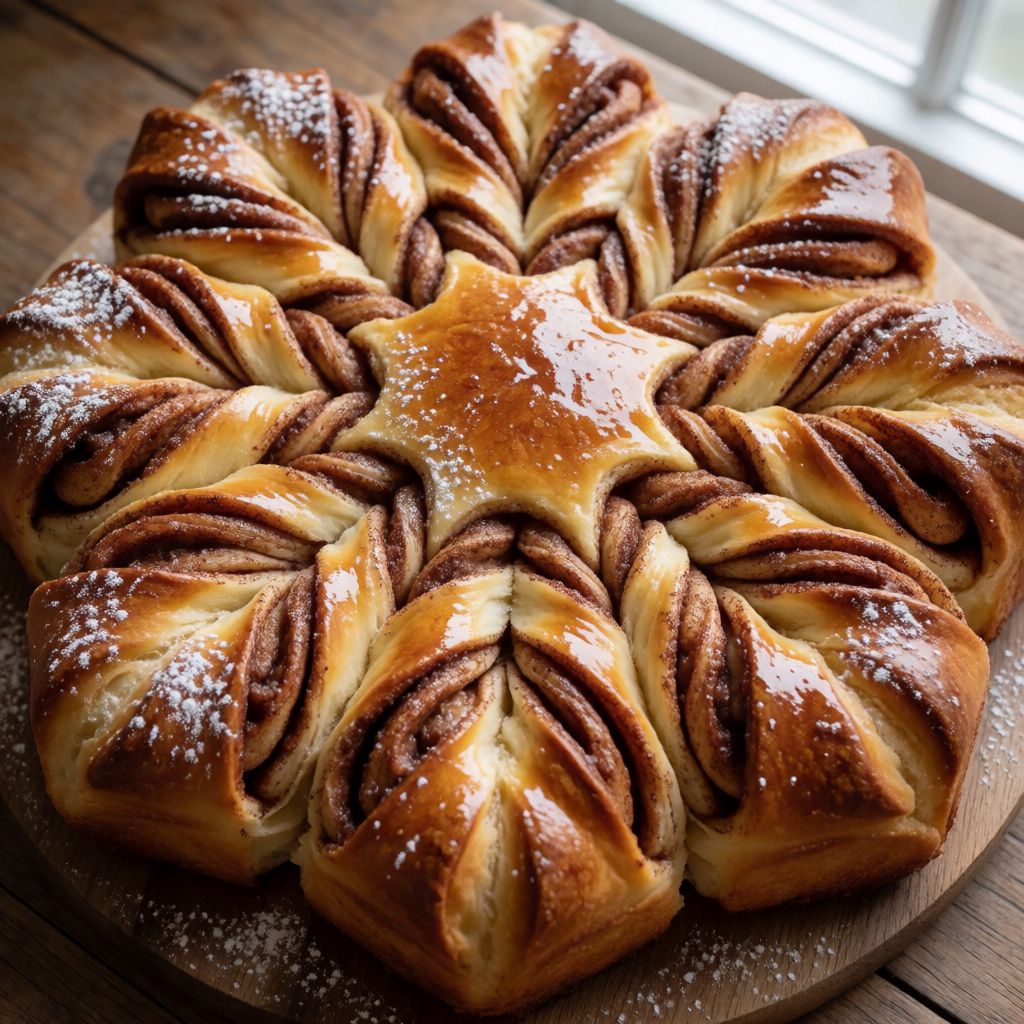
 AI photo
Cinnamon Star Bread
A pretty pull-apart sweet bread with marzipan, cinnamon and cardamom, shaped into a star pattern.
Labels are worked out automatically from the ingredients and can be wrong. Check the packaging if it matters to you.
Ingredients
- 60 g Butter
- 20 g Yeast
- 300 ml Milk whole
- 1 pcs Egg
- 50 g Caster sugar
- 1 tsp Cardamom ground
- 0.5 tsp Salt
- 500 g Plain flour
- 75 g Marzipan
- 100 g Caster sugar
- 100 g Butter room temperature
- 1 tbsp Cinnamon ground
- 1 pcs Egg beaten, for glazing
- 1 tsp Icing sugar










Steps
Melt the butter in a saucepan over low heat until fully melted.
2 minIn a bowl, dissolve the yeast in the milk, then add the melted butter, egg, sugar, cardamom, salt and half of the flour.
3 minMix well until combined, then add the remaining flour.
2 minKnead the dough with a mixer for 5 minutes until smooth and elastic.
5 minCover the dough and let it rise in the bowl for 1 hour at room temperature.
60 minMeanwhile, mix the filling of marzipan, butter, sugar and cinnamon until smooth.
2 minWeigh the dough and divide it into four equal parts.
2 minShape each part into a ball and let them rest briefly on the counter.
5 minRoll out each ball separately into a 24 cm circle.
Place one circle on a baking tray lined with parchment and spread a third of the filling over the whole circle, leaving 1 cm bare at the edge.
Place the next circle on top, spread with filling leaving 1 cm bare at the edge, and repeat until all four circles of dough and the filling are used.
5 minDo not put filling on the last layer of dough.
Place a glass in the centre of the dough and use a knife to cut from the edge of the glass to the edge of the circle, dividing the dough into 16 parts, like slicing a cake.
Take two neighbouring strips at a time and twist them in opposite directions, twisting twice, all the way round.
3 minRemove the glass from the centre.
1 minLet the dough rise under a tea towel for 30 minutes.
30 minBrush with beaten egg and bake in a preheated fan oven at 175°C for 17-20 minutes.
19 minLet the bread cool.
Before serving, dust with icing sugar.
1 min
This is a enriched yeast dough, cut and twisted into a sunburst, with layers of marzipan-cinnamon butter between the sheets instead of a single spiral. What decides whether it works is not the twisting — that part is almost foolproof — it's whether you got four thin, even circles of dough with filling spread right to the edge of patience (1 cm short of the rim) and no further. Too thick a layer of dough, or filling slopped right to the edge, and the thing weeps butter and sugar onto your tray while it bakes, and the layers won't separate cleanly when you pull the strips apart to twist them.
Some say a star bread needs a stand mixer with a dough hook running the whole time or it won't develop — no, because what you're developing here is gluten strength enough to roll thin without tearing, and five minutes of mixer work after a good hand-mix does that. If you don't have a mixer, knead by hand for closer to ten minutes: you're feeling for the dough going from shaggy and sticky to smooth and only lightly tacky, pulling back when you stretch it rather than snapping.
The one hour rise is not a clock, it's a doubling — in a cool British kitchen in winter that might take longer, near a radiator it'll be quicker. You're watching the dough go from dense and resistant to puffed and soft, holding a dent when you poke it instead of springing straight back.
Butter melted gently, not fried — the point is just to liquefy it so it mixes into milk and flour without lumps, not to brown it. Push the heat and you risk killing the yeast you're about to stir into warm milk; yeast is a living thing, not a leavening powder, and above a certain warmth (hand-hot, no more — if the milk feels hot on your wrist, let it cool) it simply dies rather than works.
Yeast dissolved straight into the milk rather than proofed separately with sugar first is a shortcut that works fine with fresh or instant yeast in this quantity, because there's enough sugar and warmth in the mix overall to wake it. Some say you must always proof yeast in warm sugared water first to "prove it's alive" — no, because that step exists to catch dead yeast before you waste a whole batch of flour, not because the dough needs it ritually. If your yeast is fresh from a packet you trust, skip the ceremony.
Cardamom here is doing what cinnamon does in the filling but lighter — a Scandinavian habit, this bread leans on that baking tradition, where cardamom in the dough is as ordinary as vanilla is here. If you haven't got it, leave it out rather than guess at a substitute; it's a background note, not a structural one.
Marzipan in the filling isn't sweetness for its own sake — it melts into the butter and sugar under heat and gives the filling body, so it holds together as a paste rather than running as pure melted butter would. If you've no marzipan, almond paste works the same way; if you've neither, use more softened butter and accept a looser, more syrupy filling — the bread will still work, just messier at the cut edges.
Flour: plain flour, not strong bread flour, and that's not an oversight — this dough wants to be tender and roll out thin without fighting back like a pizza base would. Any plain white flour with no bran bits does the job; the gluten you build by kneading is enough for this job without needing bread flour's higher protein.
The egg wash before baking is there for colour, not structure — it's what turns the surface from pale and bready to a proper gold-brown shine in the oven, by browning (the Maillard reaction, loosely) on contact with heat. Skip it and the bread still bakes, it just looks flatter, more like a scone than a showpiece.
Patience is the real ingredient twice over here: once in the first rise, where rushing it gives you a dense, tight crumb instead of an open one, and once in the second rise after shaping, where a full thirty minutes lets the twisted strips puff and set their shape before the oven's heat fixes them — skip that and the star can slump or tear as it bakes, because the gluten hasn't had time to relax back from all that rolling and cutting.