
 AI photo
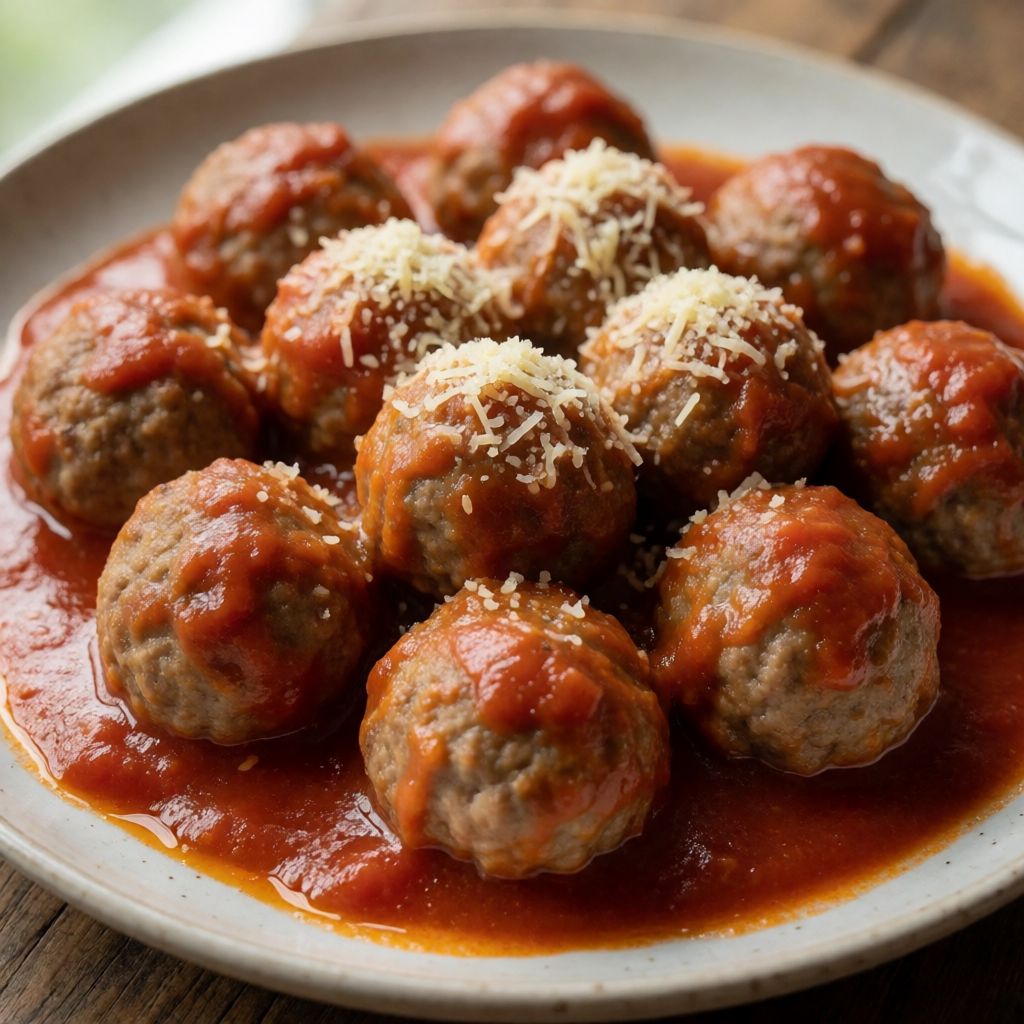
Meatballs in Tomato Sauce
Tender beef meatballs simmered in a rich tomato sauce with sage and rosemary.
Labels are worked out automatically from the ingredients and can be wrong. Check the packaging if it matters to you.
Ingredients
- 400 g Beef mince
- 55 g Bread or stale bread crumb
- 40-50 ml Milk
- 2 pcs Eggs
- 30 g Parmesan
- Salt to taste
- Black pepper to taste
- 5-6 pcs Sage leaves
- 1 pcs Rosemary sprig
- Plain flour to taste, for dusting
- 200 g Tomato passata
- 1/2 pcs Onion
- 2 clove Garlic
- Olive oil to taste














Steps
Chop the sliced bread and soak it in milk. Squeeze out the bread and add it to the beef mince.
Beat in two eggs, add the Parmesan, salt and black pepper to taste.
Finely chop the sage leaves and rosemary, and add to the mince.
Mix everything with a wooden spoon or by hand until smooth.
Shape into meatballs and coat each one in flour.
Heat the olive oil in a frying pan, add the garlic and onion.
Pour in the tomato passata, add salt and black pepper. Let the sauce simmer for a few minutes until it begins to bubble, then remove the garlic.
Place the meatballs in the sauce and cook on a low heat, covered.
8 minTurn the meatballs and cook for a further 7-8 minutes until the internal temperature reaches 71°C.
8 minServe immediately.
What was changed
Tomato passata is used instead of tomato paste, since the recipe pours and simmers it as a thin sauce.
Meatballs in tomato sauce, four people's worth, and the whole thing hinges on one decision you make before anything touches heat: how wet you keep the mince. Bread soaked in milk, squeezed, folded into beef — that's not padding, that's the mechanism. Bread swollen with liquid holds water inside the meatball as it cooks; dry breadcrumbs straight from a packet just steal moisture and give you nothing back. Squeeze too hard and you've undone the point of soaking it in the first place.
Some say mince for meatballs should be lean, the leaner the better, because fat is "bad for you" or "makes a mess." No — fat is what keeps a meatball a meatball instead of a dense little stone. 400g of ordinary beef mince, not the extra-lean tub, has enough fat in it to baste itself from the inside. Lean mince plus no bread plus overmixing is how you get a hockey puck that happens to be shaped round.
The flour dusting before the pan isn't there for a crust you'll taste — it's there so the meatball doesn't glue itself to the pan or shed its surface into the sauce. You want the outside to set fast, sealing in what the bread and egg are holding.
The sauce is passata, not a reduction you build from scratch — tinned tomato purée, already cooked down once, so your job is seasoning it and getting the garlic's flavour into the oil without burning it. Garlic goes in and comes back out; it's a flavour, not an ingredient you eat whole in the finished dish.
Doneness here isn't a clock, it's a thermometer, and that's the honest answer rather than a guess dressed up as a number. 71°C in the centre of a meatball — that's the real finish line, because beef mince, unlike a steak, is ground meat that's been handled by hands and blades, so you're not aiming for pink-and-resting, you're aiming for safely cooked through. The 15-16 minutes in the pan is the lower bound only; a thicker meatball, a cooler hob, a crowded pan all push that number up. Turn them once, not constantly — fiddling breaks the seal the flour gave you and the sauce gets cloudy with escaped meat.
On the bread: "or stale bread crumb" in the ingredient list is the real clue to why this exists at all. Stale bread was never thrown out in a kitchen that made its own bread daily — it went into meatballs, meatloaf, panzanella. Soaking it in milk softens the crumb back into something workable and adds a little fat and sugar from the milk itself, which browns and rounds out the flavour. If you've only got fresh bread, use less milk — fresh crumb is already wetter than stale and will turn to paste if you drown it.
Parmesan is doing two jobs: salt, and the savoury depth (umami, if you want the word) that raw beef mince doesn't have much of on its own. Any hard, aged, grating cheese with a similar bite stands in fine — a mature cheddar, a Grana Padano, even a strong Pecorino if you don't mind it sharper. What won't work is a soft or mild cheese; it melts into nothing and adds no backbone.
Sage and rosemary, finely chopped and folded straight into the raw mince rather than used as a garnish later, is an Italian habit that makes sense once you think about it: herbs cooked inside the meat flavour it from within for the whole cooking time, rather than sitting on top where heat burns them off in the first few minutes anyway. If you're short one or the other, lean on whichever you have more of — rosemary is the stronger of the two, so go easy if you're substituting more of it in.
For the onion and garlic: olive oil is specified because it's the oil that actually tastes of something and is meant to be noticed here, unlike a neutral oil you'd use when you want the oil itself invisible. Any olive oil will do the job of carrying heat to the onion and garlic; extra virgin is simply the more flavourful choice, not a requirement to chase down.
A note for the kitchen you're actually standing in: you don't need a kazan or a wide Italian sauté pan to make this work — a regular frying pan with a lid (or a plate balanced over it, which does the same job of trapping steam) is enough. The point of covering the meatballs while they cook in the sauce is to let them finish through with gentle, moist heat rather than drying out on direct contact with the pan's base, so don't skip that step because you don't own a proper lid.
And patience is the one ingredient not listed in grams: don't rush the squeeze on the bread, don't rush the mixing, and don't rush the turn in the pan. A meatball that's handled too roughly, too fast, falls apart in the sauce — and once it's in pieces, there's no putting it back together.