
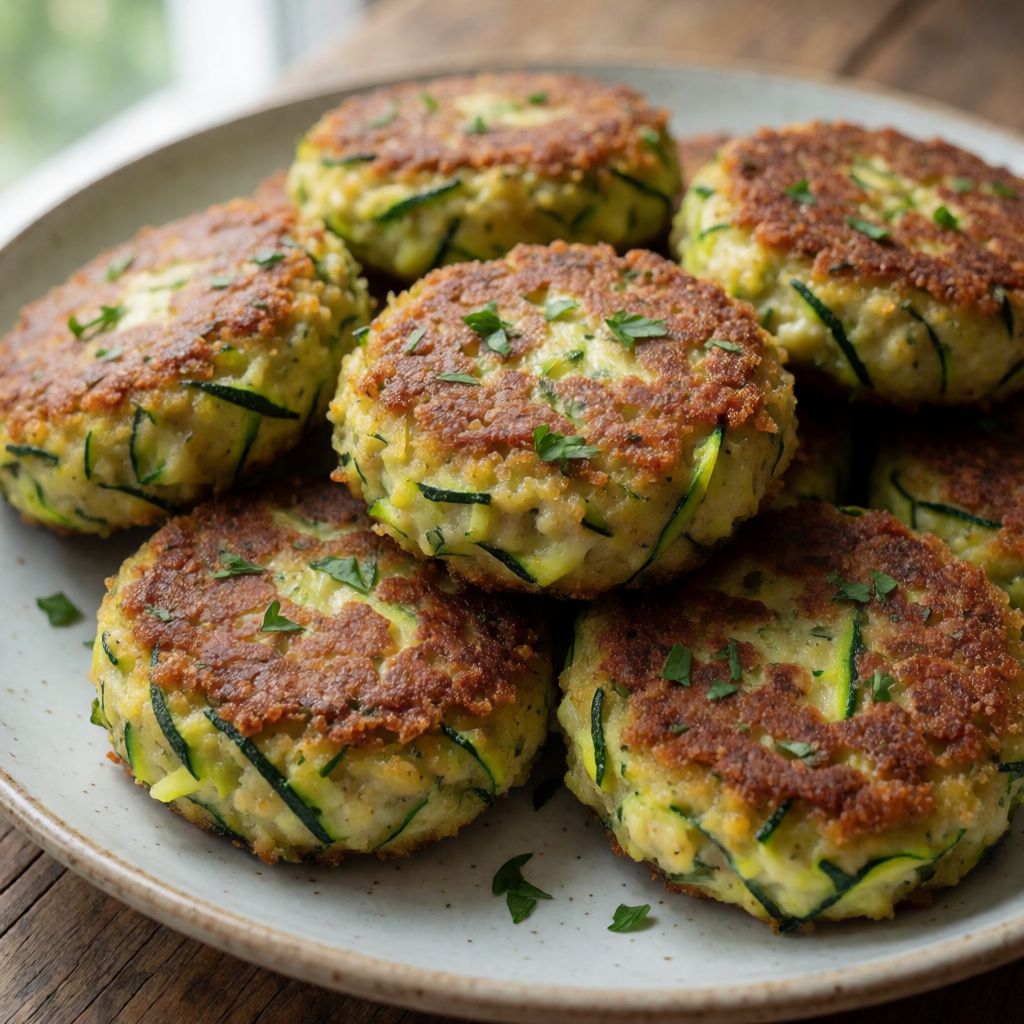
 AI photo
Courgette and Ricotta Patties
Crisp baked courgette patties with ricotta and parmesan, finished with a hint of curry and parsley.
Labels are worked out automatically from the ingredients and can be wrong. Check the packaging if it matters to you.
Ingredients
- 500 g Courgette
- 60 g Ricotta
- 2 tbsp Parmesan
- 1 pcs Egg
- 1 tsp Curry powder
- 1 tbsp Parsley
- Salt to taste
- Black pepper to taste
- Vegetable oil to taste
- Cornflour as needed, until the mixture is firm










Steps
Wash the courgettes, trim the ends and grate them on the coarse side of a grater.
Put the grated courgette in a frying pan with a little oil, add salt and black pepper, and fry so the courgette releases its excess moisture.
Leave the mixture to cool.
Lightly beat the egg with a fork and add it to the cooled courgette together with the ricotta, parmesan, curry powder and parsley.
Mix all the ingredients thoroughly with a fork, then gradually add cornflour until the mixture is even and firm.
Chill the mixture in the fridge for about 30 minutes so the patties hold their shape better while baking.
30 minPreheat a fan oven to 200°C.
Shape the patties: take a small portion of the mixture at a time and wet your hands with water to make shaping easier.
Place the shaped patties on a baking tray lined with baking paper.
Bake at 200°C for 30-35 minutes.
33 min
What was changed
Cornflour was added as a binder in place of breadcrumbs, to avoid gluten.
Courgette is ninety-six percent water wearing a vegetable's clothing. That's the whole problem this recipe solves, and the whole reason it looks the way it does. Grate it, and you've got a pile of green sponge. Mix that straight into egg and cheese and bake it, and you don't get a patty — you get soup with ambitions, spreading flat on the tray and weeping into the paper underneath it.
So you fry the gratings first, in a little oil, before anything else goes near them. Not to cook the courgette — it's already basically cooked once it's bled. You're boiling off water in a wide, hot surface where steam can actually escape, which a crowded saucepan won't give you. Some say you should salt and squeeze courgette in a cloth instead — fine for a salad, useless here, because squeezing removes water but not flavour, and you still need the heat to drive off what the squeezing leaves behind.
Once that moisture is gone and the mixture has cooled — cooled, because egg scrambles the second it meets a hot pan, and you want it binding, not curdling — you build the rest: ricotta for softness, parmesan for salt and savour, curry powder for warmth, parsley for green brightness, cornflour added gradually until the mix stops being batter and starts being dough. That "gradually" matters. Too little and the patty collapses in the oven; too much and you're eating starch with a courgette memory.
Courgette itself: pick firm, glossy, no soft give at the ends — a soft one has already started losing its structure, and you need every bit of that structure since you're about to fry half of it away anyway. Any summer squash with a similar water content works the same way; the mechanism — grate, fry, drain, cool — doesn't care what the vegetable is called.
Ricotta is there for a soft, slightly sweet creaminess that firmer cheeses won't give you — it's whey curd, barely pressed, so it carries moisture of its own. If you haven't got it, use cottage cheese pressed through a sieve, or a mild curd cheese; you're after the same loose, lactic softness, not a strong cheese flavour, because that job belongs to the parmesan.
Parmesan is the salt and the savoury backbone — a hard, aged cheese with nowhere to hide, so a little goes a long way. Any hard grating cheese with real age on it — a mature pecorino, an aged gouda — does the same work. Don't double it up with extra salt without tasting first; it's doing two jobs at once.
The egg is the glue. Lightly beaten, not whisked to foam — you want it binding the mixture, not aerating it. One egg for 500g of courgette is a modest ratio; if your mixture still feels loose after the cornflour, you're better off adding more flour than more egg, because excess egg loosens a mixture rather than firming it.
Curry powder here isn't an attempt at a curry — it's one spoon of warmth against a very green, very mild base, the kind of move that makes sense once you remember spice blends travelled to British kitchens through trade routes and stayed because they're convenient, not because of any deep culinary logic. A pinch of ground cumin and turmeric together gets you close if you've none.
Cornflour is the real safety net, and the instruction to add it "gradually, until firm" is the one line in this recipe that can't be reduced to a number — every batch of courgette releases a slightly different amount of water, so the flour has to answer to what's actually in the bowl, not to a tablespoon measurement written for a different courgette on a different day. Wet hands when shaping aren't a nicety — a sticky mixture this delicate rips and smears on dry palms, and a torn patty won't close back up in the oven, it'll just hold its crack and leak.
A domestic fan oven at 200°C browns the outside and sets the inside without a flip, which is the one genuine advantage a flat-oven kitchen has over a stovetop pan here — no turning, no watching for the moment before it catches. Judge it by colour at the edges going from pale to gently gold, not purely by the clock; thirty minutes is where to start checking, not where to stop looking.