
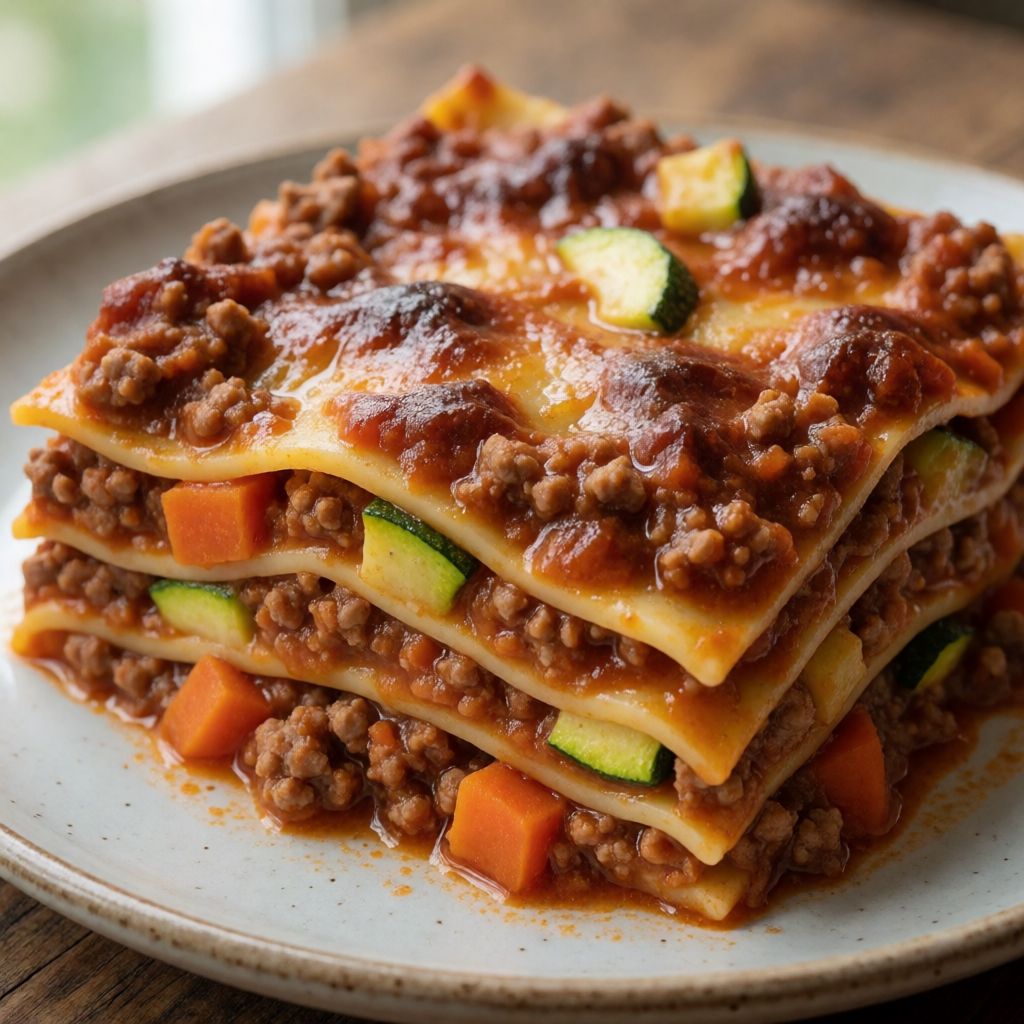
 AI photo
Easy and Quick Lasagne
A quick, easy beef and vegetable lasagne with a rich tomato sauce and melted mozzarella.
Labels are worked out automatically from the ingredients and can be wrong. Check the packaging if it matters to you.
Ingredients
- 400 g Beef mince
- 1 pcs Onion finely chopped
- 4 clove Garlic
- 3 pcs Carrot coarsely grated
- 1 pcs Courgette coarsely grated
- 800 g Tinned chopped tomatoes
- 30 g Sun-dried tomatoes finely chopped
- 40 g Tomato purée
- 1 tbsp Dried oregano
- 1 tbsp Dried thyme
- 100 ml Stock
- 100 ml Double cream
- 1 tbsp Olive oil for frying
- Salt
- Black pepper freshly ground
- 200 g Fresh lasagne sheets
- 125 g Mozzarella fresh
- 5 g Butter for the dish


















Steps
Fry the mince in a pan with olive oil, stirring, over high heat.
Add the vegetables, chopped tomatoes, sun-dried tomatoes, tomato purée, oregano, thyme and stock.
Let it simmer uncovered for 5 minutes.
Season to taste with salt, freshly ground pepper and double cream.
Grease an ovenproof dish and layer the sauce and lasagne sheets alternately, finishing with a layer of sauce.
Tear the mozzarella into small pieces and scatter over the top.
Bake the lasagne in a preheated oven at 175°C (fan) for 15 minutes.
This is lasagne with the slow part cut out — no béchamel, no hours of ragù, no boiling sheets. It works because it borrows the two things a real ragù needs and skips the one thing it doesn't: meat cooked hard and fast so it browns rather than stews, vegetables grated small so they soften in minutes instead of an hour, and cream stirred in at the end instead of a separate white sauce built from flour and butter and patience. What decides whether this succeeds isn't the oven — it's whether the sauce goes in wet enough, because fresh sheets have no water of their own to borrow from, unlike the dry ones.
Some say lasagne needs a béchamel or it isn't really lasagne. No — béchamel exists to add moisture and richness to a dry pasta bake; if your sauce is already loose with stock and cream, you've built that moisture in another way. The dish doesn't care which route got it there.
The whole thing turns on one fact: fresh lasagne sheets are already cooked through with water, they just need heat and liquid around them to finish softening in the oven, not a pre-boil. That's the entire trick that makes this "quick." Everything else is ordinary good sense — brown the meat properly, don't drown the vegetables, don't scorch the cheese.
Start with the mince and high heat, not medium — you want the surface of the meat to dry and catch colour, which is where the savoury depth comes from, not from the meat itself but from the proteins browning against hot metal. Drop it into a crowded, lukewarm pan and it steams grey instead, releasing water, sitting in it, going on sitting in it. A wide domestic frying pan actually helps here more than a narrow saucepan would — more surface in contact with the heat, less crowding, less steaming. If your hob runs weak, fry the mince in two batches rather than one slow one.
Onion and garlic go in for sweetness and backbone — the onion turning from raw white to soft and translucent is your cue, not a clock. Carrot and courgette are grated coarse rather than diced because grated vegetable cooks through in the five minutes this sauce gets, where diced vegetable would still be raw-tasting at the centre; grating multiplies the surface touching the hot sauce. The carrot is done when it's lost its snap and bends instead of breaking under the spoon. If you've no courgette, any watery, mild vegetable that grates — marrow, even a mild summer squash — does the same job of bulking the sauce without fighting the tomato for flavour.
Tinned chopped tomatoes carry the bulk and the acid; tomato purée and sun-dried tomatoes aren't decoration, they're concentrated tomato doing in a spoonful what an hour of reduction would otherwise do — this is exactly how the recipe gets away with five minutes of simmering instead of the forty a proper ragù wants. Stock loosens it, and the double cream stirred in afterwards rounds off the acidity and gives you the gloss and richness that béchamel usually supplies — add it off the boil or near it, cream split hard on a roaring simmer turns grainy rather than silky. Oregano and thyme, dried rather than fresh, because dried herbs want time in a hot liquid to release their oil, which fresh herbs don't need and would scorch given the same five minutes.
For the sheets and cheese: fresh lasagne needs no pre-boiling because it's already hydrated — treat it like dried and you'll get a leathery top layer, since dried sheets rely on absorbing the sauce's liquid to cook through and fresh ones don't need to steal that much. Mozzarella should be fresh, the kind sitting in its own whey, torn by hand rather than grated — tearing leaves rough surfaces that catch and brown unevenly, which is exactly what you want on top; a block mozzarella meant for grating will just melt flat and rubbery instead. If you've no mozzarella to hand, any mild, stretchy melting cheese — a mild cheddar grated fine, say — will cover the job, though you lose that particular pull of a torn piece going golden at the edges.
The butter greasing the dish isn't about flavour, it's there so the bottom layer of pasta doesn't weld itself to the dish — a thin film of any neutral fat does the same, oil included, if that's what's open. And 175°C fan for fifteen minutes is a fast bake by lasagne standards, which tells you something: this dish is built to go in already nearly finished, with the oven only there to melt the cheese, crisp its torn edges, and let the layers settle into each other. Patience went into getting the sauce thick and well-seasoned before it ever reached the dish — once it's assembled, there's almost none left to give, and that's by design, not a shortcut you should feel guilty about.