
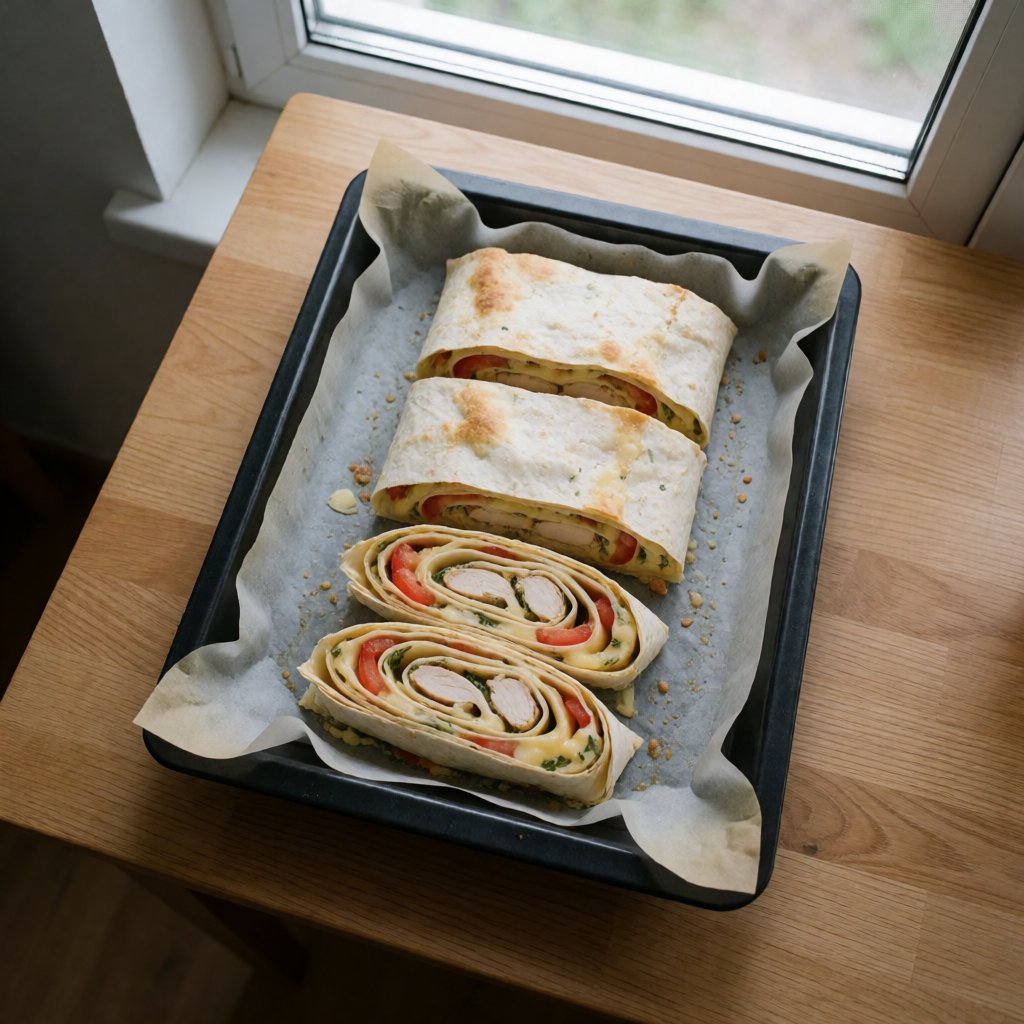
 AI photo
Lavash Roll with Chicken and Cheese
A quick savoury lavash roll filled with chicken, cheese, tomato and herbs, baked until golden.
Labels are worked out automatically from the ingredients and can be wrong. Check the packaging if it matters to you.
Ingredients
- 1 pcs lavash large sheet
- 200 g chicken breast cooked, e.g. recipe 5
- 80 g mature cheddar grated
- 1 pcs tomato
- 1 bunch fresh herbs chopped
- 2 tbsp yogurt
- 1 tbsp sunflower oil for brushing, or use beaten egg





Steps
Spread the lavash with yogurt, then top with pieces of chicken, tomato, cheddar and herbs.
Roll it up tightly, seam-side down, and brush the top with egg or oil.
Place the roll on a parchment-lined baking tray and bake for 20 minutes until golden.
20 minTake the tray out of the oven.
What was changed
The cheese has been swapped for mature cheddar, the kind most British kitchens have on hand.
This is not a recipe so much as a parcel — bread wrapped around things you already have, baked until the outside goes crisp and the inside turns into one soft mass of chicken, melted cheese and tomato juice. What decides whether it works isn't the filling, it's the seal. A lavash roll that comes out of the oven split open has usually failed before it ever went in — rolled too loose, or placed seam-up, where the first rush of steam finds the weak point and prises it apart.
The lavash is doing more work than you'd think. This is a bread built, across the Caucasus and beyond, to be baked thin, dried hard, and kept for months — then splashed with water to come back to life before a meal. That history is why it can take a wet filling at all: ordinary sliced bread would collapse into mush where lavash tolerates moisture, because its whole job was always to absorb water and still hold shape. Some reach for a tortilla or a pitta instead because "it's basically the same thing" — no, a tortilla has fat worked through the dough so it resists liquid, and pitta is thick enough to steam through rather than crisp. Use true lavash, or something as thin and lean as you can find, or the roll won't crisp — it'll go chewy and sag.
Now the pieces, and why each one is there.
Chicken: already cooked, which changes the whole logic of this bake. You're not cooking meat here, you're warming it through and letting it pick up moisture from the tomato and yogurt. That's why it should go in torn or sliced thin, not in big chunks — thin pieces take the heat fast and stay tender, while a thick lump in the middle will still be cool when the lavash outside is already brown. Leftover Sunday roast chicken does this job well, and that's really the economics of the dish — it exists to turn yesterday's bird into tonight's dinner, not to have you cook chicken specially for it.
Cheese: mature cheddar, grated, chosen for sharpness, not for melt. A young, mild cheese will melt smoother but leave the whole thing bland under the tomato and herbs — you want cheese with enough bite to stand up to them. The criterion for a substitute is a firm cheese that melts without weeping oil everywhere: Gruyère, a hard Lancashire, a strong Red Leicester. Soft fresh cheeses belong to a different family entirely — they'd turn the filling wet instead of binding it.
Tomato: fresh, not tinned, and this is where people get it wrong. Some leave it in thick, juicy slices thinking more tomato means more flavour — no, because that juice has nowhere to go once it's rolled up inside bread, and it's tomato water, not the oven, that splits a soggy seam. Cut it thinner than feels necessary, and deseed it if it's very ripe. The yogurt underneath is doing real work here too, as a barrier as much as a seasoning, keeping the lavash from drinking the tomato's water straight through.
Yogurt: plain, full-fat if you can get it, spread as a thin coat, not a puddle. Its job is to glue the filling to the bread and season it quietly from underneath. Any soured dairy with body will stand in for it — soured cream, crème fraîche, even a thin smear of mayonnaise — the criterion is something thick enough to sit still, not run.
Herbs: whatever's fresh and has a smell you'd actually want to eat — parsley, dill, coriander. Their job is lift, cutting through the fat of melted cheese and the sweetness of cooked chicken. Dried herbs won't do this work; they need the water still in a fresh leaf to release any smell at all under heat.
Oil or egg for brushing: not decoration — this is what turns pale bread into golden bread. Oil gives shine and some crispness; egg gives a deeper colour and a firmer crust, because egg proteins brown faster and harder than oil ever will alone. Use any oil with no smell of its own — sunflower, a mild rapeseed — so it doesn't compete with the filling; if there's an egg spare, use that instead and expect a darker, shinier top. One honest limit worth naming: a home oven isn't a hot stone deck, and lavash baked in one will never crisp quite as fast or as evenly as it would against the fierce radiant heat it was designed for. The parchment under the roll isn't tradition, it's just the easiest way to stop the roll fusing to the tray and tearing when you lift it off — a flat-kitchen workaround, nothing more.
·