
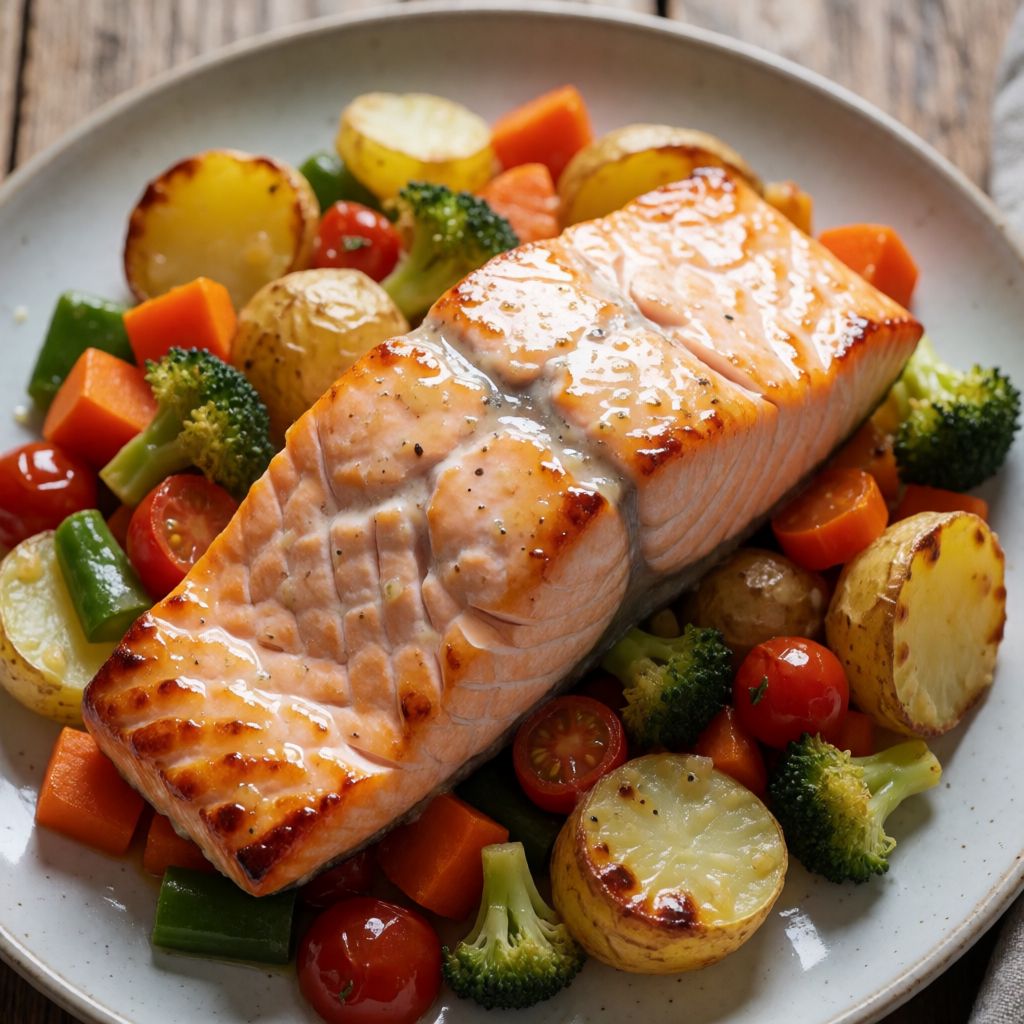
 AI photo
Salmon Bake with Potatoes and Vegetables
A warming oven bake of salmon with leek, carrot, fennel, cabbage and potatoes in a creamy mustard sauce.
Labels are worked out automatically from the ingredients and can be wrong. Check the packaging if it matters to you.
Ingredients
- 1 pcs Leek thinly sliced
- 3 pcs Carrot thinly sliced
- 1 pcs Fennel thinly sliced
- 1 pcs Onion thinly wedged
- 400 g Pointed cabbage finely shredded
- 600 g Potato thinly sliced
- 150 ml Stock
- 100 ml White wine
- 150 ml Double cream
- 1 tsp Dijon mustard
- 1 tsp Dried thyme
- 500 g Salmon cut into large cubes
- 30 g Capers
- 1 pcs Lemon for juice and zest
- Salt to taste
- Black pepper freshly ground, to taste
- 1 bunch Parsley finely chopped
















Steps
Spread the leek, carrot, fennel, onion, cabbage and potato in a greased ovenproof baking dish.
Mix the stock, cream and white wine with the Dijon mustard, thyme, salt and pepper, and pour the mixture over the dish.
Bake in a preheated oven at 190°C (fan) for about 45 minutes.
45 minSprinkle the vegetables with capers and arrange the salmon cubes on top, then season with a little salt, freshly ground pepper, and the lemon juice and zest.
Return the dish to the oven and bake for a further 7-8 minutes, until the salmon is cooked through.
8 minLet the dish rest for 4-5 minutes before serving.
5 minSprinkle with finely chopped parsley before serving.
This is a one-dish bake where the vegetables cook in a bath of cream, stock and wine until they've given up their water and taken on the mustard and thyme instead, and the salmon only goes in right at the end, so it steams rather than roasts. Get that sequence backwards — salmon in from the start — and you'll have grey, dry fish sitting on crunchy potato. That's the whole mechanism: two different jobs, two different lengths of time in the oven.
What decides whether it works is the thickness of your potato and vegetable slices, not the minutes on the timer. Thin, even slices mean the liquid can get all the way through by the time 45 minutes is up — a slice that's a few millimetres too thick in the middle of the dish will still be raw while the edges are collapsing into the sauce. Nobody's oven runs exactly true either, so treat the first bake as "until a knife goes into the potato without resistance" and the 45 minutes as the point you start checking, not the point you stop.
The cream-stock-wine mixture isn't just for flavour — it's doing the job a lid would do in a stew, keeping the vegetables from drying out as they release their own moisture and sucking in the thyme and mustard while they're at it. In a flat with a standard fan oven and a Pyrex or ceramic dish rather than a kazan, this works fine; just make sure the dish is wide enough that the vegetables sit in a shallow layer, two or three deep, not piled up — piled vegetables near the bottom stay pale and wet while the top layer catches colour, because heat and liquid both struggle to reach the middle of a heap.
Leek, fennel, onion and cabbage are there for two reasons: bulk, and the sweetness that comes out of them as they soften — raw, fennel and cabbage are sharp and leek is sulphurous, but half an hour in a hot, moist dish turns that into something closer to sweetness. If you don't have fennel, don't skip it and don't mourn it — a bit of extra leek or celery gives you the aniseed-shaped gap filled with something milder; the dish survives.
The carrot is the gauge, not just a vegetable. Thinly sliced carrot is the slowest thing in the dish to soften, so when it bends rather than snaps, everything else underneath it is already done — that's your real doneness test, more honest than the clock. Potato, by contrast, is there for starch and bulk and to soak up the sauce; use a waxy or all-rounder variety that holds its slice rather than one that collapses to mush, because mush and a creamy sauce together just becomes wallpaper paste.
The stock, wine and cream aren't three separate liquids so much as one liquid with three jobs — stock for savoury depth, wine for acid to cut the cream, cream to carry both and to thicken as it bakes. If you drop the wine, add a spoon more lemon juice at the end to replace the acid it was providing, or the whole dish tastes flat and rich with nothing to lift it. Dijon mustard here isn't for heat, it's an emulsifier and a background sharpness — it helps the cream and stock sit together rather than splitting, and English mustard or wholegrain will both do that job, just with more bite or more texture respectively.
Salmon cut into large cubes rather than left as fillets is a practical choice for a shared bake: cubes cook evenly through in the brief second stage, where a whole fillet would need its thickest point timed separately from its thin tail end. Capers and lemon zest go in raw, scattered rather than cooked, because their whole purpose is sharp contrast against the cream — cook them with everything else for 45 minutes and they'd just melt into the same softness as the vegetables and you'd lose the point of having them. Parsley at the very end, after the rest, is the same principle: added for the last fresh green note, not for flavour that needs cooking in.
Patience here isn't really about watching a clock, it's about not opening the oven door every five minutes to check — every time you do, you let the heat out and add minutes you didn't account for. Put the dish in, leave it alone until the time you were told is nearly up, then check by eye and by knife, not by habit.
On resting: four or five minutes isn't about the salmon needing to "set" the way a roast joint does — it's simply too hot to serve straight from the oven, and the sauce needs a moment to stop being volcanic and start being a sauce you can actually taste rather than just feel burning your tongue.