
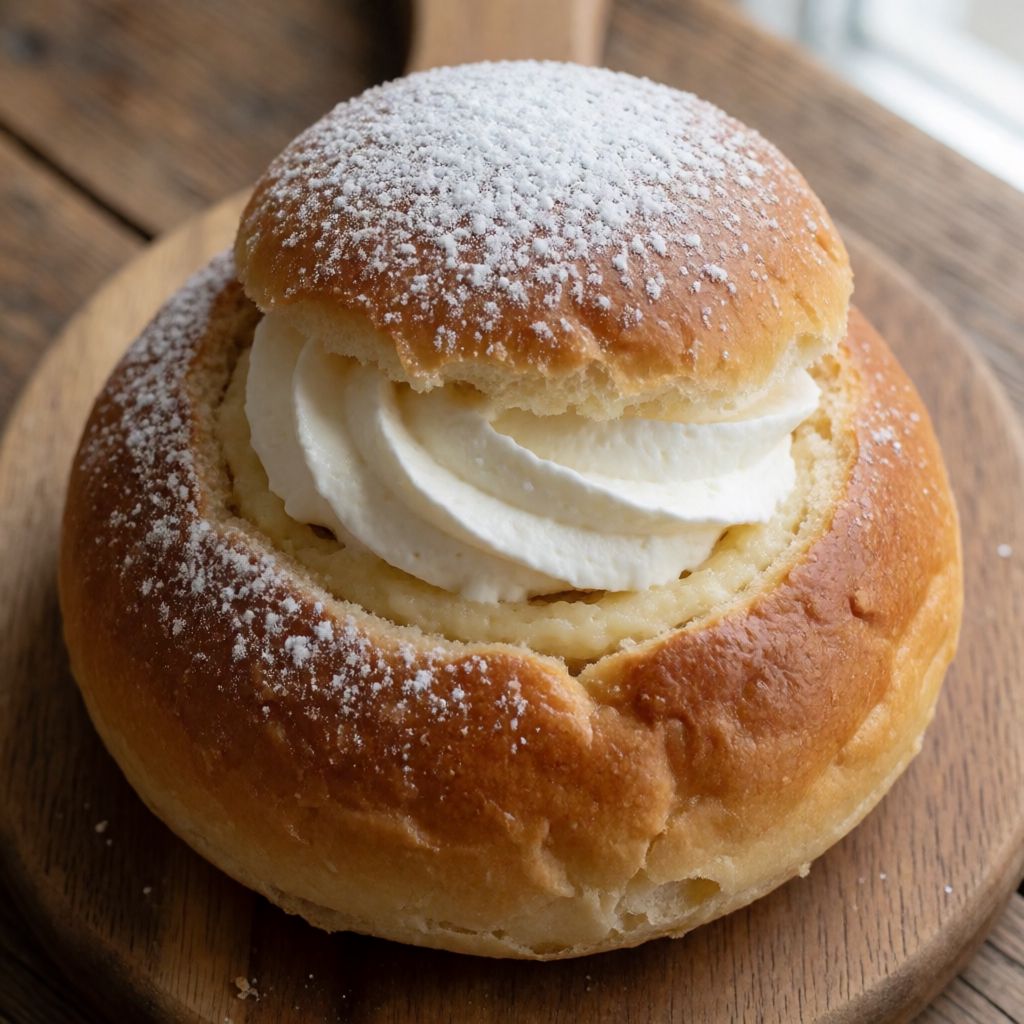
 AI photo
Lenten Semla Buns with Marzipan
Soft cardamom buns filled with a marzipan-almond cream and topped with whipped cream, finished with a dusting of icing sugar.
Labels are worked out automatically from the ingredients and can be wrong. Check the packaging if it matters to you.
Ingredients
- 20 g Yeast
- 200 ml Milk at room temperature
- 50 ml Milk
- 2 pcs Eggs
- 125 g Butter
- 1 tsp Vanilla sugar
- 50 g Caster sugar
- 1 tsp Cardamom ground
- 0.5 tsp Salt
- 400 g Plain flour
- 1 pcs Egg beaten, for glazing
- 150 g Marzipan
- 50 g Almonds roughly chopped
- 250 ml Double cream for whipping
- 25 g Icing sugar for dusting












Steps
Stir the yeast into a bowl with the room-temperature milk.
Melt the butter in a saucepan over low heat.
Off the heat, stir in the melted butter, sugar, vanilla sugar, cardamom, salt and eggs into the bowl with the milk and yeast.
Sift in the flour and mix well to form a dough.
Knead the dough on low speed with a mixer for about 10 minutes, until smooth, soft and elastic.
Leave the dough to rise in the bowl on the kitchen counter, covered with a clean tea towel, for 30 minutes.
Shape the dough into equal round buns and place them on a baking tray lined with baking paper.
Leave the buns to rise, covered with a clean cloth, for 60 minutes.
Brush the buns with beaten egg and bake in a preheated fan oven at 175°C for about 17-18 minutes.
Leave the buns to cool on a wire rack.
Cut off the top of each bun and set it aside for later.
Scoop out the inside of each bun and put the crumb into a blender together with the coarsely grated marzipan, chopped almonds and a little milk.
Blend quickly to a smooth, tasty cream. Spoon the filling back into the hollowed buns, top with whipped cream and cover with the bun's lid.
Dust with a little icing sugar before serving.
A semla is Sweden's answer to the question "what do we do with the last of the butter and cream before Lent takes it away." Historically it was eaten on Fat Tuesday, a cardamom bun stuffed with almond paste and cream, built to use up the rich things a household was about to give up for forty days. "Lenten" in this title is a bit of a wink — this version has eggs, butter and cream in it, so it's lenten only in the sense of "the thing you eat before Lent," not "the thing you eat during it." Don't let the name confuse you.
What decides whether this works is the dough and the restraint at the end. The dough is a basic sweet yeast dough — milk, egg, butter, cardamom — enriched but not heavy, and it lives or dies on two risings, not one. The first proof, in the bowl, builds the yeast's strength; the second, after shaping, is what gives you an airy bun rather than a dense knot. Skip or rush the second and you'll get something that bakes into a bread roll with ambitions, not a semla.
The other hinge is restraint when you fill it. The almond-marzipan cream has to be soft and barely sweet — it's a base note, not a flavour explosion — and the whipped cream on top has to stay cream: whipped to soft peaks, not stiff, because stiff cream turns the whole bun into something closer to a slice of gateau than a bun you eat with a spoon and a cup of tea. Some say a semla should be filling-heavy and cream-piled. No — the bun has to still taste of cardamom butter dough under all that, or you've just built a sugar bomb with a roll holding it up.
Yeast first. 20g of fresh yeast dissolved into room-temperature milk — not warm, not hot. Heat above body temperature starts killing yeast cells before they've done any work, which is the real reason behind "proof in warm not hot liquid": it's not superstition, it's biology. If you're using dried yeast instead of fresh, use about a third of the weight and you don't need to dissolve it first — mix it straight into the flour. Either way, the milk at room temperature gives the yeast a gentle start rather than a shock.
The butter goes in melted but off the heat, with the eggs. This matters more than it looks: hot melted butter poured straight onto egg can scramble it at the edges, giving you flecks of cooked egg in your dough. Let the butter cool for a minute in the pan before it meets the eggs, and you avoid that entirely. Cardamom here isn't decoration — it's the flavour that makes this a semla and not just a sweet bun; if you can't find it ground, crack a few pods and grind the seeds yourself, the flavour fades fast once ground so pre-ground jars lose punch within months.
Flour: plain flour, sifted in. Sifting isn't ceremony, it's aeration — it knocks out the lumps that would otherwise sit stubborn in your dough and never fully hydrate. Kneading for 10 minutes on low speed is building gluten strength, the structure that will trap the gas the yeast produces later. By hand this takes longer and your arm will know it; a stand mixer just does the work faster, not differently. You're looking for a dough that stretches without tearing when you pull it — smooth and a bit springy under your hand, not sticky, not stiff.
The two rises: the first, 30 minutes covered in the bowl, is about building yeast activity broadly. The second, 60 minutes after shaping, is about the individual buns gaining the volume they'll bake with. A tea towel, not a tight lid, because the dough needs to breathe slightly as it rises — trap it under plastic and you risk a soggy skin forming on top. In a British kitchen this just means finding a draught-free spot on the counter, away from a cold windowsill; your oven, switched off, with the door shut, often does the job if your kitchen runs chilly.
Baking at 175°C fan for 17–18 minutes is short and hot enough to set the crust before the inside dries out — a lower, longer bake would give you a paler, tougher crumb. You're watching for golden-brown tops, not a clock; ovens vary enough that "about 18 minutes" is a floor, not a guarantee.
Marzipan: 150g, coarsely grated, blended with the scooped-out crumb, chopped almonds and a splash of milk. The crumb isn't filler, it's what turns marzipan from a stiff almond block into a spreadable cream with body. No marzipan in the cupboard? Blend blanched almonds with icing sugar and a few drops of almond extract roughly 2:1 — it won't have quite the same density, but it carries the same idea: ground almond sweetness under the cream.
Double cream whipped to soft peaks is the final layer, and icing sugar dusted over the top at the end rather than mixed into the cream — because the bun itself is already sweet, and you want a visual frost, not another layer of sugar working against the cardamom. Serve these with tea, obviously, since they were built for a pause before a long fast — and even without the fast, that's still the right moment for one.