
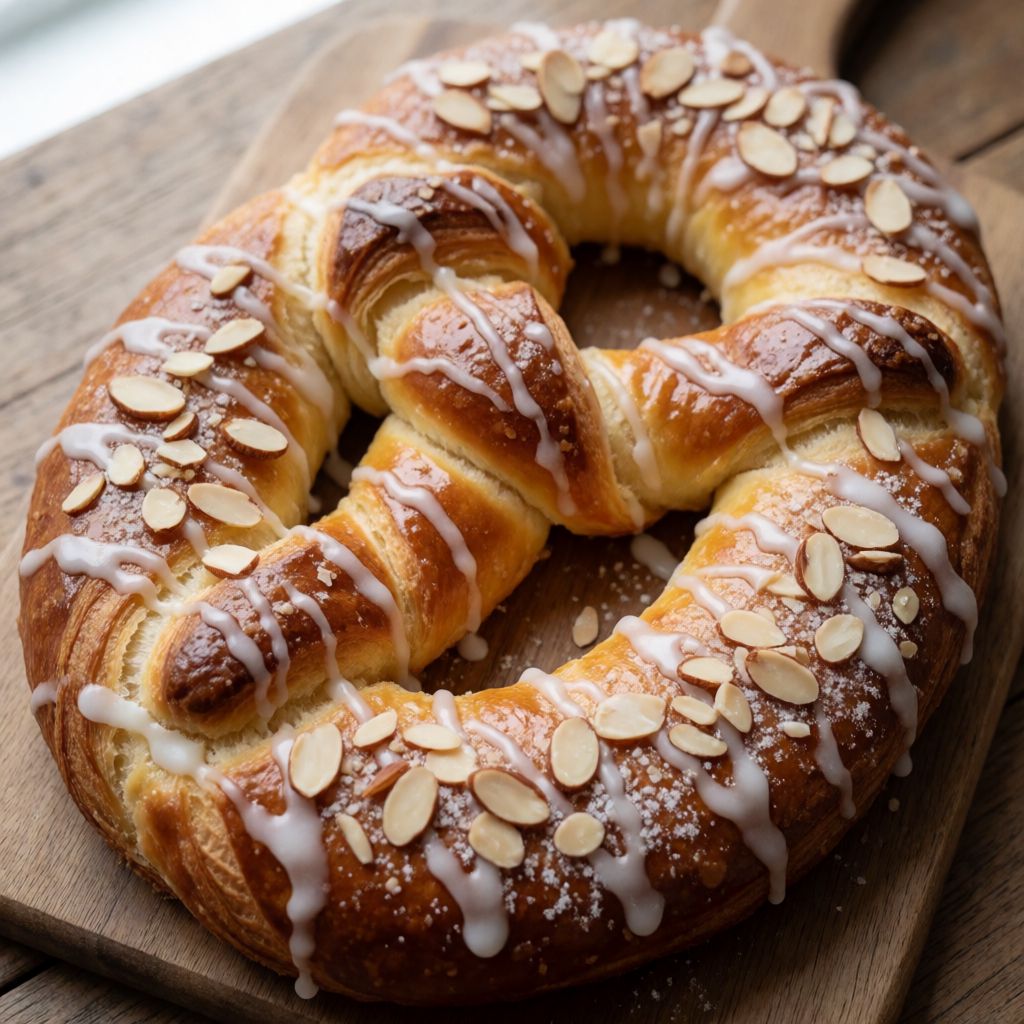
 AI photo
Danish Kringle with Marzipan
A soft yeasted Danish kringle filled with marzipan, cinnamon and cardamom, topped with pearl sugar and almonds.
Labels are worked out automatically from the ingredients and can be wrong. Check the packaging if it matters to you.
Ingredients
- 15 g Yeast
- 50 ml Milk warmed to 30°C
- 125 g Butter room temperature
- 20 g Caster sugar
- 2 pcs Eggs
- ½ tsp Salt
- 250 g Plain flour
- 100 g Raisins
- 40 g Almonds blanched, coarsely chopped or flaked
- 1 pcs Egg beaten, for glazing
- 2 tbsp Pearl sugar










For the filling
- 100 g Marzipan
- 75 g Butter
- 75 g Caster sugar
- 1 pinch Cardamom
- 1 pinch Cinnamon


Steps
Mix the yeast with the milk, add the butter cut into small cubes, sugar, eggs, salt and half the flour. Mix well until smooth.
Gradually add the remaining flour and knead the dough until soft, elastic and smooth. Cover the bowl with a clean tea towel and leave the dough to rise for 30 minutes.
30 minFor the filling, mix the marzipan, butter, sugar, cardamom and cinnamon in a bowl until smooth.
Roll out the dough on a floured surface into a rectangle. Spread the filling along the centre of the dough, sprinkle with raisins and half the almonds. Fold each side of the dough towards the middle so the edges overlap and the kringle closes.
Place the kringle on a baking tray lined with baking parchment.
Brush the kringle with the beaten egg, sprinkle with pearl sugar and the remaining almonds. Leave the kringle to rise for another 20 minutes. If you like, make a few small cuts along the kringle — this gives a nice pattern during baking.
20 minBake the kringle in a preheated 180°C (fan) oven for 15–18 minutes, until golden and cooked through.
16 min
A kringle is a yeasted pastry folded like a book over an almond-paste filling — not a pretzel-shaped thing despite the name wandering across Scandinavia and picking up confused meanings on the way. Danes call the open, layered version wienerbrød-adjacent, and this one is simpler: an enriched dough, closed over marzipan, butter and sugar, baked until the outside goes the colour of strong tea and the inside has set but not dried.
What decides whether it works is the dough's temperature discipline, start to finish. Yeast at 30°C milk — not hot, not cold — wakes up without being scalded; butter at room temperature so it blends rather than smears into streaks; a first rise that's about volume doubling, not a clock; and an oven hot enough to set the crust before the marzipan filling turns to syrup and floods out through the seams. Miss any one of those and you get either a dense, unrisen brick or a kringle that leaks sugar-butter lava onto your tray.
The other thing that decides it: the seal. You fold the dough over the filling from both long sides so the edges overlap in the middle — that overlap is not decorative, it's the only thing stopping marzipan and melted butter escaping during baking. A weak seam is the single most common reason a kringle collapses or weeps on the tray.
Some say pearl sugar is just for looks. No — it's there because it doesn't melt and vanish into caramel like ordinary sugar would at 180°C; it survives the oven and stays as crunch. Swap it for caster sugar and you lose that texture entirely, not just the sparkle.
Yeast, 15g fresh — go by smell and crumble, not just weight. If you can only get dried yeast, use about a third of that by weight and skip proofing it in the milk separately; mix it straight into the flour. Fresh yeast dissolved in 30°C milk is a check on itself: too hot and you kill it outright, giving you a flat, chewy slab instead of pastry; too cold and it just sits there sulking while you wait.
Butter, split into two lots and two temperatures on purpose. The 125g for the dough is room temperature so it folds into the flour and eggs smoothly, building a soft elastic dough rather than a greasy one. The 75g in the filling is there to carry the marzipan — on its own, marzipan is too dense and dry to spread; the butter loosens it into something you can push along the dough with a spoon without tearing it.
Marzipan is the backbone of the filling, not a flavour note — it's ground almonds and sugar, already sweet and intensely almond-forward, so the cardamom and cinnamon are there only to lift it, a pinch each, not a dessert spice-rack event. No marzipan in the cupboard? Make a rough substitute from ground almonds, icing sugar and a spoon of egg white worked into a paste — it won't be as smooth, but it holds the same job: a sweet, oily filling that melts slightly in the oven and perfumes the dough around it.
Raisins and almonds go in on top of the filling, not blended through it, so they stay as texture rather than disappearing — raisins plump slightly from the oven's heat and the butter running through the dough, almonds toast where they're exposed on the surface. If raisins aren't to your taste, any dried fruit cut small enough not to tear the dough as you roll works the same way — sultanas, chopped dried apricot, even chopped dates.
The egg wash and pearl sugar on top aren't just for shine. The egg gives you the deep gold-brown colour and a barrier that helps the surface set early in the oven, which matters on a domestic hob where your oven may run hotter or cooler at the back than the dial says — watch the colour, not the clock, past the 15-minute mark. Pearl sugar, if you genuinely can't find it, can be swapped for roughly crushed sugar cubes — the point is a sugar coarse enough to survive baking as crunch, not caster sugar, which will just melt flat.
In a flat kitchen without a proper proofing drawer, the "leave to rise" steps are where patience earns its keep — a tea towel over the bowl, somewhere not cold, and judging by how the dough looks and springs back rather than staring at a timer. Rushing this is the single easiest way to end up with pastry that's heavy rather than light, no matter how carefully you got the rest right.