
 AI photo
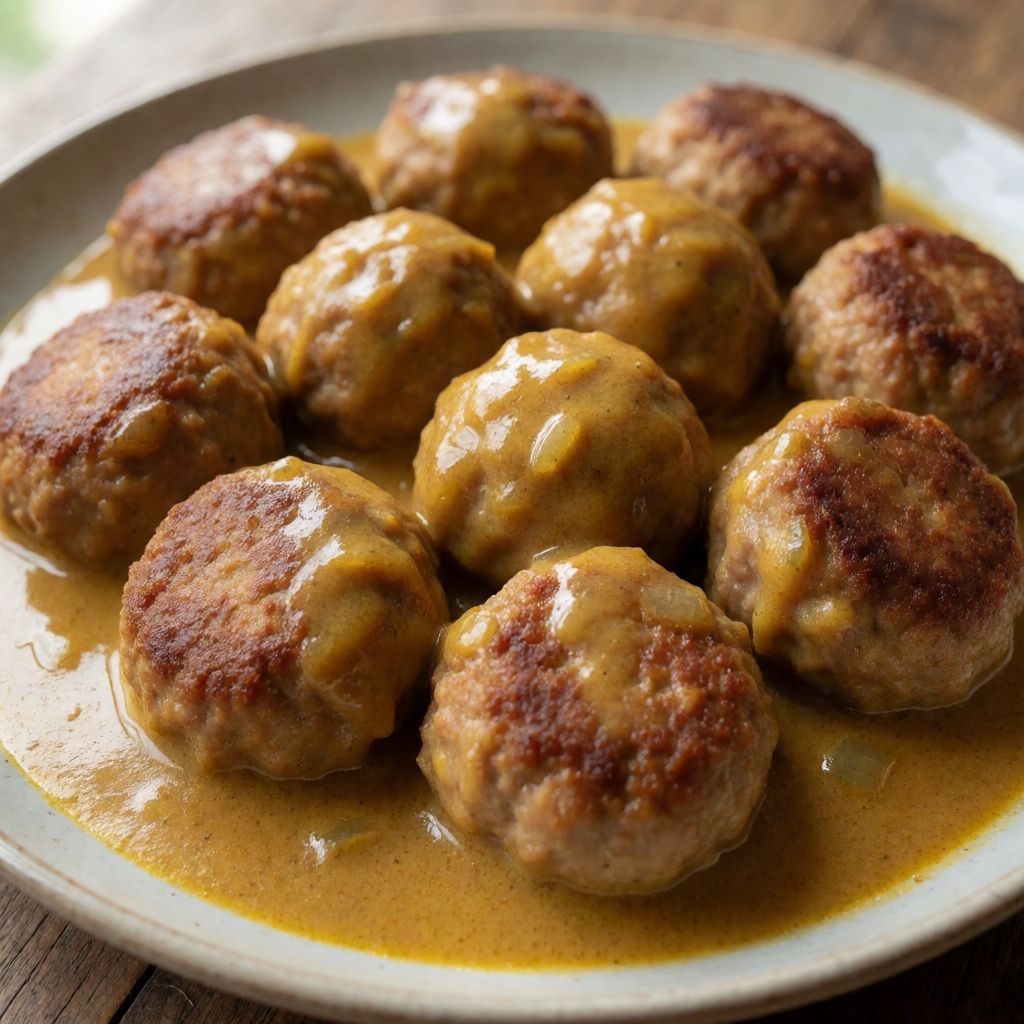
Curry Meatballs
Pork meatballs simmered in a mild curry sauce, traditionally served with rice.
Labels are worked out automatically from the ingredients and can be wrong. Check the packaging if it matters to you.
Ingredients
- 400 g Pork mince
- 1 pcs Onion finely chopped
- 50 ml Milk
- 1 pcs Egg
- 100 ml Porridge oats
- 1 tsp Salt
- 1 tsp Black pepper freshly ground
- 2 tbsp Butter
- 2 tsp Curry powder medium strength
- 1 tsp Cumin ground
- 1 tsp Ground coriander
- 3 tbsp Plain flour
- 300 ml Milk
- 300 ml Stock
- 400 ml Basmati rice
- 1 pcs Apple diced
- 1 pcs Mango diced
- 1 bunch Parsley finely chopped

















Steps
Cook the rice according to the package instructions.
18 minMix the meatball ingredients in a bowl using a mixer, and prepare the sauce while the mince rests.
5 minMelt the butter over low heat with the curry powder, coriander and cumin, then whisk in the flour until smooth.
2 minSlowly pour in the milk, stirring until the base is smooth and even.
2 minBring the sauce to the boil and add stock to reach the desired thickness. Season with salt, pepper and more curry powder if needed.
1 minShape the mince into meatballs, wetting your hands with cold water so the surface is smooth and firm.
5 minSimmer the meatballs briefly in stock, then transfer to the curry sauce — or add the raw meatballs straight into the sauce, where they will cook and flavour it.
Cover the pan and let the sauce and meatballs simmer gently on low heat for about 15 minutes, until the meatballs are cooked through. Stir occasionally with a wooden spoon so the sauce doesn't catch but the meatballs stay whole, adding more stock if needed.
15 minServe with rice; it's also lovely topped with diced apple, mango and chopped parsley.
This is a roux curry wearing a Sunday-dinner coat — meatballs instead of a joint, a sauce built the way you'd build a white sauce for cauliflower cheese, except the butter's been perfumed with curry powder, cumin and coriander before the flour goes anywhere near it. That's the whole trick of the dish, and it's worth noticing: nobody simmers a bag of dried spices in a pot of stock for an hour here, because the fat does the extracting. Spice flavour is oil-soluble, not water-soluble — curry powder stirred into hot butter for a minute releases more of itself than the same powder boiled in stock for twenty. So the roux stage isn't a thickening step you tolerate on the way to the sauce. It is the flavour step. Everything after is dilution and seasoning.
What decides whether this works is two unrelated things, and people usually only watch one of them. First: does the roux go lumpy. Second: do the meatballs hold their shape. The roux fails if you pour cold milk into hot flour-butter paste too fast, or in one go — the starch seizes around pockets of liquid before it can disperse, and no amount of whisking after the fact un-lumps it. Pour slowly, in a thin stream, whisking the whole time, and the starch swells evenly instead of in clumps. Some say pass it through a sieve if it goes wrong — no, because a sieve removes the lumps, it doesn't fix the texture; you're just serving a thinner, less-thickened sauce and pretending the problem's solved.
Pork mince is the right choice here because it carries enough fat to stay moist through a double cooking — poach or sear, then a fifteen-minute simmer in sauce — without you having to add any back in. Lean mince, beef especially, dries and toughens under that second heat; the fat renders out with nowhere to go. If pork isn't what's in, turkey thigh mince (not breast — too lean, same problem) or a pork-beef mix keeps you safer than straight beef.
The porridge oats and milk-soaked bread-equivalent role here is a panade, though nobody calls it that in a home kitchen — oats soaked in milk, swelling and turning to a soft paste that the mince gets bound around. Its job is to trap moisture inside the structure of the meatball as a kind of sponge, so that as the meat proteins tighten and squeeze out juice under heat, the oats hold that juice rather than letting it run into the pan. Leave the binder out and you get a meatball that's technically cooked but tastes dry and grainy — the texture of meat that's lost its water with nothing there to catch it. Breadcrumbs do the same job if that's what's to hand; the amount of liquid they'll absorb is roughly the same, so no need to recalculate.
Curry powder "medium strength" is doing a specific job of balance, not just heat — it's usually a blend already containing turmeric, chilli, fenugreek and more, so the cumin and coriander added alongside aren't there to repeat flavours already present, they're there to deepen the earthy, toasted register of the blend rather than its heat. If all you've got is a hot curry powder, use less of it and lean harder on the separate cumin and coriander to keep the balance — you want depth, not a mouth that's burning before the flavour's registered.
Butter rather than a neutral oil matters for the roux specifically because you want a fat that itself contributes almost nothing — any fat with no flavour of its own would behave the same way structurally, oils included, but butter's own mild dairy note sits comfortably underneath a milk-and-stock sauce rather than fighting it, which a strongly flavoured oil might. If you're avoiding dairy, a neutral oil (sunflower, a mild vegetable oil — not olive, which has a flavour of its own that'll argue with the spices) will thicken the flour just as well; you'll lose a little richness in the final sauce, which the stock and milk mostly cover anyway.
Milk and stock together, rather than either alone, is about getting body and savouriness into the same pot. Milk alone gives you creaminess but a flat, slightly sweet background; stock alone gives you savoury depth but a thinner, wetter sauce that won't cling to rice. Together, the milk's proteins and fat give the sauce the coating thickness you want on a spoon, and the stock carries the meatiness. Adjust the ratio toward more stock if the sauce feels heavy, more milk if it tastes thin — that's a texture call you make by eye at the stove, not a fixed number worth defending.
Apple, mango and parsley scattered on top at the end aren't decoration for the plate, they're there to interrupt the sauce. A spoonful of curry on its own, bite after bite, flattens out on the tongue — the fat coats and the spice blurs together. A piece of raw apple or mango brings acidity and sudden crunch back into each mouthful, and parsley brings a green, grassy note that curry powder, cooked, never has. Leave them off and the dish still works, but it works less — it's one register of flavour from start to finish instead of two talking to each other.