
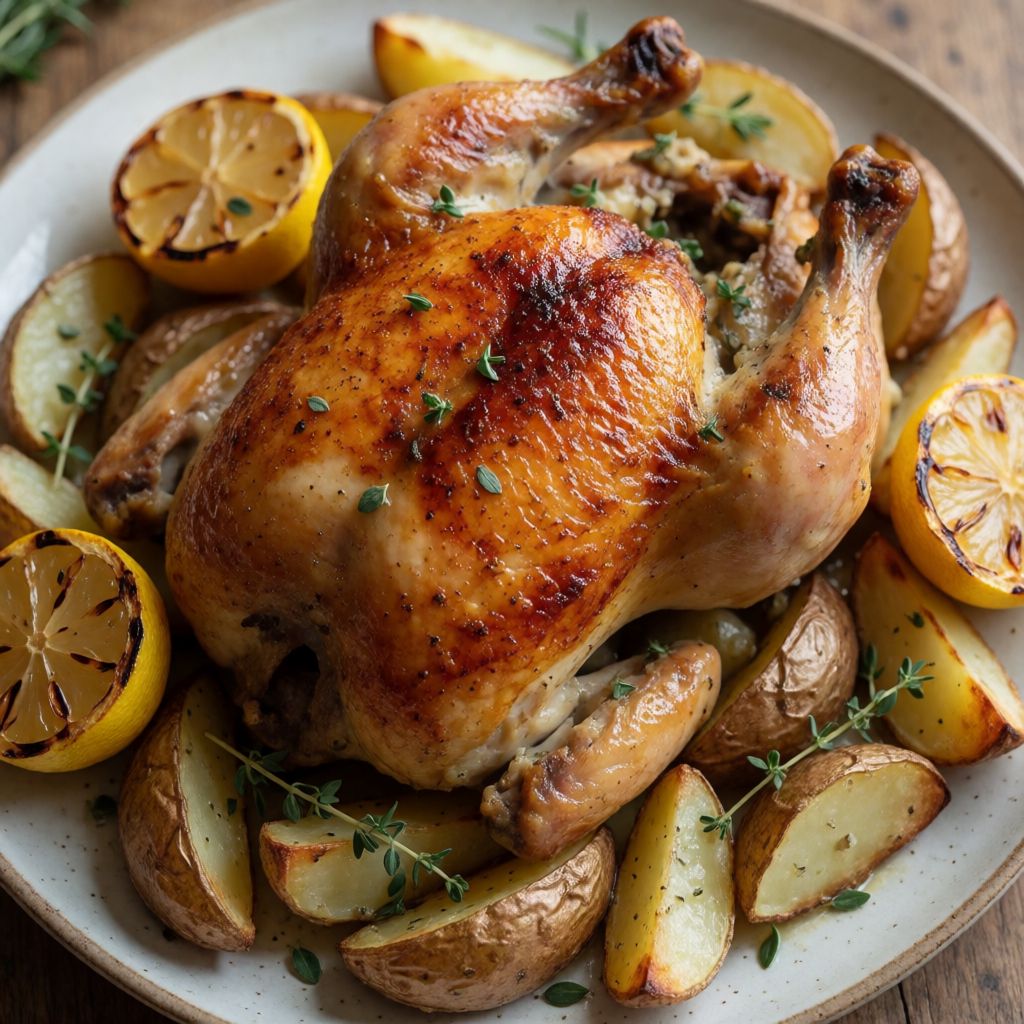
 AI photo
Mediterranean Tray-Baked Chicken
A one-tray Mediterranean chicken bake with roast potatoes, tomatoes, olives and feta, served with creamy tzatziki and rocket.
Labels are worked out automatically from the ingredients and can be wrong. Check the packaging if it matters to you.
Ingredients
- 1 kg Potatoes cut into wedges
- 800 g Whole chicken breast and thighs
- 1 pcs Lemon
- 1 tsp Oregano dried
- 1 tsp Dried thyme dried
- 1 tsp Dried rosemary dried
- 75 g Feta
- 400 g Tomatoes
- 50 g Black olives
- 2 tbsp Olive oil for roasting
- Salt
- Black pepper freshly ground
- 80 g Rocket












Tzatziki
- 500 ml Greek yogurt
- 2 pcs Cucumber coarsely grated
- 3 clove Garlic crushed
- 2 tbsp Olive oil
- Salt
- Black pepper freshly ground



Steps
Toss the potatoes with the oil, half the herbs, grated lemon zest, salt and pepper, then spread onto a baking tray.
Roast the potatoes for 25 minutes in a preheated 180°C fan oven, stirring a few times.
25 minToss the chicken with the oil, the remaining herbs, lemon zest, salt and pepper.
Arrange the chicken on the tray with the potatoes, then add the tomatoes, olives and feta.
Bake for 25-30 minutes, until the chicken is fully cooked through.
27 minCut the cucumbers lengthways in half and scoop out the seeds with a spoon.
Grate the cucumbers coarsely, salt them and leave for 5-10 minutes.
7 minTip the cucumber into a sieve and squeeze out the liquid well.
Mix the cucumber with the yogurt and season with garlic, salt, pepper and olive oil.
Toss the rocket with lemon juice, oil, salt and pepper.
Serve the Mediterranean chicken with the creamy tzatziki and rocket.
This is a Sunday roast that got tired of being one thing. Potatoes, chicken, tomatoes, olives, feta — all on the same tray, all finishing at roughly the same moment, which is the entire point of a tray bake and also the entire difficulty of one. Everything cooks at a different speed, so the trick isn't a recipe, it's a sequence: give the slow thing a head start.
Potatoes go in first, alone, because a raw potato wedge needs real time at real heat to turn its starch into something soft in the middle and caught at the edges — chicken thighs don't need anywhere near that long, and chicken breast needs even less. Stagger the start and both arrive done at the same time instead of you choosing between crunchy potato and dry chicken.
What decides whether this works is restraint with the tray, not the oven. A domestic oven tray is not a kazan and not even a proper roasting dish from a professional kitchen — it's shallow, narrow, and if you crowd it, the vegetables stop roasting and start steaming in their own juice. Spread everything in one layer with gaps between pieces. The gaps are where the browning happens.
And resist judging the chicken by the clock. "25-30 minutes" is where to start checking, not where to stop. A knife into the thickest part of a thigh, juices running clear not pink, or a probe reading properly cooked through — that's doneness. Time is just the point past which you're allowed to look.
Chicken on the bone, breast and thigh together, isn't an accident of butchery — it's insurance. Breast meat cooks faster and dries out faster; thigh is more forgiving because it carries more fat and connective tissue that keeps basting the meat from inside as it melts. Put them on the same tray and the thighs buy you a margin of error the breast alone wouldn't give you. If you only have breast, watch it harder — it goes from done to sawdust in a few careless minutes, and there's no fat reserve to save you from being distracted by the yogurt sauce.
Lemon zest, not juice, goes into the marinade with the dried herbs — zest brings the oil of the peel, which is where the actual lemon smell lives, without the acid that would start "cooking" the surface of the chicken the way it does in a ceviche, tightening the flesh before the oven ever gets to it. Juice comes later, on the rocket, cold, where acid is exactly what you want — it wakes the leaves up and cuts through the richness of everything else on the plate.
Dried oregano, thyme, rosemary: use dried here, not fresh, and not out of poverty — dried herbs survive forty-plus minutes in a hot oven; fresh ones mostly just scorch and turn bitter before the potato's even soft. If you've only got fresh, add it at the very end, scattered over the finished tray, where it can smell like itself instead of like ash.
Feta added raw to the tray in the last stretch isn't there to melt — it's a salty cheese, not a melting one, so what you're after is it softening and slumping slightly at the edges, taking on a bit of colour, while staying mostly itself. If you push it in too early it just dries out and goes rubbery. Any firm, salty, brined white cheese does the same job — a feta-style block, a young pecorino in a pinch — the criterion is "holds its shape under heat and tastes of salt," not the label on the packet.
The tzatziki is where most people lose patience, and it's the one place patience actually matters. Grated cucumber is mostly water held in by cell walls; salt pulls that water out by osmosis, and if you skip the five-to-ten-minute rest or skimp on the squeezing, that water goes straight into your yogurt and turns a thick sauce into a thin, sad one that pools on the plate. Some say you can just grate and mix — no, because you end up tasting watered-down yogurt instead of cucumber. The squeeze is the whole trick; do it properly, with your hand or a clean tea towel instead of a delicate sieve, and the sauce stays thick enough to sit on the fork.
Greek yogurt specifically, not regular yogurt, because it's already been strained once at the dairy — more protein, less water, which is exactly the texture tzatziki needs before you even start adding cucumber. Regular yogurt will work in an emergency but you're fighting the same watery-sauce problem twice over.
Garlic goes in crushed and raw, straight into the cold yogurt — it never sees heat, so there's no mellowing, no sweetness from cooking it out. That sharp, slightly aggressive bite is correct; it's there to cut the fat of the chicken skin and the roasted potato, not to be gentle. If raw garlic genuinely disagrees with you, halve it rather than cooking it — cooked garlic in a cold sauce just tastes like a different, muddier thing.
Olive oil here is doing two unrelated jobs and you don't need the expensive bottle for either. On the tray it's a heat-transfer medium and a browning agent — any neutral oil with a high enough smoke point does that job, though olive oil's flavour is part of what makes this dish taste Mediterranean rather than generically roasted. In the tzatziki and on the rocket it's raw, so there its own taste matters more — use the better oil there if you're going to be choosy about it anywhere.
This feeds four the way a Sunday roast feeds four — generously, with the tray doing visible work rather than being topped up course by course. Scale the potatoes and chicken up together if you're feeding more, but don't scale the tray size down to match a small oven; better to run two trays and swap their shelves halfway than to crowd one and end up steaming everything into a uniform greyish softness instead of letting it brown.