
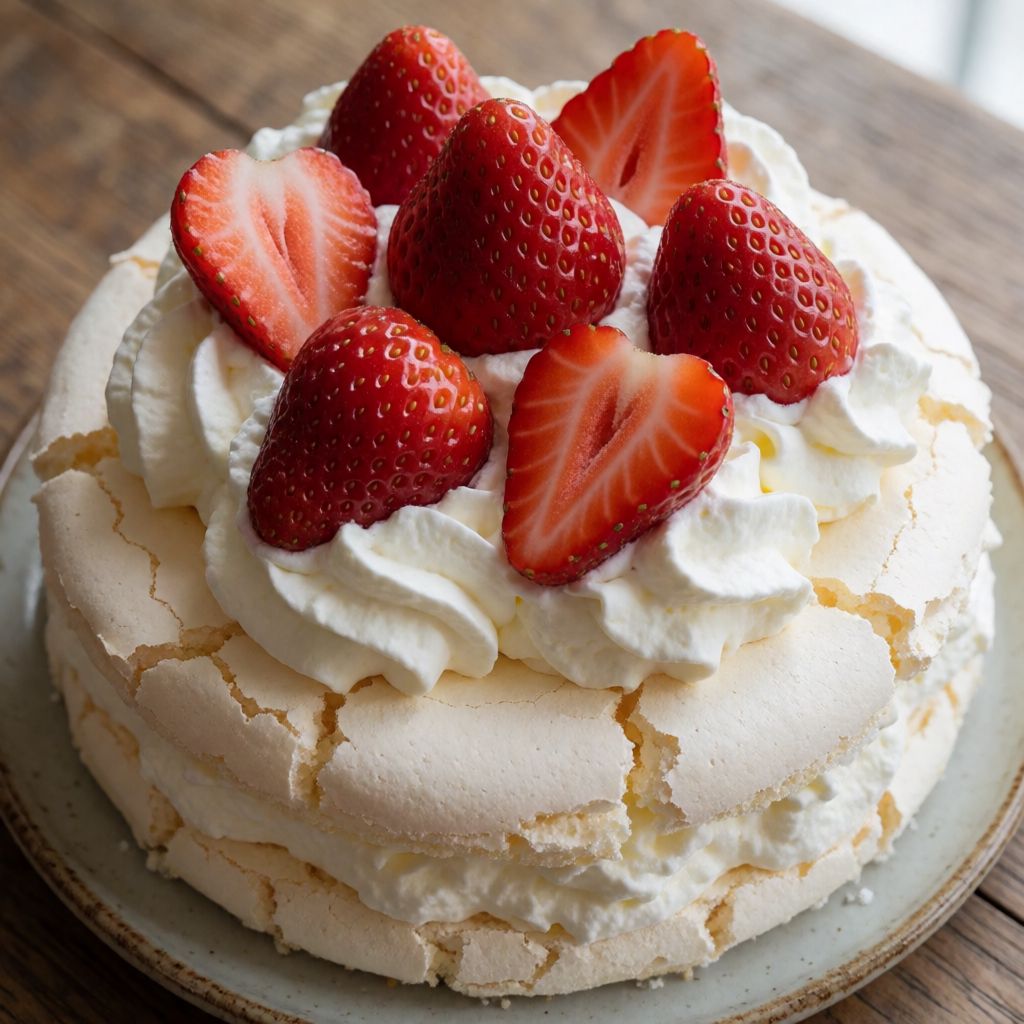
 AI photo
Meringue Cake with Strawberries
A layered Italian-style meringue cake with cream and strawberries.
Labels are worked out automatically from the ingredients and can be wrong. Check the packaging if it matters to you.
Ingredients
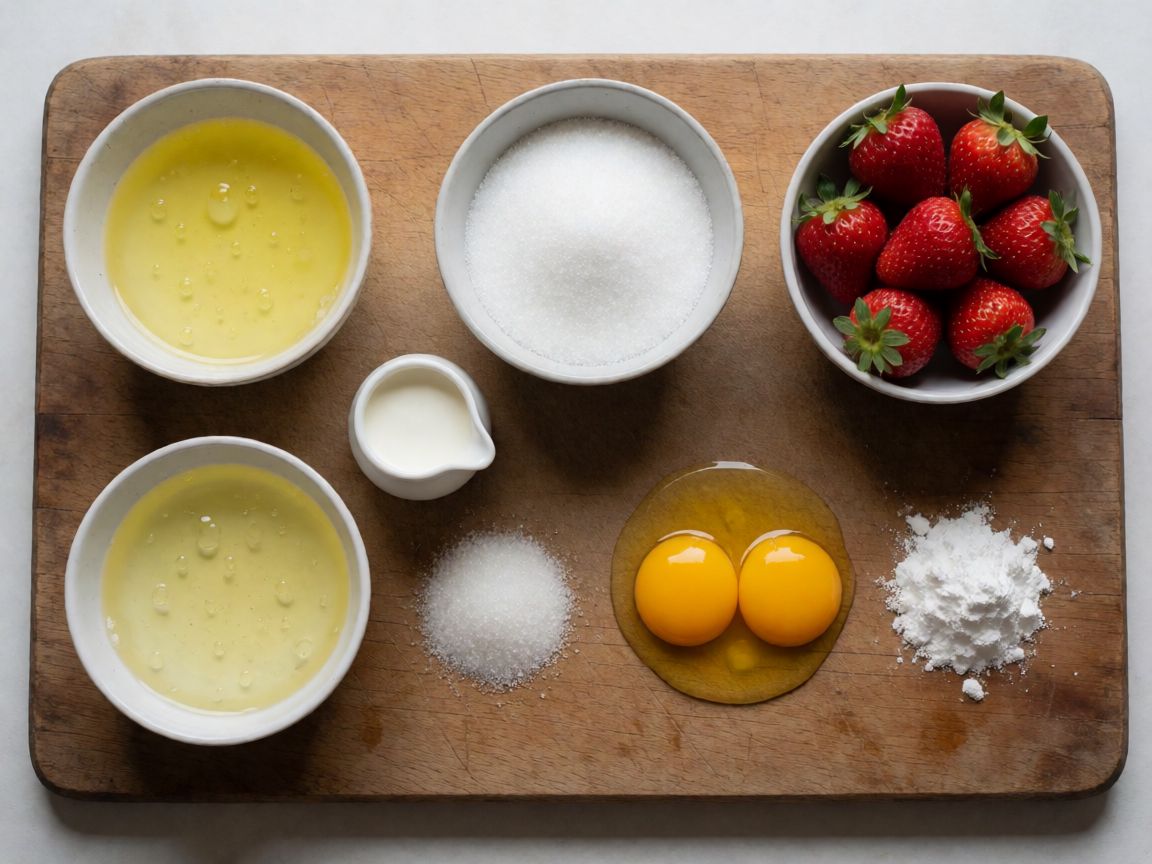
- 300 g Egg whites
- 600 g Caster sugar
- 120 g Water
- 250 g Double cream
- 200 g Strawberries
- 50 g Egg whites
- 100 g Caster sugar
- 30 g Water
- 2 pcs Egg yolks
- 15 g Cornflour
- 45 g Caster sugar
- 1 pcs Vanilla pod
- 35 g Double cream
- 135 g Milk
- 150 g Double cream
- 50 g Strawberries








Steps
Pour the egg whites into a bowl and whisk with a mixer to a thick, stable foam.
Combine the sugar and water in a saucepan, place over heat and bring the syrup to 121°C.
Pour the hot syrup into the whisked egg whites in a thin stream, continuing to whisk until the mixture cools.
On two sheets of baking paper draw 22 cm circles and fill each with a spiral of meringue from the centre to the edge.
Switch to a star nozzle and pipe meringue swirls on top of one of the spirals.
Pipe a few small meringues in the free space beside the second disc for the side decoration.
Bake the sheets in an oven preheated to 70°C, keeping the door slightly open.
240 minCrumble the cooked small meringues into small pieces.
Bring the milk, cream and vanilla to a gentle simmer.
Mix the sugar, egg yolks and cornflour, then stir into the simmering milk.
Cook the custard, stirring, until thickened, remove from the heat and cover with cling film.
4 minLet the custard cool to room temperature, then place it in the fridge.
Prepare the second batch of meringue with 50 g egg whites, 30 g water and 100 g sugar.
Gently fold the meringue into the cooled custard, then add the whipped cream and crumbled meringue.
Assemble the cake: place the spiral disc, spread the filling, arrange the strawberries.
Cover with the second meringue disc and place the cake in the freezer.
150 minCoat the sides of the cake with whipped cream and decorate with crumbled meringue.
This is a Pavlova's quieter, more architectural cousin — two meringue discs sandwiching a cold cream, a custard, a crumble of broken meringue and strawberries, built like a cake rather than served like a dessert. The question that decides everything isn't flavour, it's water. Meringue is a war against moisture, and every stage here is either removing it or keeping it away from the finished shell once it's dry.
What makes it work is the Italian meringue method — cooking the sugar into a syrup and pouring it hot into whisked whites, rather than just whisking sugar and whites cold together (that's a French meringue, and it's less stable, more prone to weeping sugar beads on the surface). The hot syrup actually cooks the egg white protein a little as it goes in, which is why this version holds its shape in swirls and piped shells instead of collapsing into a sticky puddle in the fridge.
Some say meringue needs a very hot, fast oven to "set the crust" — no, because heat is exactly what you don't want here. A hot oven browns the sugar and puffs the white with steam that then collapses as it cools, giving you that hollow, caramel-tasting biscuit you get from supermarket meringue nests. This recipe bakes at barely-warm, door ajar, for four hours — that's not baking, that's drying. You're driving water out slowly enough that the sugar crystallises into a stable lattice instead of melting and weeping.
Start with the whites. 300 g is roughly nine large eggs' worth — whisk them before the syrup goes anywhere near heat, because if the syrup overshoots and you're still cracking eggs, you've got burnt sugar and nothing to pour it into. The syrup goes to 121°C — this is not a guess-by-eye stage, get a thermometer, because under that the meringue stays soft and won't hold piped shapes, over it and the sugar starts to caramelise and you'll taste bitterness under the sweetness. No thermometer? Drop a bit into cold water — it should form a firm ball you can roll between fingers, not a thread that dissolves.
On an ordinary UK hob, this is the one place where you need to actually watch the pan rather than multitask — sugar syrup goes from "nearly there" to "too far" in under a minute once it passes 110°C. Pour it in a thin, steady stream down the side of the bowl, whisk running, not into the whisk itself or it'll spin sugar threads onto the bowl walls and never fully incorporate.
The oven stage is the one domestic kitchens get wrong most often, because 70°C with the door open sounds like nothing is happening. It is. A gap of a few centimetres (a folded tea towel wedged in the door works, or just let it sit ajar) lets steam escape instead of condensing back onto the meringue — that's what stops it turning sticky and soft on the outside after it looked perfectly dry an hour earlier. Four hours is the lower bound; the real test is a piece snapping clean and dry when you break it, not bending, not leaving tack on your finger.
The custard is a crème pâtissière, done properly: cornflour thickens it fast and holds it stable in the freezer without turning to ice-crystal slush, which plain egg-yolk custard would do. Cook it stirring constantly until it visibly thickens to coat the back of a spoon — don't walk away, egg yolks scramble silently and you won't notice until it's grainy. Cling film pressed directly onto the surface while it cools stops a skin forming, which otherwise you'd have to pick out or blend in, wasting the smoothness you just worked for.
Vanilla pod, not essence, because you want the actual seeds showing as flecks through pale custard — if you only have essence or paste, a teaspoon stirred in at the end does the job on flavour, you just lose the visual. Double cream is doing two separate jobs — whipped into the filling for lightness, and again for coating the sides — any cream with high enough fat to hold soft peaks when whipped will do, UK double cream (about 48% fat) is already the right one, don't substitute single cream, it won't whip at all.
Strawberries want to be ripe enough to give a little under your thumb, not rock-hard supermarket ones picked for shelf life — those have the acid but none of the sugar to balance the sweetness around them. Out of season, frozen and defrosted strawberries, drained well, will do for the inside layer where they're hidden in the filling; for the ones you can see, you do want fresh.
Patience is the actual ingredient list item nobody writes down: four hours drying, a long freezer set, a custard that needs to cool fully before you fold anything into it. Rush any of these and you don't get a different cake, you get a wet one.