
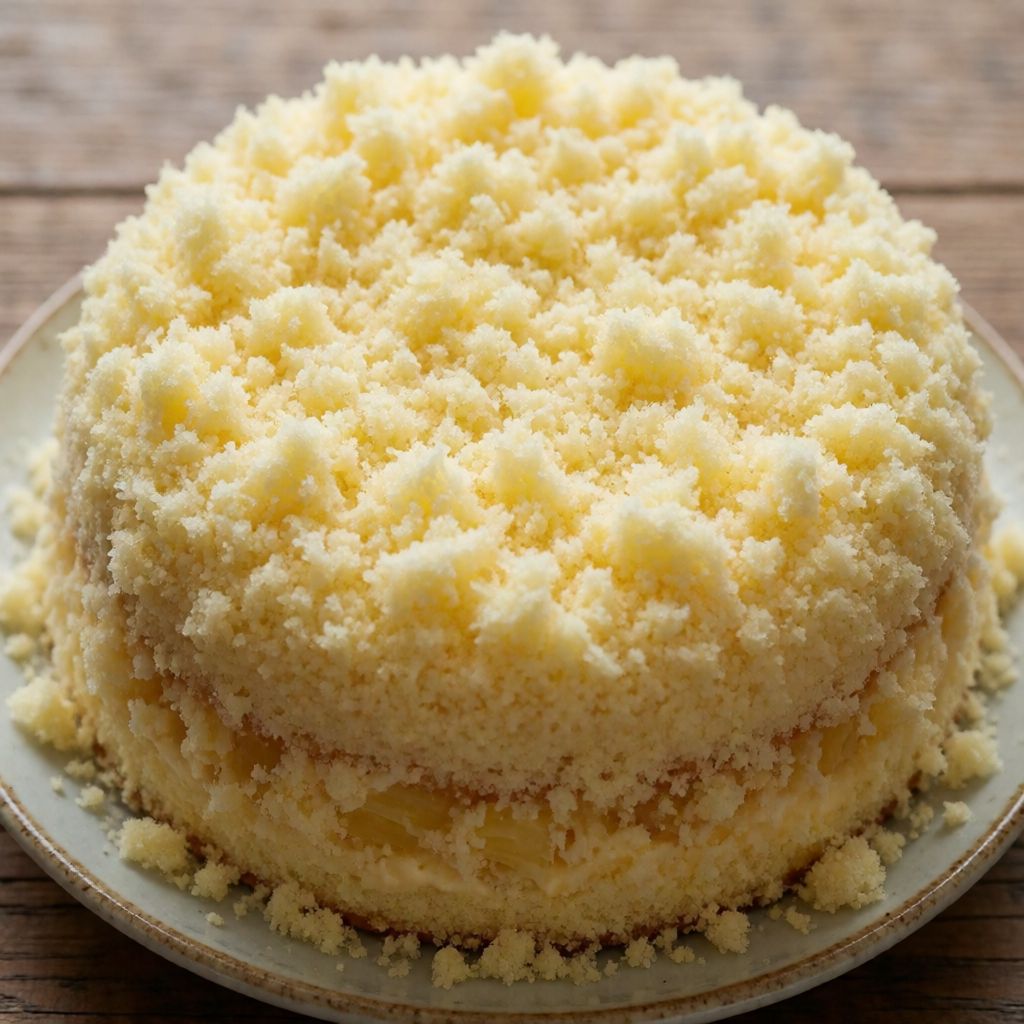
 AI photo
Mimosa Cake with Pineapple
A light sponge cake layered with pineapple diplomat cream, finished with sponge crumbs to look like mimosa blossom.
Labels are worked out automatically from the ingredients and can be wrong. Check the packaging if it matters to you.
Ingredients
- 4 pcs Eggs
- 100 g Caster sugar
- 65 g Potato starch
- 65 g Plain flour
- 1 pcs Lemon zest
- Pineapple juice to taste
- 500 ml Milk
- 130 g Caster sugar
- 4 pcs Egg yolk
- 50 g Plain flour or cornflour
- 250 ml Double cream
- 350 g Tinned pineapple
- 1 pcs Lemon zest







Steps
Whisk the eggs with the sugar until light and creamy.
Gradually fold in the sifted flour and potato starch, mixing gently from the bottom up.
Add the lemon zest and pour the batter into a buttered tin.
Bake the first sponge for about 50 minutes in an oven preheated to 170°C, conventional setting.
50 minLet the sponge cool completely.
Bake a second sponge using the same recipe.
50 minBring the milk to the boil with the lemon zest.
Beat the egg yolks with the sugar, then add the sifted flour.
Pour the hot milk in a thin stream into the yolk mixture, then remove the zest.
Pour the custard mixture into a saucepan and bring it to the boil.
Let the diplomat cream cool completely.
Whip the double cream to stiff peaks.
Fold the whipped cream into the cooled custard.
Mix in the chopped tinned pineapple.
Cut three layers from one sponge for the cake.
Soak each layer with pineapple juice and spread cream over the surface.
Cover the whole cake with the remaining cream using a palette knife.
Cut the second sponge into roughly 1 cm cubes.
Scatter the sponge cubes over the surface of the cake.
Chill the cake for about 2 hours before serving.
120 min
Mimosa isn't really a cake, it's a trick of disguise — you bake a sponge, then break half of it back down into crumbs so the whole thing can wear a yellow, fluffy coat that looks like a shaken-up mimosa flower. That's the whole idea behind the name, nothing more mystical than that. What decides whether it works is restraint in two places: not over-soaking the thin layers, and not over-whipping the cream that goes on top.
Underneath the fluff sits a diplomat cream — a pastry cream lightened with whipped double cream — and that's where the actual cooking happens. Everything else is assembly. The custard base has to actually thicken by coming to a full boil, not just steam gently and look thick in the pan, because raw flour in a half-cooked custard turns gluey and tastes of flour, not pineapple. Some say you can skip that boil if the mixture "feels right" off heat — no, because flour needs that burst of heat to lose its starchy taste and texture, cream or no cream.
The other hinge point is temperature at the end: a cold custard folded into cold whipped cream holds its air; a warm custard folded into cream collapses it, and you get pineapple soup instead of a mousse-like filling. So the long waits in this recipe — cooling the sponges, cooling the custard — aren't dead time to rush past. They're the ingredient that makes the texture work.
This isn't a show-off cake. It's three unglamorous components — sponge, custard, cream — combined with patience, and the patience is doing more work than any technique.
Start with the eggs and sugar for the sponge. Whisking them until "light and creamy" isn't decoration talk — you're beating air into the mixture mechanically, because there's no other raising agent here, no baking powder in the list. That foam is the only thing holding the cake up in the oven. If you stop whisking too early, the batter stays dense and wet-looking even after baking; if you fold the flour in badly — stirring hard instead of folding from the bottom up — you knock that air straight back out, and the sponge comes out flat and tight-crumbed. The gentle fold is there specifically to protect the bubbles you just worked for.
Potato starch alongside the plain flour is the reason this sponge stays soft rather than bready. Starch has no gluten to speak of, so it dilutes the flour's gluten-forming power and gives you a crumb that's light and a little short, closer to a Victoria sponge than a dense loaf cake. If you don't have potato starch, cornflour does the same diluting job — any starch with no flavour of its own and no gluten, that's the real criterion, not the brand on the box.
For an ordinary British kitchen, "conventional setting" at 170°C means don't use the fan if your oven has one, because a fan dries the surface of a sponge faster than the inside cooks, and you get a tough skin over a pale middle. The 50 minutes is a floor, not a verdict — a skewer coming out clean, or the sponge springing back when you press it lightly, tells you it's actually done; a domestic oven running a bit hot or cold will shift that number around by ten minutes either way, and that's normal, not a failure.
The custard stage is where most mimosa cakes go wrong, and it comes down to one thing: pouring the hot milk into the yolks "in a thin stream" while you keep stirring. That's tempering — bringing the yolks up to heat gradually so the proteins set slowly into a smooth cream, instead of hitting a wall of heat all at once and scrambling. Some believe a water bath is the only safe way to cook egg yolks without curdling them; no, because tempering plus a gentle hand over the heat does the same protecting job without an extra pan to wash. Bringing the mixture fully to the boil afterwards is non-negotiable for the flour reason already mentioned — taste it afterwards and you'll notice it's clean, not pasty.
The double cream has one job: whipped to stiff peaks, it carries air into the custard the way the eggs carried air into the sponge. Whip it too far, past stiff into grainy and separating, and when you fold it into the custard the cream breaks rather than lightens it — so stop the moment it holds a peak that just about stands, don't chase extra firmness. Any cream with enough fat to whip stiff will do this job; in the UK that's double cream itself, no substitute needed, since it's sold everywhere and this is exactly what it's for.
Tinned pineapple earns its place for practical reasons as much as flavour — fresh pineapple contains an enzyme, bromelain, that breaks down proteins and would slowly turn your cream watery and thin over the two hours it needs to chill; the tinning process cooks that enzyme to death, which is why tinned is specified and not a swap you should casually reverse. The syrup from the tin, or straight pineapple juice, becomes your soaking liquid for the thin sponge layers — soak lightly, a brush or spoon pass is enough, because three thin layers plus sauce can slump into a soggy stack if you drown them, and there's no outer sponge wall here to hold a wet filling in.
The final move — grating or cubing the second sponge and scattering it over the cream-covered cake — is the whole point of baking two sponges in the first place. You're not wasting a cake, you're manufacturing crumbs on purpose, in a texture a food processor or a fork can't quite replicate as well as a knife cutting clean 1cm cubes by hand. A kazan or a show-off piping tip has no role here; a wide bowl, a palette knife and a chopping board are the entire equipment list, and that's honestly all a flat kitchen needs for this one. This is a cake for six, and the long chill at the end is the last patience test — rush it and you're serving warm custard with crumbs on top rather than a cake that holds its shape when you cut into it.