
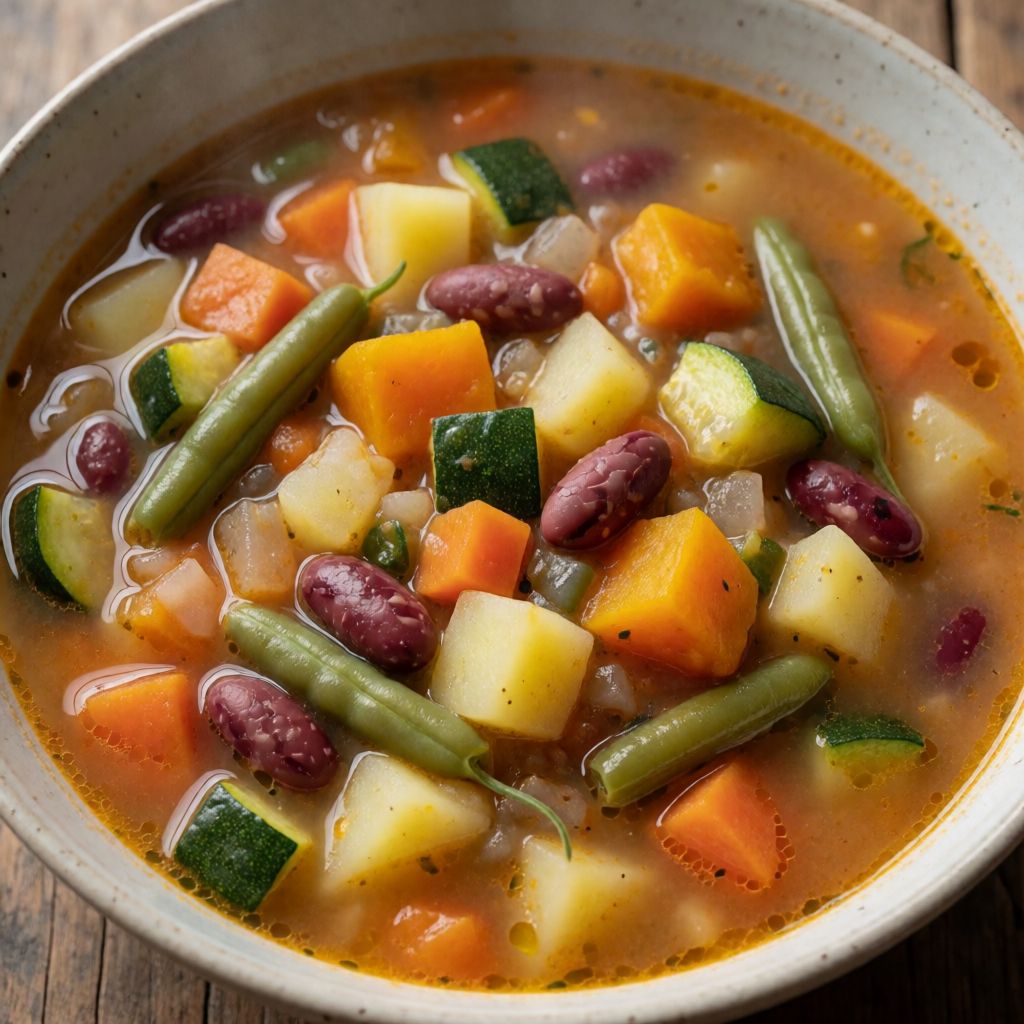
 AI photo
Genoese Minestrone
A Genoese-style vegetable soup, slowly simmered with a medley of vegetables and finished with pesto and parmesan.
Labels are worked out automatically from the ingredients and can be wrong. Check the packaging if it matters to you.
Ingredients
- 150 g Potato
- 150 g Courgette
- 150 g Pumpkin
- 150 g Green beans
- 100 g Borlotti beans
- 100 g Carrot
- 100 g Celery sticks
- 150 g Aubergine
- 150 g Leafy green vegetables
- 1 pcs Onion
- 1 clove Garlic
- 1 pcs Rosemary
- 6 tbsp Pesto
- 300 g Soup pasta
- Olive oil to taste
- Salt to taste
- Parmesan to taste














Steps
Wash and clean all the vegetables thoroughly, then cut them into the smallest pieces possible.
Pour a few tablespoons of olive oil into a wide pot, add the finely chopped onion and garlic, and sauté gently until golden.
Add the chopped vegetables, let them cook briefly, then cover generously with water.
Season with salt and add a sprig of rosemary for extra aroma.
Simmer the vegetable soup on a low heat (up to 2-3 hours).
Remove the rosemary sprig and lift out the vegetables with a slotted spoon.
Place the vegetables on a plate and mash with a fork into a creamy texture.
Return the mashed vegetables to the pot and stir through.
Add the soup pasta and cook according to the packet instructions.
Stir in the pesto, adjust the seasoning and remove from the heat.
Serve warm, generously sprinkled with parmesan.
What was changed
Borlotti beans is used instead of butter beans, matching the original's borlotti beans.
Minestrone alla Genovese is not really a vegetable soup with pasta thrown in — it's a vegetable soup that spends two or three hours quietly turning itself into a sauce, and pasta is just the thing that finally gives that sauce somewhere to sit. Nine vegetables, cut small, go into water and more or less dissolve. That's the whole trick: patience doing the work a blender would do in ten seconds, except slower and with better flavour, because nothing gets torn, it gets coaxed.
What decides whether it works is restraint at two ends. At the start, don't rush the onion and garlic — gold, not brown, because browned garlic turns bitter and you'll taste it for the next two hours, in every spoonful. At the end, don't let the pesto near real heat: basil cooked loses its green smell and turns into something flat and grassy. Pesto goes in off the flame, stirred through, not simmered.
The genius of the dish, if you want to call it that, is economic before it's culinary: this is what a Ligurian household did with whatever vegetables were lying around and getting soft — potato, courgette, pumpkin, beans, whatever the garden gave that week. The exact nine vegetables are a guide, not a law. Some say there's one true minestrone — no, because the whole point of the dish was never having to buy anything special.
Cut everything small, and actually mean it — not "diced" the way a recipe book means it, but small enough that two or three hours of low simmering can break it down without you doing anything violent to it. Big chunks of carrot or potato will cook through fine, but they won't fall apart, and falling apart is the entire job of this stage. You're not making vegetables tender, you're making them disappear into the liquid around them.
The onion and garlic stage matters more than its one line in the method suggests. Gold is the colour you want — pale honey, soft, translucent at the edges — not the deep amber you'd chase for a French onion soup. On a domestic hob this means a flame low enough that you can walk away for a minute and come back to no damage; if your biggest ring runs hot, start on the second-biggest instead. Garlic burns fast once the onion's moisture stops protecting it, and burnt garlic is sharp and acrid in a way no amount of simmering later will undo.
The long simmer — up to two or three hours — is not there to make the vegetables edible, they'd be edible in twenty minutes. It's there to extract starch and break cell walls so the vegetables can later be mashed into something with body, almost a purée, rather than staying as separate bits floating in broth. This is the step people skip, and it's the one that actually makes the soup what it is rather than just a lot of boiled veg. Patience is an ingredient here, the same way flour is an ingredient in bread — leave it out and you have something else, not a faster version of the same thing.
Potato brings starch and body — it's doing some of the thickening work alongside the mashing. Courgette and aubergine break down almost completely and add sweetness without much fight. Pumpkin does the same, plus a little colour and roundness. Green beans and borlotti beans give you something that holds a bit of shape and bite even after the long cook, so the soup isn't uniformly soft — beans don't surrender like courgette does. Carrot and celery are the aromatic backbone, the same pairing that underpins half of Italian cooking, there for savoury depth rather than bulk. Leafy greens — chard, cavolo nero, even spinach in a pinch — go in for a slight bitterness that cuts the sweetness of everything else; use whatever dark leaf is in the fridge, that's exactly the spirit of the dish.
Rosemary is there for scent, not flavour you taste directly — pull the sprig before it starts tasting resinous and medicinal, which it will if left in too long. Pesto, stirred in at the end off the heat, is what turns a good vegetable soup into something distinctly Genoese; any oil-based basil paste works, but one with real basil smell, not the jarred stuff that tastes mostly of pine nuts and nothing green. Soup pasta — small shapes, ditalini or similar — cooks directly in the pot to packet time, no draining, no separate pan; a wide pan at home does this job just as well as any kazan-shaped pot would, the width just means more surface for the water to reduce down as it goes. Parmesan at the table, generously, because it's salty and sharp in a way that wakes the whole bowl up after an hour of gentle flavours. Eight people from these quantities, assuming it's the main event of the meal and not a starter before a roast.