
 AI photo
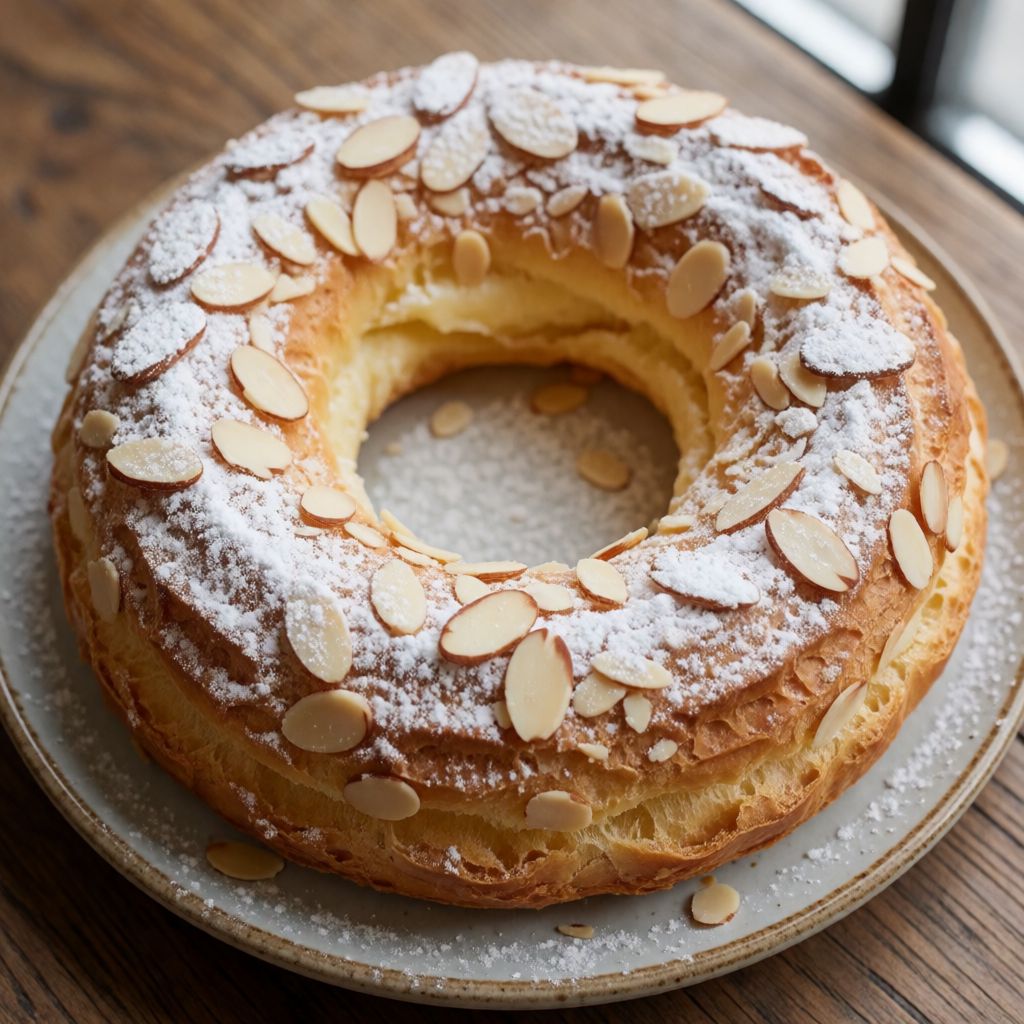
Paris-Brest
A French ring-shaped choux pastry filled with lemon-scented mousseline cream, topped with almond flakes and icing sugar.
Labels are worked out automatically from the ingredients and can be wrong. Check the packaging if it matters to you.
Ingredients
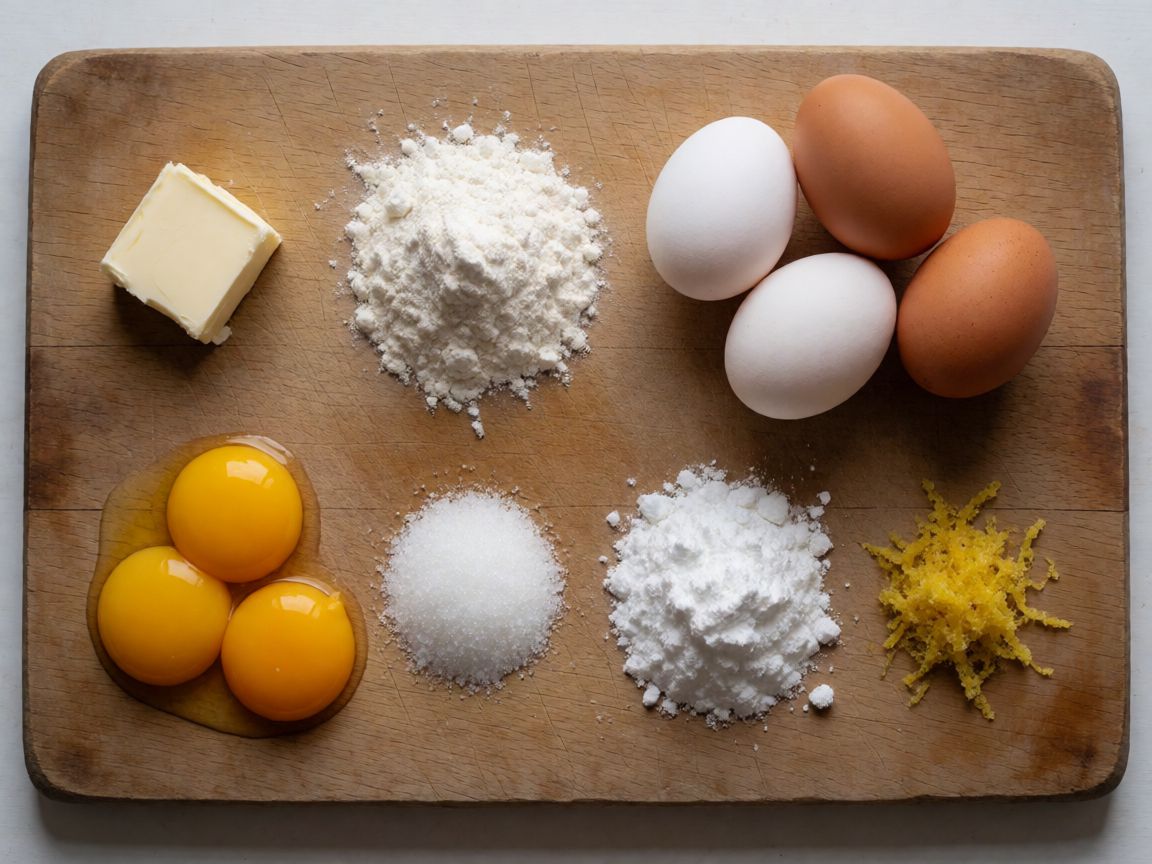
- 125 ml Water
- 90 g Butter
- 1 pinch Salt
- 125 g Plain flour
- 4 pcs Eggs
- 3 pcs Egg yolk
- 80 g Caster sugar
- 15 g Plain flour
- 10 g Cornflour
- 1 pcs Lemon zest
- 250 ml Milk
- 125 g Butter
- 2 tbsp Milk
- 1 tbsp Almond flakes
- 1 tbsp Icing sugar












Steps
Start with the mousseline cream: in a saucepan, combine the egg yolks and caster sugar and whisk vigorously. Add the plain flour and cornflour and whisk until smooth.
Heat the milk together with the lemon zest so it releases its aroma, then strain and pour in a thin stream into the egg mixture, whisking continuously.
Set the pan over a medium heat and, stirring constantly, bring to the boil. Let the cream thicken, cooking on a low heat for 2-3 minutes.
3 minTake off the heat and leave the cream to stand for 10 minutes to cool slightly.
10 minBeat half the butter into the warm cream, cover with cling film and leave to cool completely to room temperature.
Add the remaining butter and beat the cream with an electric mixer for 2 minutes, until it turns silky and smooth.
2 minChill the mousseline cream for at least 1 hour.
Pour the water into a heavy-based saucepan, add the butter and salt. Set over a medium heat, stir with a wooden spoon and bring to the boil.
Lower the heat, tip in all the flour at once and beat vigorously. Keep beating for 2 minutes, until the dough comes away from the sides of the pan.
2 minTransfer the dough to a mixer bowl and beat briefly to let it cool slightly.
Beat in the eggs one at a time, mixing well after each addition, until the dough is thick and smooth.
Spoon the choux dough into a piping bag, either plain or fitted with a star nozzle.
On a sheet of baking paper draw a 20 cm circle, turn the sheet over and pipe a thick ring of choux dough along the circle.
Pipe another ring around the first, then a third ring on top of the two previous ones.
Brush the surface with a little milk and sprinkle with almond flakes.
Heat the oven to 200°C on conventional (top and bottom) heat. Once hot, place the Paris-Brest in the middle of the oven and bake for 20 minutes.
Lower the temperature to 175°C and bake for a further 25 minutes.
25 minOpen the oven door slightly to let out the steam, and bake for a further 5 minutes.
5 minLeave the Paris-Brest to cool in the switched-off oven with the door slightly open.
Transfer the ring to a board and cut it in half horizontally with a serrated knife.
Spoon the mousseline cream into a piping bag fitted with a star nozzle and generously fill the bottom half of the Paris-Brest.
Cover with the top half, dust with icing sugar and serve.
Paris-Brest is choux pastry — the same dough that makes profiteroles — piped into a ring, split, and stuffed with a praline-less mousseline cream. The ring shape is not decoration. The story goes it was made in 1910 for a cycling race between Paris and Brest, and the ring is a wheel. True or not, the shape earns its keep for a different reason: a ring bakes more evenly than a dome, because there's no thick centre to stay wet while the edges scorch.
What decides whether this works is two separate crafts meeting at the right moment. The choux has to be dry and hollow inside, sturdy enough to be sliced like a bread roll without collapsing. The cream has to be cold, dense and holding its shape — not the loose custard you'd pour over fruit. Get either one wrong and you have a sandwich of soggy bread and runny jam, which is not the same dessert at all.
Some say choux pastry is difficult. It isn't difficult, it's exacting — there is a right moment to add the flour, a right moment to add the eggs, and the dough tells you both if you watch it instead of the clock. The two enemies here are raw dough that collapses in the oven and a shell that's dry on the outside but gluey inside, and both come from doing the same thing: rushing the drying-out stage on the hob, or opening the oven too early.
Mousseline cream is pastry cream with butter beaten through it twice — once warm, once cold — and that double beating is the whole trick. It's what turns a custard, which slumps, into a cream that pipes into neat ridges and holds them even at room temperature on a tea tray.
The choux dough starts with water, butter and a pinch of salt boiled together, then flour tipped in all at once and beaten hard on the heat. This isn't just mixing — it's cooking the starch so the flour can absorb far more moisture than it would raw, which is the whole reason this dough can later hold enough egg to puff properly. The sign you're looking for is the dough pulling away from the pan sides in one mass, sheen rather than wetness. Two minutes is the lower bound — watch the dough, not the clock.
The eggs go in afterwards, off the direct heat, one at a time. Why one at a time, and why does it matter if you dump them all in together? Egg is mostly water bound in protein, and the dough can only take on so much liquid before it curdles into lumps instead of emulsifying smooth. Beating each egg in fully before the next keeps the fat and water married. Four whole eggs plus however much the dough will accept — if yours stops looking glossy and starts looking slack, stop; a too-wet dough won't hold its ring shape and won't puff into a hollow shell, it'll bake into a dense biscuit.
Butter here needs no flavour of its own beyond butter — 90g for the choux, no substitute that brings its own taste, because there's nothing else in the dough to hide behind. The flour is plain, not strong bread flour — you want structure, not chew.
For the oven: three stages, and each does a different job. The first blast at 200°C is what makes the choux puff — steam trapped inside the dough forces it to expand before a crust sets. Drop to 175°C and the inside has time to dry rather than just colour. Then the door cracked open at the end lets the trapped steam escape instead of condensing back into the shell as you cool it — this is the single step that stops a Paris-Brest going soft an hour after it leaves the oven. If your oven runs hot or has no fan, trust the colour and the hollow sound more than the dial. Leaving it to cool in the switched-off oven, door ajar, is doing the same job slowly instead of all at once.
The cream: egg yolks and sugar whisked first, because sugar poured straight onto raw yolk and left sitting will start to cook the yolk's surface and give you lumps — whisking disperses it before that happens. Flour and cornflour together, not just one — the cornflour sets a cleaner, glossier set; plain flour alone gives a slightly cloudier, more cake-like body. Milk infused with lemon zest and then strained is there for scent, not thickening — don't skip the straining or you'll be biting into bitter white pith later.
The double butter-beating — half into the warm cream, the rest once it's fully cooled — is not fussiness for its own sake. Butter beaten into hot cream melts and simply disappears, giving you shine but no real structure; butter beaten into cold cream whips in as tiny air-trapping particles, which is what gives mousseline its lightness and its ability to hold a piped ridge. Skip the second beating and you've made a rich custard, not a mousseline — it'll taste similar in the first bite and slump by the third.
If you have no stand mixer, a hand whisk works for all of this; it just asks more patience from your arm, and patience is the one ingredient this recipe can't do without at any stage. A domestic oven with no steam injection is fine — choux doesn't need added steam, it makes its own from the water already in the dough, which is one reason this recipe suits an ordinary flat kitchen better than people expect.