
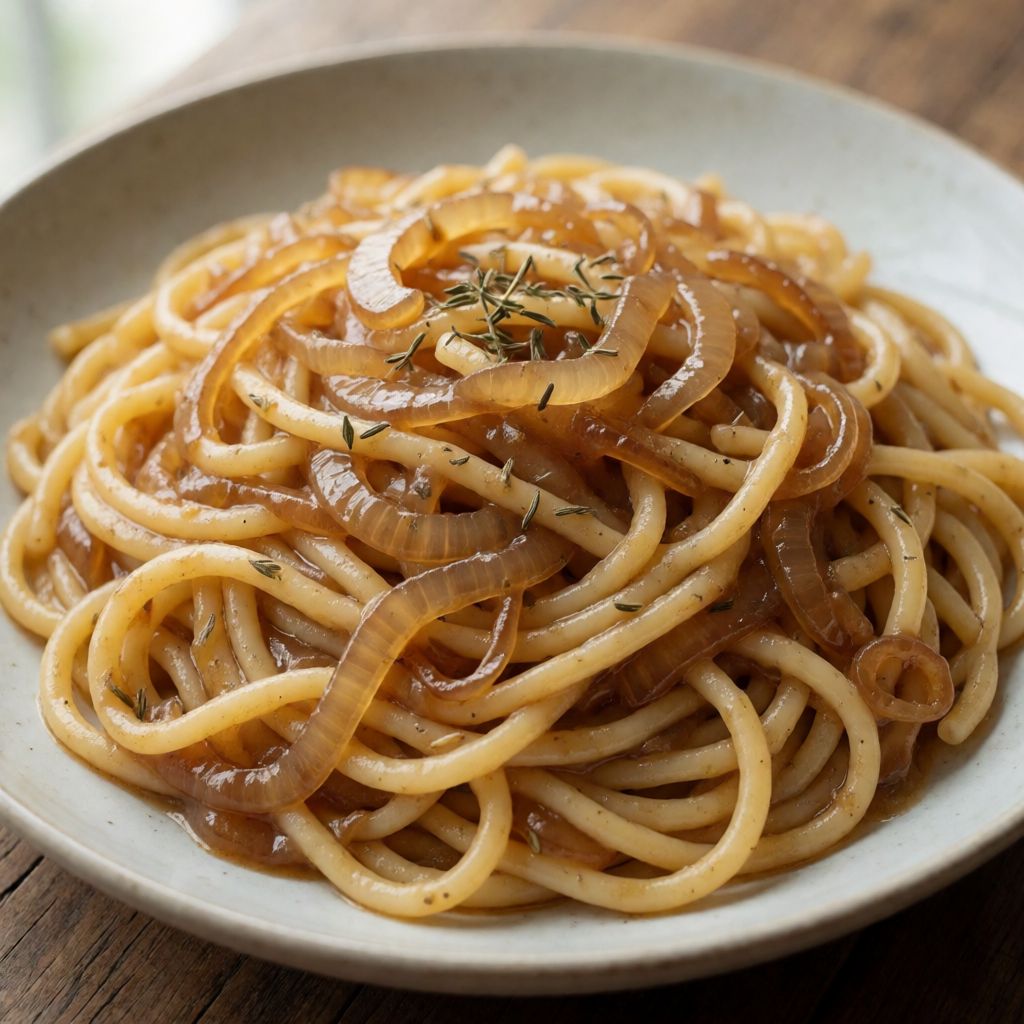
 AI photo
French Onion Pasta
A pasta dish built on sweet, slow-cooked caramelised onions, finished with cream and melted cheese.
Labels are worked out automatically from the ingredients and can be wrong. Check the packaging if it matters to you.
Ingredients
- 4 pcs Onion halved and thinly sliced
- 3 clove Garlic finely chopped
- 1 tsp Dried thyme
- 100 ml White wine
- 400 g Pasta
- 800 ml Stock
- 100 ml Double cream
- 1 tbsp Balsamic vinegar
- 175 g Emmental coarsely grated
- 1 bunch Parsley leaves, finely chopped
- 15 g Butter for frying
- 1 tbsp Olive oil for frying
- Salt to taste
- Black pepper to taste, freshly ground











Steps
Put the onion into a pan with the oil and butter and fry over medium-low heat for 30 minutes, stirring occasionally, until the onion is soft, sweet and lightly caramelised.
30 minAdd the garlic, thyme, white wine, pasta, stock and double cream. Stir well for 5 minutes, cover and bring to the boil.
5 minSimmer for about 10 minutes, or until the pasta is cooked. Season with salt, freshly ground pepper and balsamic vinegar, add the coarsely grated Emmental and stir well until the cheese melts and the sauce is smooth.
10 minServe immediately, sprinkled with parsley leaves and freshly ground pepper.
What was changed
Whipping cream was replaced with Double cream, the cream British cooks keep on hand.
This is French onion soup that gave up on being a soup and married a plate of pasta instead — the stock, the caramelised onion, the cheese pull, all present, just poured straight onto the carbohydrate that would otherwise sit next to it in a bowl. One pan, one washing-up, which is the whole point of it on a weeknight.
What decides whether it works is step one, and it is the only step with any real stakes. Four onions, sliced thin, going in with butter and oil over heat gentle enough that you could hold a conversation next to it — this is not "medium heat" as a vague gesture, it is heat low enough that the onion softens and releases sugar before it browns, rather than browning on the outside while staying raw and sharp in the middle. Thirty minutes is the lower bound, not the instruction. You know it's done by colour and smell: pale gold sliding into something closer to amber, a smell that's gone from sharp and eye-watering to sweet, almost like toffee with an edge. If you rush this with high heat, you get bitter, patchy onion and a sauce that tastes of nothing but raw onion sting later, because there's no later stage in this recipe that fixes it — everything else just builds on top of whatever you did here.
The pasta itself matters less for shape than for surface — go for something with ridges or a tube, penne, fusilli, rigatoni, because the sauce here is loose and cheese-heavy and needs somewhere to cling. A long thin strand like spaghetti will mostly slide past it. Check doneness by biting a piece, not by the clock on the box; the liquid ratio here isn't identical to a pot of boiling water, so it can run a touch faster or slower.
The stock is the bones of the thing, standing in for the beef stock of the original soup; a good chicken or vegetable stock does the job, the test is simply that it should taste of something on its own before you add anything else to it — if it tastes of nothing, no amount of cheese later will rescue it. Any dry white wine with no real sweetness works for the wine; if you don't want to open a bottle for 100ml, a splash of extra stock with a squeeze of something sharp — lemon or more of the balsamic — gets you the acidity without the alcohol, because that's the wine's actual job here: cutting the richness of the cream and cheese, not flavour for its own sake.
Emmental is chosen for one reason — it melts smooth and stretchy without turning oily or grainy, the way a hard, aged cheese like a mature cheddar can when it gets too hot. Any cheese with the same low-protein, high-moisture melting behaviour will do: Gruyère, which is the more traditional choice for an actual French onion soup and arguably a better one if you have it; a mild Swiss-type cheese at a push. Stir it in off the boil, or close to it — cheese added to a hard-rolling boil can split into grease and curd, which is the defect you're protecting against by waiting until step three to add it and turning the heat down first.
Double cream and balsamic vinegar are opposites doing the same job from either side: one rounds the sauce out, the other stops it being sickly. Taste before you decide how much balsamic — a tablespoon is a starting point, not a commandment, because vinegars vary enormously in sharpness.
Thyme, dried here for convenience, is doing what it always does with onion and beef-adjacent stock — it has an earthy, slightly medicinal note that plays well against sweetness. Fresh thyme works too, use more of it, since dried herbs are concentrated by losing their water.
This is a one-pan dish built for a flat with one hob and no wide enough kazan or le creuset to pretend otherwise — just use the widest pan you own so the onion has room to sit in a layer rather than stew in a heap, and once the pasta goes in, cover with a plate or a tight layer of foil if you don't own a lid that fits. The patience is front-loaded: give the onion its full half hour honestly, because every minute you steal from it there, you'll be tasting at the table.