
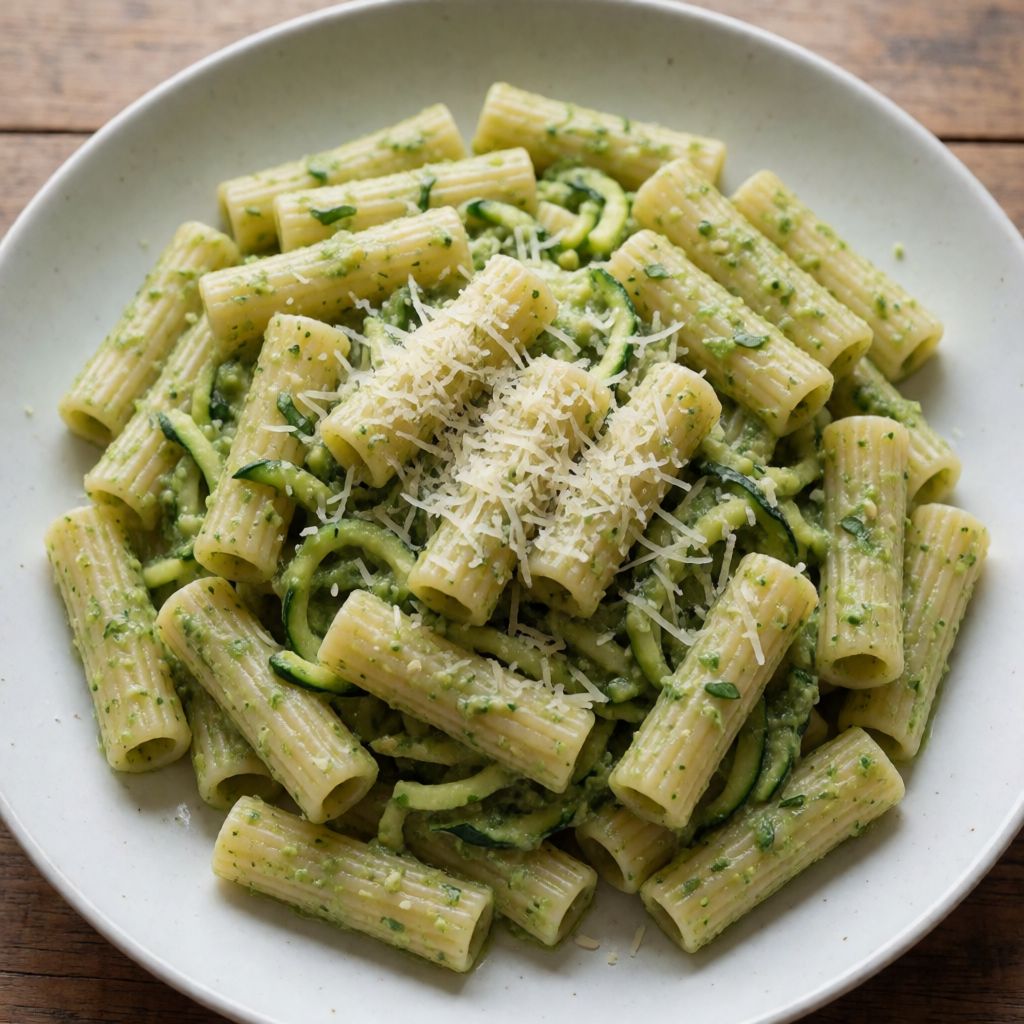
 AI photo
Pennoni Rigate with Basil, Courgette and Hazelnut Pesto
Pennoni rigate tossed with a fresh basil, courgette and hazelnut pesto, topped with prawns.
Labels are worked out automatically from the ingredients and can be wrong. Check the packaging if it matters to you.
Ingredients









Steps
Cool 3 blanched courgettes and place them in a blender. Add the basil, salt, pine nuts, hazelnuts, garlic, Parmesan, black pepper and olive oil. Blend until creamy.
Fry the remaining 2 courgettes, sliced into rounds, in olive oil in a pan.
Add the prawns and cook until they reach an internal temperature of 63°C. Season with salt.
Cook the pasta in salted water until al dente, then drain.
Toss the pasta with the pesto in the pan. Add a little pasta water if needed for consistency.
Serve immediately.
This isn't basil pesto with a vegetable added for virtue's sake — it's the other way round. Three courgettes do the bulk work that basil leaves usually do, and basil, nuts, garlic and cheese are there to remind the sauce which family it belongs to. Pesto means "pounded" or blended raw with oil — that's the method, not a fixed guest list. Liguria used pine nuts because pine trees grew there; here hazelnuts step in, cheaper and just as fatty, and courgette stretches the basil because basil, fresh and in quantity, has never been cheap in a British supermarket either.
What decides whether this plate works isn't the blending — a blender doesn't fail you — it's the frying pan with the remaining two courgettes and the heat you give it. Courgette is mostly water held in a thin green skin. Crowd the slices in a pan that isn't hot enough and they stop frying and start steaming in their own juice: grey, limp, sweating onto the plate. You want the oil visibly moving, almost shimmering, before the rounds go in, and you want space between them — on a domestic hob, that usually means two batches, not one brave one.
The prawns are not the main event, only an accent — 150g against 400g of pasta tells you that. Their doneness isn't a clock question either: raw prawn flesh is grey and slightly translucent, cooked it turns opaque and pink and curls into a loose C. If it curls into a tight, clenched O, you've gone past the point and the texture turns rubbery — that's the real cause of "tough prawns," not the prawns themselves.
Blanch the three courgettes for the sauce and then actually let them cool before they go anywhere near the blender — this is the one place patience is doing real work. Blend them hot and the basil blackens almost instantly from residual heat, the cheese starts to seize slightly, and the extra heat drives more water out of the courgette flesh than you want, thinning the sauce before you've even seasoned it. Blanching itself isn't about cooking the courgette through — it's about softening it enough to blend smooth and fixing the colour, so the flesh goes from pale and raw to a deep matte green rather than the dull khaki you get from overcooking.
Basil here is a flavour concentrate, not a vegetable — one plant, used whole, has to carry the smell of basil through a sauce that's mostly courgette. Bruised or wilted leaves won't do that; you need it fresh enough to smell sharp and green when you tear it, because there's nothing else in the blend doing that job. If you can't get decent basil, don't bother chasing a substitute that tastes like basil — there isn't one — use less courgette instead and let the dish lean more savoury, less herbal.
Hazelnuts and pine nuts together give fat and a faint sweetness rather than crunch, since everything's going into a blender — their job is texture in the mouth of the sauce, not texture on the tooth. If you only have one or the other, use more of it; the two aren't doing different jobs, just different notes of the same job. Parmesan's role is salt, savoury depth and a little grit that stops the sauce tasting purely of oil and nuts — any hard cheese that grates into dust rather than shreds into string will do the same work: pecorino, grana padano, even an aged cheddar if you want to admit this dish has quietly moved to Britain.
Garlic goes in raw, one clove, because raw garlic's sharpness is the only aggressive note in an otherwise soft, fatty sauce — it's there to cut, not to dominate, which is why one clove and not three. Olive oil in the blender should taste of something; it's going in uncooked and you'll taste it directly, so a bland bottle wastes the point of using olive oil at all. For frying the second batch of courgette, the logic flips — any oil with no strong smell of its own will do there, since the courgette and the browning are the flavour, not the oil, so a neutral vegetable or sunflower oil is no loss if that's what's in the cupboard.
Pennoni rigate is a ridged tube, and the ridges aren't decoration — they're surface area for a thick, clingy sauce to catch on. A smooth pasta shape just lets this pesto slide off and pool at the bottom of the bowl. Any ridged tube — rigatoni, penne rigate — does the same job; smooth penne or spaghetti doesn't, however close the name looks on the box.
Served this way it's a main course for four, not a side, which is worth knowing before you portion it next to anything else from a Sunday table — there's nothing else this dish is waiting for.