
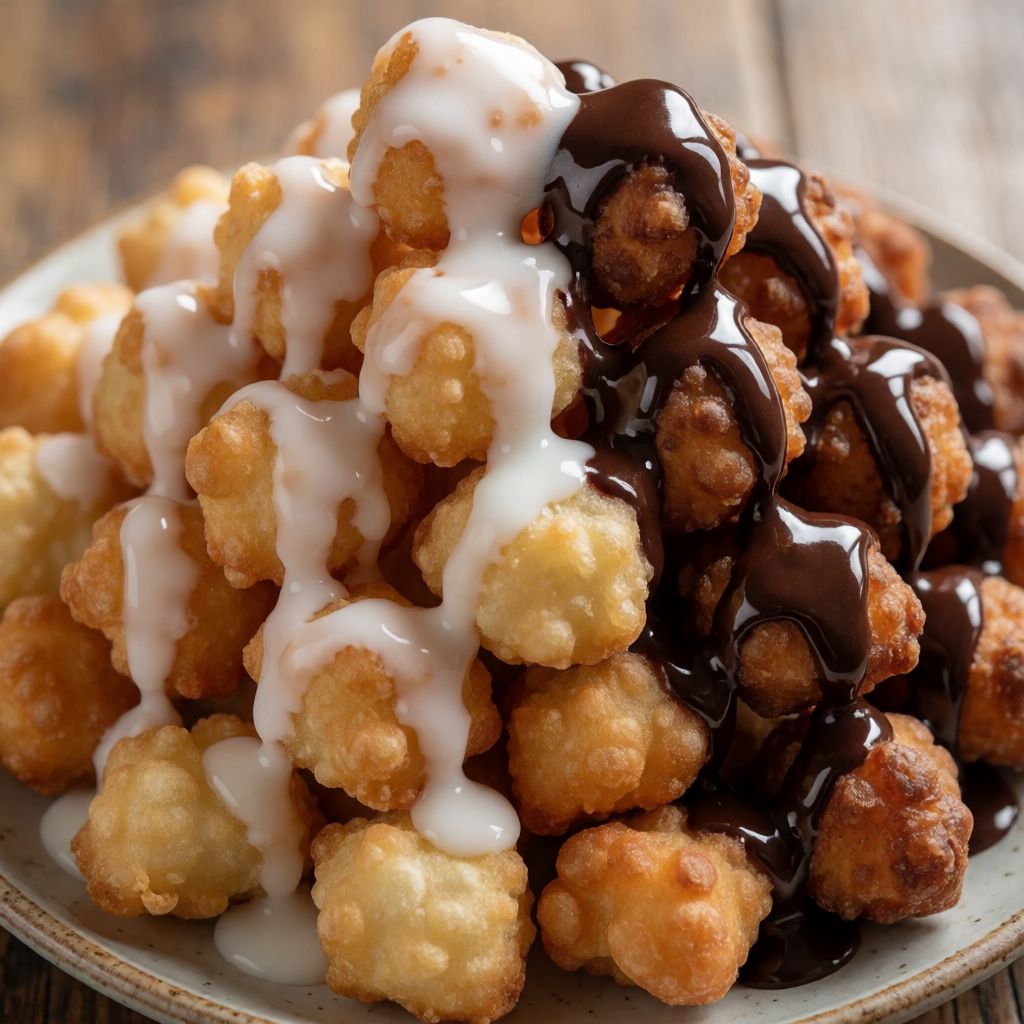
 AI photo
Pignolata Messinese
A Sicilian sweet of fried dough balls, half dipped in lemon icing, half in dark chocolate glaze.
Labels are worked out automatically from the ingredients and can be wrong. Check the packaging if it matters to you.
Ingredients
- 300 g Plain flour
- 100 g Caster sugar
- 2 pcs Eggs
- 1 pcs Egg yolk
- 40 g Lard or butter
- 1 pcs Lemon zest
- 1 pcs Egg white
- 150 g Icing sugar
- 1 tsp Lemon juice
- 100 g Dark chocolate
- 10 g Butter
- 500 ml Vegetable oil for frying










Steps
Tip the flour onto the worktop in a mound, make a well in the centre and add the sugar, eggs, egg yolk, lard and lemon zest.
Bring the ingredients together by hand and knead the dough until it is soft and smooth.
Wrap the dough in cling film and leave it in the fridge for 30 minutes.
30 minTake out the dough, divide it into 3-4 pieces and roll into ropes about 1.5 cm thick.
Using a spatula or scraper, cut the ropes into small pieces 1-2 cm long.
Heat plenty of oil in a pan and fry the pieces of dough in two or three batches, until golden.
Lift the fried pieces onto a paper towel to remove excess fat, and let them cool.
Whisk the egg white with a mixer until stiff, then whisk in the lemon juice and icing sugar a little at a time.
Divide the fried dough pieces into two equal portions; put one portion into the bowl with the white icing and mix thoroughly.
Melt the chopped dark chocolate in a bain-marie together with the butter, mix well and pour this glaze over the remaining dough pieces.
Arrange both portions on a tray side by side.
Pignolata messinese is Messina's answer to the Christmas pile of fried dough that Naples calls struffoli — little nuggets of eggy dough, fried hard, then split in two: half dressed in white lemon icing, half in dark chocolate glaze. Piled together on one tray, it looks like a chessboard made of rubble, and that's the point — it's a dessert built for sharing off a board with your hands, not plated with a fork.
What decides whether it works isn't the frying — that's the easy bit, ten minutes of attention and a thermometer you don't actually need if you watch the dough instead of the clock. It's the dough itself. This isn't a batter, it's a short, tight bread-dough cousin, worked by hand on the counter the old way — flour in a mound, a well, the wet things poured in and drawn together gradually. That method isn't tradition for tradition's sake: before stand mixers, a loose dough in a bowl is a dough that runs everywhere; a mound with a well lets you control how much flour the egg actually takes up, so you stop the moment it's soft, not a spoonful later when it's gone tough.
The other hinge is the rest in the fridge. Thirty minutes isn't decoration — the gluten you've just built by kneading is tight and springy, and if you try to roll ropes straight away it fights you, shrinks back, tears. Let it sit cold and it relaxes; that's not magic, that's just protein strands settling after you've stressed them. Skip it and you'll be wrestling dough that keeps un-rolling itself.
Flour is just flour here, nothing fancy — plain, because this isn't bread that needs the chew of strong flour, it needs to fry up crisp and short, almost biscuity at the core. Too much protein and your little nuggets turn tough and leathery instead of giving that dry crack when you bite one.
The eggs and extra yolk are doing the work that water would do in a plainer dough, but richer — the yolk especially brings fat and colour, so the dough fries to a proper gold rather than a pale, anaemic one. Lard is the traditional fat because it was the cheap, available fat in a southern Italian kitchen with a pig in the yard and no cream to spare — it gives a clean crumb with no competing flavour. Butter is the honest substitute if lard isn't in your fridge (and in most UK kitchens it won't be); you lose a little of that short texture but gain nothing bad.
Lemon zest isn't a flourish, it's doing a job: this dough is sweet but plain, and without the zest's oil the fried pieces taste mostly of egg and frying fat. Any zest with a clean, sharp smell — lime at a push — covers the same ground; don't reach for lemon extract, it tastes of a chemistry set, not a lemon.
The frying oil should have no smell of its own — sunflower, a light vegetable oil, groundnut if you want it — because you need to taste the dough and the two glazes, not the oil underneath them. Olive oil is wrong here for the opposite reason it's right in savoury cooking: its flavour would sit on top of a delicate, sweet fry and fight the chocolate.
The two glazes are the chessboard trick, and each one is simple arithmetic: egg white whipped to stiff peaks holds air and structure, so when you fold in icing sugar and a touch of lemon juice, you get a glossy, clinging coat rather than a puddle — the lemon juice there is doing double duty, cutting the sweetness and helping the sugar set rather than stay sticky-wet. The chocolate glaze is just chocolate loosened with a little butter over a bain-marie — gentle, indirect heat, because chocolate seizes and grains if it meets a direct flame or boiling water splashing into it, and once it's grainy there's no fixing it, only starting again.
Patience here isn't poetic, it's literal: the fridge rest, the cooling on paper before glazing (glaze poured onto hot fried dough just slides off or melts into a mess), the mixing by hand into the white icing rather than dumping and stirring once — each pause is preventing a specific, nameable failure, not just padding out the recipe.