
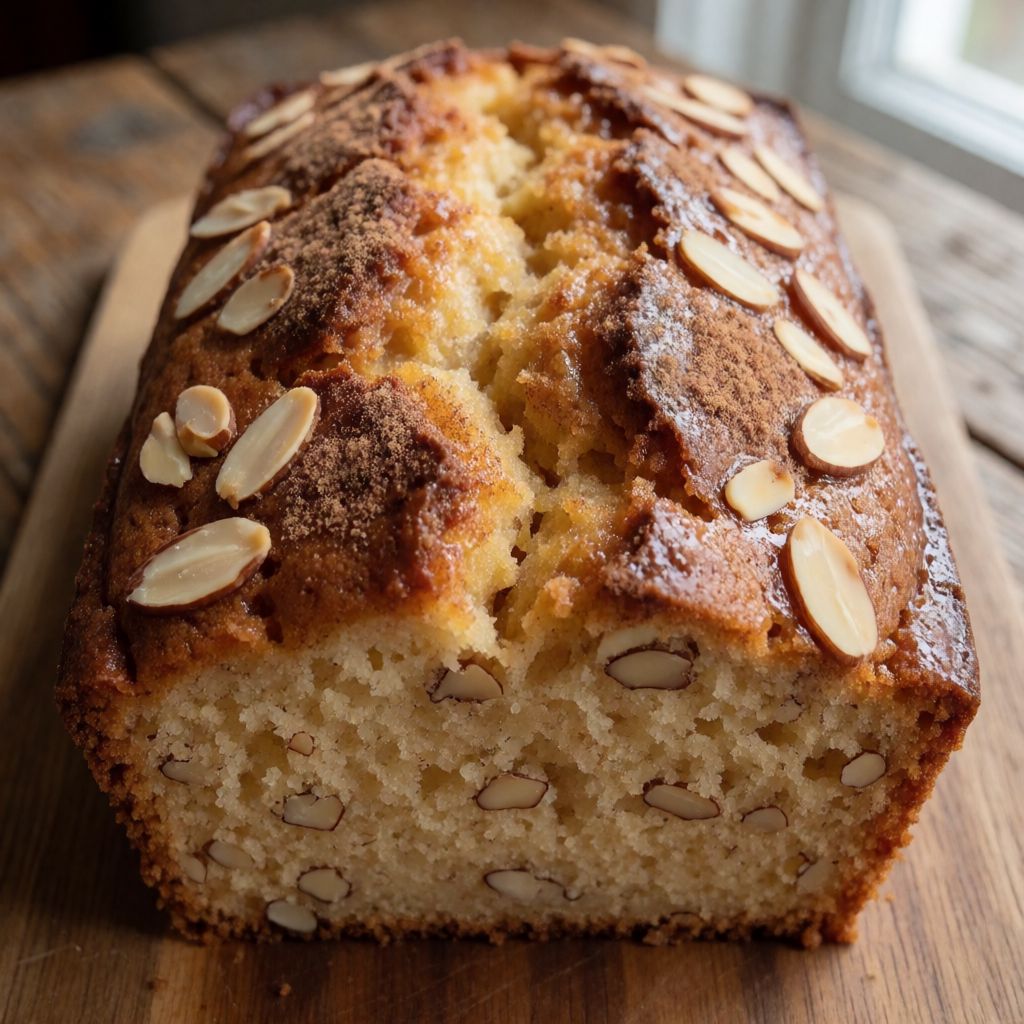
 AI photo
Honey and Cinnamon Loaf Cake
A fragrant almond-flour loaf cake flavoured with honey and cinnamon, finished with a dusting of icing sugar.
Labels are worked out automatically from the ingredients and can be wrong. Check the packaging if it matters to you.
Ingredients
- 4 pcs Eggs
- 180 g Olive oil
- 2 tsp Cinnamon
- 200 g Sugar
- 180 g Plain flour
- 125 g Almonds
- 1 tbsp Honey
- 1 tsp Baking powder
- 1 tsp Vanilla extract
- a pinch Salt
- Icing sugar to taste










Steps
Blitz the almonds in a blender into a fine, even flour, or use ready-made ground almonds.
In a separate bowl, mix the honey with the olive oil until smooth.
Separate the egg whites from the yolks into two large bowls.
Whisk the egg whites with an electric mixer to stiff peaks.
Whisk the yolks with the sugar until pale and fluffy, then beat in the honey-and-oil mixture, continuing to whisk.
Still whisking, add the plain flour and ground almonds.
Stir the baking powder, vanilla extract, salt and cinnamon into the batter.
Gently fold in the whisked egg whites with a spatula, using bottom-to-top movements.
Grease a loaf tin and dust with flour, pour in the batter and level with a spatula.
Bake in a preheated conventional (non-fan) oven at 180°C for about 50 minutes, until well risen and cooked through.
50 minTake the finished loaf cake out of the oven and let it cool on a wire rack.
Before serving, dust with icing sugar if you like.
What was changed
Baking powder and Vanilla extract: the vanilla baking powder was replaced with plain baking powder plus vanilla extract added separately, in amounts suited to British kitchens.
This is a sponge built on two engines of lift: air beaten into egg whites, and the chemical push of baking powder working alongside it. Oil instead of butter, ground almonds instead of all flour — that's what keeps a loaf cake from turning into the usual brick by day three, forgotten under clingfilm on top of the fridge. One tin, six honest slices — the right size for tea after a Sunday roast, not a showstopper.
What decides whether it works isn't the oven dial, it's what happens just before the oven: how much of that whisked air survives the fold into the heavier batter. Stir too hard and the lift collapses — dense, flat, the cake equivalent of a soufflé pulled out five minutes early. Fold too timidly and you get streaks of raw white, dry pockets where no batter reached. The fold is the real recipe here; everything else just builds what the egg whites have to carry.
Honey and cinnamon aren't there to compete for your attention. One tablespoon of honey won't make this a honey cake — it's enough to keep the crumb from going stale and crumbly by the next morning, because honey holds water in a way sugar alone can't. The cinnamon should read as background warmth, not potpourri; if you can name the spice the moment it hits your tongue, you've either used too much or it's past its best.
Some say oil cakes taste of the oil — no, only if you grab the peppery extra-virgin bottle meant for salad. Use something closer to flavourless and the oil vanishes into the crumb, leaving only the moisture butter cakes lose after a day in the tin.
Four eggs, separated, doing two different jobs. The yolks carry fat and sugar and emulsify with the honey-oil mix into something smooth and pale; the whites carry the air. Whisk the whites in a bowl that's properly clean and dry — any smear of yolk or grease coats the protein and stops it trapping bubbles at all. That's not superstition, it's just what fat does to egg foam, and it's the real reason a 'failed' whip usually isn't the mixer's fault.
Olive oil here isn't a flavour choice, it's a texture one. Pick something mild — labelled 'light' or pomace, not the cold-pressed bottle you'd dress a salad with — or swap in any neutral oil like sunflower or rapeseed. The criterion is an oil with no smell of its own; that's what disappears into the cake and leaves behind nothing but moisture that stays put, unlike butter, which sets hard once the cake cools and makes the crumb feel dry even when it isn't.
Ground almonds do something flour alone can't: they bring fat and protein without gluten, breaking up the gluten network that plain flour wants to build. That's what keeps this loaf tender rather than chewy. Blitz your own from blanched almonds if you want it fresher and cheaper than the bags of ground almonds that cost more than the nuts they came from; just stop blitzing the moment it looks like flour, before the oil in the nuts turns it into paste.
Honey earns its keep through chemistry, not romance. It's hygroscopic — it holds onto water longer than sugar does — which is the actual, unmagical reason honey cakes used to keep for a week when sugar was the expensive, imported thing and honey was what every village had. Use something mild and runny; a dark, assertive honey like heather will argue with the cinnamon instead of backing it up. And buy your cinnamon in small amounts and use it quickly — ground spice loses its oils within months, and what's sat at the back of the cupboard for two years is just brown dust with a label.
The baking powder is doing a second, smaller job of lifting, alongside the whites — not instead of them. Don't be tempted to add more for insurance; too much leaves a faint bitter, metallic edge that people often blame on something else in the bake. The two lifting mechanisms need to agree with each other, not compete.
In an ordinary UK kitchen, 180°C assumes a conventional oven, no fan. If yours only does fan, come down by about 20°C, or you'll get a cake set and browned on the outside while the middle is still wet underneath the crust — the oven equivalent of judging a stew by its lid. Check doneness with a skewer coming out clean, or a few moist crumbs, not wet batter, and a top that springs back rather than holds your fingerprint. Turn it out onto a wire rack straightaway rather than leaving it to sit smugly in the tin — trapped steam underneath is what gives you a soggy base, not bad luck. Dust the icing sugar on once it's properly cool; dust it warm and you'll watch it vanish into the surface and have to do it twice.