
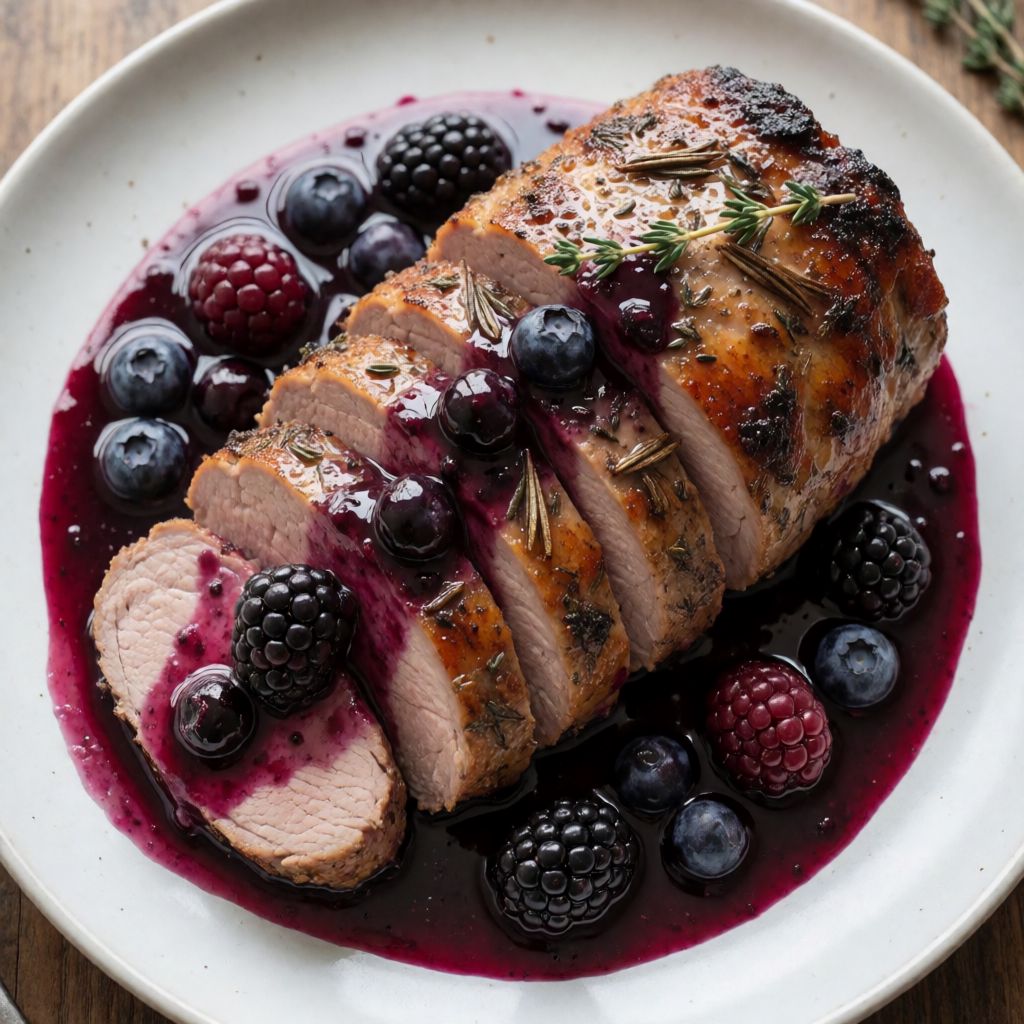
 AI photo
Pork Loin with Forest Berries
A tender pork loin seared and slow-cooked, finished with a rich forest berry sauce.
Labels are worked out automatically from the ingredients and can be wrong. Check the packaging if it matters to you.
Ingredients
- 700 g pork loin
- 74 ml olive oil
- thyme to taste
- rosemary to taste
- salt to taste
- black pepper to taste
- 1 pcs gin one shot glass
- 1 pcs shallot
- 1 package mixed forest berries
- 20 g butter
- 1 pcs orange juice
- 1 tbsp acacia honey












Steps
Heat the olive oil in a pan and sear the pork loin on all sides.
Add the thyme and rosemary, season with salt and black pepper, turning the meat frequently.
Pour in the gin and let it evaporate completely.
Cover with a lid and cook on low heat for 90 minutes, topping up with warm water occasionally. Done when the inside reaches 70°C.
90 minIn a blender, pulse the shallot, then add the thawed forest berries and blend in short bursts.
In a pan, melt the butter with the acacia honey.
Add the berry mixture.
Pour in the orange juice and simmer the sauce on the lowest heat until thickened.
Slice the loin into 4 cm thick pieces and spoon over the berry sauce.
Serve with duchess potatoes or a rich mashed potato.
What was changed
We swapped the red Hawaiian salt salt for ordinary salt, since it isn't typically stocked in local shops.
This isn't a roast, it's a braise dressed up as one. You sear the loin hard first, then shut the lid and let it cook slowly in its own steam and a bit of water — the pork never gets near the dry heat that would make a loin, lean as it is, taste like rope. Pork loin has almost no fat running through it, so the usual Sunday-roast logic of "high oven, long time, baste occasionally" works against you here: by the time the middle is done the outside is grey leather. Low, gentle, lidded heat is the whole trick.
What decides the dish is that 70°C number, not the 90 minutes next to it. Time is just a guess at how long it takes to get there — your loin might take 70 minutes, might take 110, depending on its shape and how cold it was when it went in. A probe thermometer earns its keep on this one cut more than almost any other, because pork loin has no forgiveness: five degrees past done and it's chewing cardboard, five degrees under and you're serving it with a side of salmonella worry you don't need to have.
The gin isn't there to get anyone drunk — it's there to burn off, taking raw-alcohol sharpness with it and leaving behind the juniper and botanicals that do for pork what rosemary does, only wetter. You let it evaporate "completely" because half-evaporated gin tastes like a bad cocktail sitting in meat juice; fully evaporated, it's just seasoning.
Pork loin itself: buy it in one piece, not pre-cut steaks, because a 700g block holds its moisture far better over 90 minutes than four thin slices would — surface area is the enemy of a long gentle cook. If your loin comes rolled and tied, leave the string on until after it's sliced; it's holding the shape together while the fibres relax.
Olive oil here is doing a browning job, not a flavouring one — any oil with a high smoke point and no strong smell of its own will sear the meat the same way. Olive oil works, but a neutral vegetable or sunflower oil does it just as well and won't fight with the gin and herbs later. Save the good extra-virgin stuff for something that isn't about to be braised for an hour and a half.
Thyme and rosemary: woody herbs, not leafy ones, because leafy herbs like basil or parsley would just scorch at searing temperature and turn bitter. If you're using fresh sprigs, leave them whole and pull them out before serving — nobody wants to chew a twig. Dried works too, just use less; dried herbs are concentrated, fresh ones are diluted with water weight.
The shallot in the sauce isn't for crunch, it's blended smooth, so its job is background sweetness and a faint allium depth under the berries — a small ordinary onion does the same work if shallots aren't in the shop, just use less, since shallot is milder and sweeter gram for gram.
Mixed forest berries, frozen and thawed, are doing what fresh summer berries would do at ten times the price in a British winter — this is a dish built around a freezer-aisle convenience, not a myth about foraged fruit. Blackberries, blackcurrants, a few raspberries, whatever mix you can get, work interchangeably; the point is tartness and colour, not a specific berry's character.
Acacia honey is chosen for being mild and floral rather than assertive — any pale, light honey does the same job. A dark, strong honey like chestnut or heather will fight the orange and berries instead of lifting them, so if that's what's in your cupboard, use a little less and add it later, tasting as you go.
Butter carries the honey into the berries and gives the sauce a shine that water or juice alone can't — it's an emulsifier here as much as a flavour, holding fat and fruit acid together instead of letting them separate into a thin, sad puddle. Orange juice, freshly squeezed if you can manage it, brings the acid that stops the sauce being flat sweetness; bottled juice works, it's just thinner on flavour, so taste before you decide it needs more honey.
Last thing: the 4cm slicing isn't arbitrary showing-off, it's thick enough that each piece holds its own juice when you cut it, rather than bleeding out onto the board the way thin slices do. Cut it, plate it, pour the sauce over rather than mixing meat into sauce — this is one of those dishes where mash underneath is doing real work, soaking up what drips off the pork instead of leaving it to sit in a puddle on the plate.