
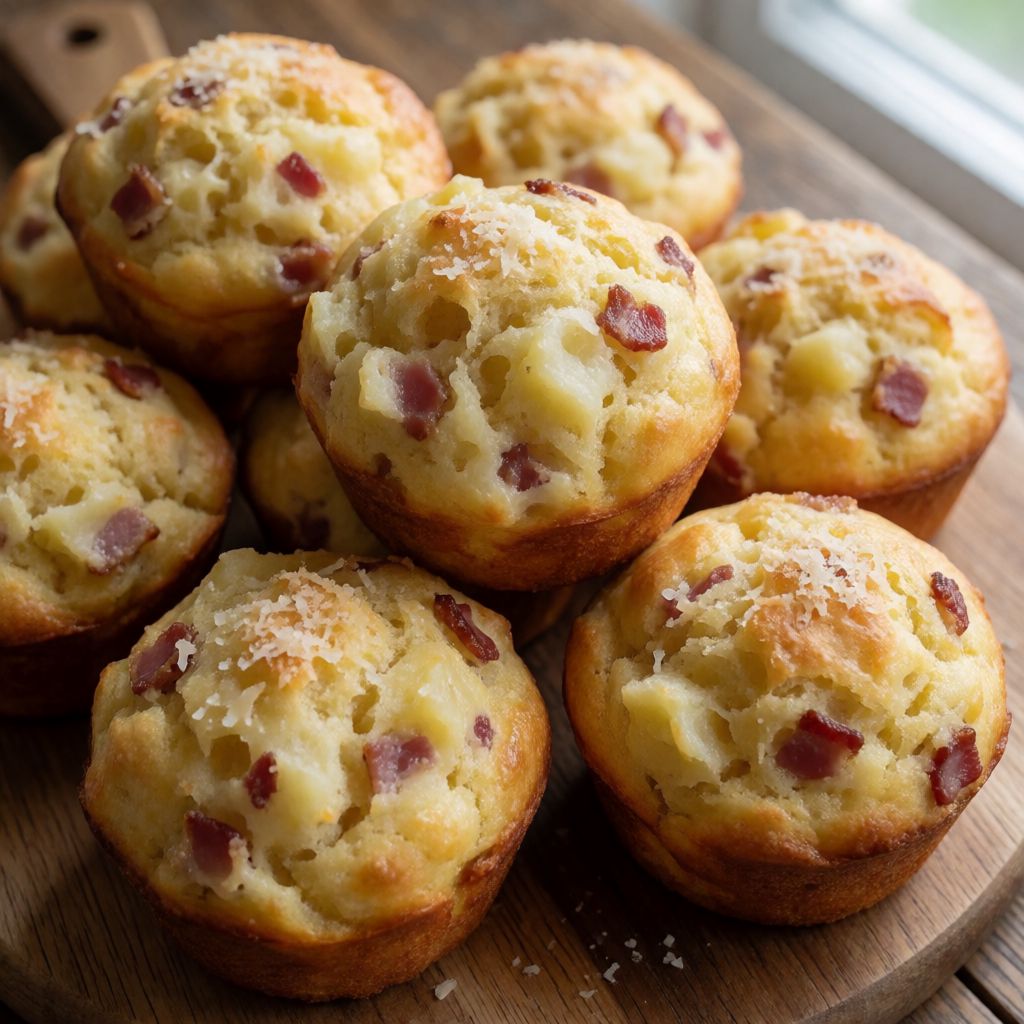
 AI photo
Potato Muffins
Savoury potato muffins with provolone cheese and bacon, perfect for a snack or light lunch.
Labels are worked out automatically from the ingredients and can be wrong. Check the packaging if it matters to you.
Ingredients
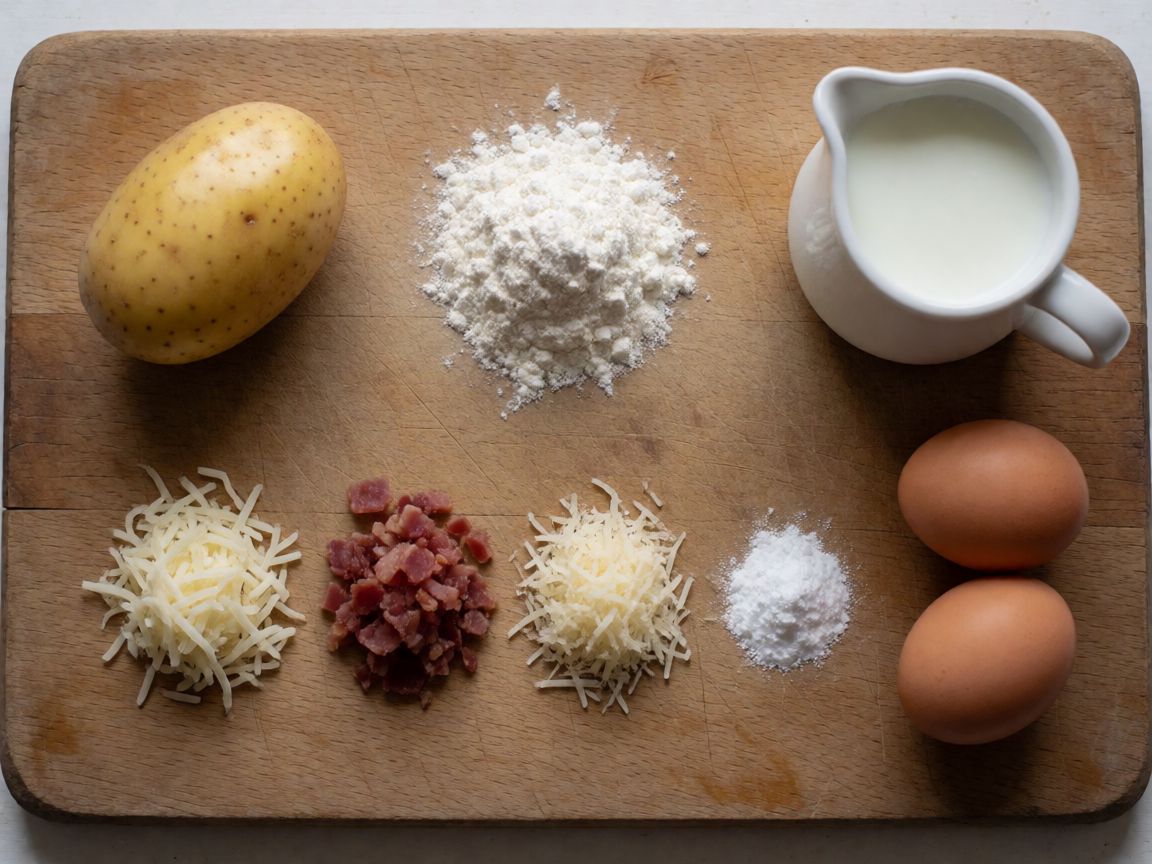
- 280 g Potato
- 250 g Plain flour sifted
- 150 ml Milk
- 130 g Provolone
- 60 g Bacon
- 60 g Parmesan
- 2 pcs Eggs
- 8 g Baking powder
- Nutmeg to taste
- Salt to taste
- Black pepper to taste
- Vegetable oil for frying







Steps
Dice the provolone and bacon. Place in a frying pan with a little oil and fry for a few minutes.
Leave to cool. The bacon should be cooked through; check that the pieces reach an internal temperature of 70°C.
Wash and peel the potatoes, then boil them in salted water.
30 minOnce the potatoes are soft, drain and mash with a potato masher.
In a large bowl, beat the eggs with a fork, add the mashed potato and mix thoroughly until smooth.
Add the diced provolone and fried bacon, and mix well.
Gradually pour in the milk, stirring constantly, then add the Parmesan, salt, black pepper and nutmeg.
Add the baking powder and sifted flour, and mix with a spoon until smooth.
Line a muffin tin with paper cases and fill with the batter using two teaspoons, no more than 3/4 full.
Preheat the oven to 180°C (conventional, no fan), place the tin with the muffins inside and bake.
20 minOnce the muffins have risen well and browned on top, remove from the oven and leave to cool on a wire rack.
Serve the potato muffins warm, or let them cool completely before serving.
A muffin that forgot it was supposed to be sweet. Underneath the paper case this is savoury bread dough's cousin — mashed potato doing the job flour usually does alone, bacon and two cheeses doing the job sugar usually does. Think of it as what you'd get if a Sunday roast's leftover potato had a word with a scone.
What decides whether it works is moisture, not flavour. Potato mash is wet and heavy; flour and baking powder have to lift that weight without drowning in it. Too much milk, too loose a mash, and you get a dense, gluey disc that never rises — it just sits in the case looking apologetic. The potato needs to be properly dry-mashed, no extra butter or cream stirred in "for richness," because every bit of fat or liquid you add here is fat and liquid the raising agent has to fight against later.
Some say mashed potato makes bread heavy, full stop — no. It makes bread heavy only when it's wet potato. Dry, floury mash (the kind that falls apart rather than sticks to the masher) actually helps structure, the way it does in Irish potato farls or German Kartoffelbrot. The starch binds, it doesn't drown.
Potato: 280g boiled and mashed dry — no milk or butter worked in at this stage, that comes later and separately. Any floury potato works; a waxy new potato (Charlotte, Jersey Royal) mashes gluey and wet and will fight you. If you're shopping British, a Maris Piper or King Edward is exactly the texture you want — the same reason they're the ones you'd roast on a Sunday. Boil them whole or in large chunks in salted water until a knife meets no resistance, not until they're falling apart in the pot, because a potato that's absorbed too much cooking water is already working against the flour before you've even mixed anything.
Flour: 250g plain, sifted. Sifting here isn't ceremony — it's aeration and it breaks up any compacted lumps so the baking powder distributes evenly instead of leaving one muffin flat and its neighbour over-risen. You don't need strength or gluten development in this dough (you're not kneading, you're folding), so plain flour is correct; strong bread flour would just make the crumb tougher for no gain.
Milk: 150ml, poured in gradually while stirring. The reason for "gradually" isn't fussiness — add it all at once to warm mashed potato and egg and you risk the mixture seizing into lumps rather than loosening smoothly. Whole milk gives the best balance of moisture and fat; if you only have semi-skimmed, it'll still work, just a shade less rich. Any dairy or plant milk with no strong flavour of its own will do the job — oat milk, for instance, not coconut.
Provolone and Parmesan: two cheeses doing two different jobs, not one job twice. Provolone is diced and fried with the bacon — it's there to melt into soft, stretchy pockets through the crumb, the way mozzarella would in a savoury scone. Parmesan goes in grated, later, dry — it's there for salt and a sharp, savoury backbone running through the whole batter rather than sitting in pockets. If provolone isn't in your fridge, any semi-firm melting cheese with a mild flavour stands in — a mild Cheddar, Gouda, or Edam. If Parmesan's missing, a hard, aged, salty cheese does the same job — a mature Cheddar grated fine, or Grana Padano.
Bacon: 60g, diced and fried before it ever meets the batter, for the reasons above — texture and safety both solved by one pan step, not left to a twenty-minute bake at a temperature too gentle to render raw fat and meat through. Streaky or back bacon both work; smoked gives you more of a punch through the cheese, unsmoked is quieter and lets the nutmeg and pepper show more.
Eggs: 2, beaten first and then mixed with the mash while the potato's still warm — this is what turns "mashed potato and flour" into something with a bit of lift and a soft, custardy crumb rather than a dense potato cake. Eggs here are structure, not flavour.
Baking powder: 8g. This is your whole rise, since there's no yeast and no time for one — patience in this recipe isn't a long proof, it's getting the potato dry enough and the mixing gentle enough that the baking powder has something light to lift rather than something heavy to haul. Mix it in with the flour at the end, not earlier, so it doesn't start working in a wet bowl and lose its gas before the oven ever sees it.
On the tin and the cases: three-quarters full is the rule because potato batter rises less dramatically than a sugar-and-butter muffin batter but still rises — fill to the brim and you get spill-over, burnt edges stuck to the tin, and a flat top instead of a dome. In an ordinary flat with a standard conventional oven and no fan, 180°C set without fan assistance behaves close enough to what's written; if your oven only does fan, drop it by about 20°C and keep your eye on colour rather than the clock, because that's the only honest cue a domestic oven gives you — "risen well and browned" is the doneness test, twenty minutes is just where to start looking.