
 AI photo
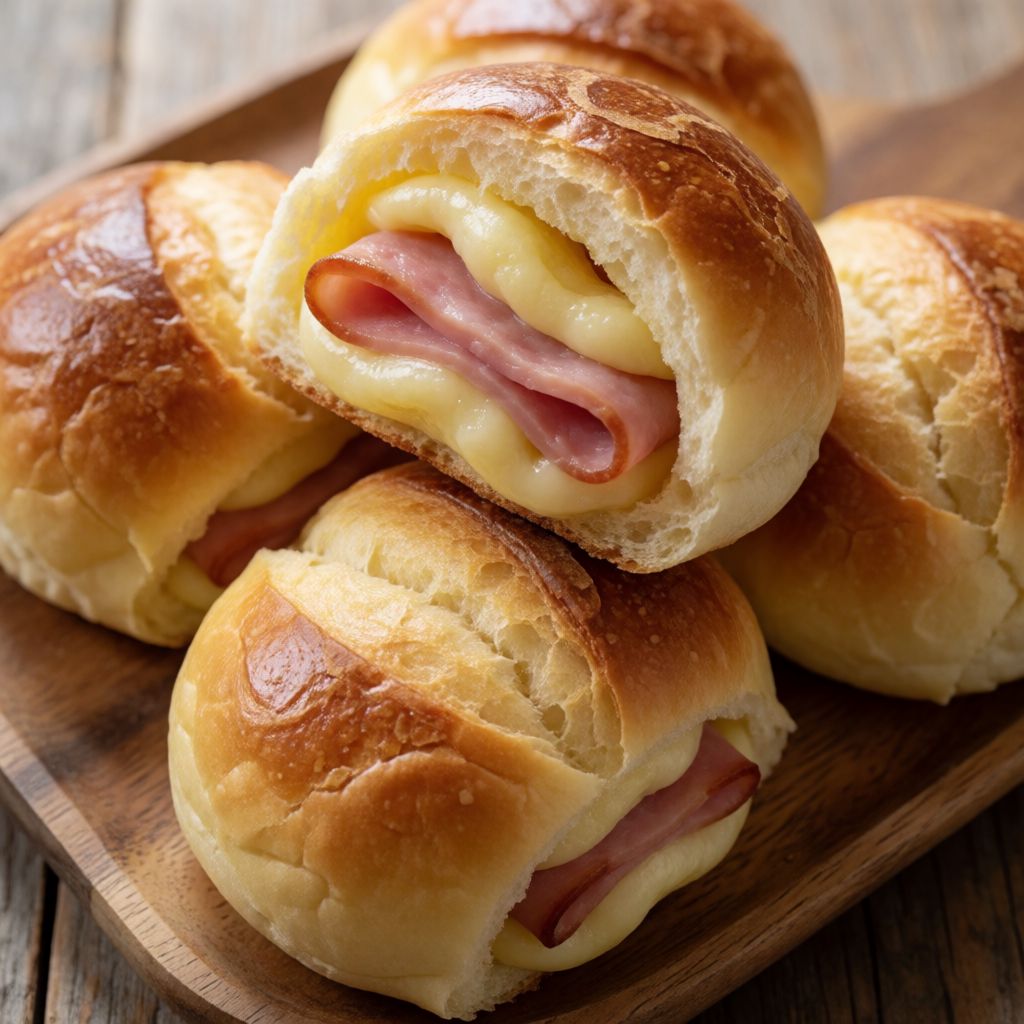
Potato Buns with Ham and Provolone
Soft potato dough buns stuffed with ham and provolone cheese.
Labels are worked out automatically from the ingredients and can be wrong. Check the packaging if it matters to you.
Ingredients
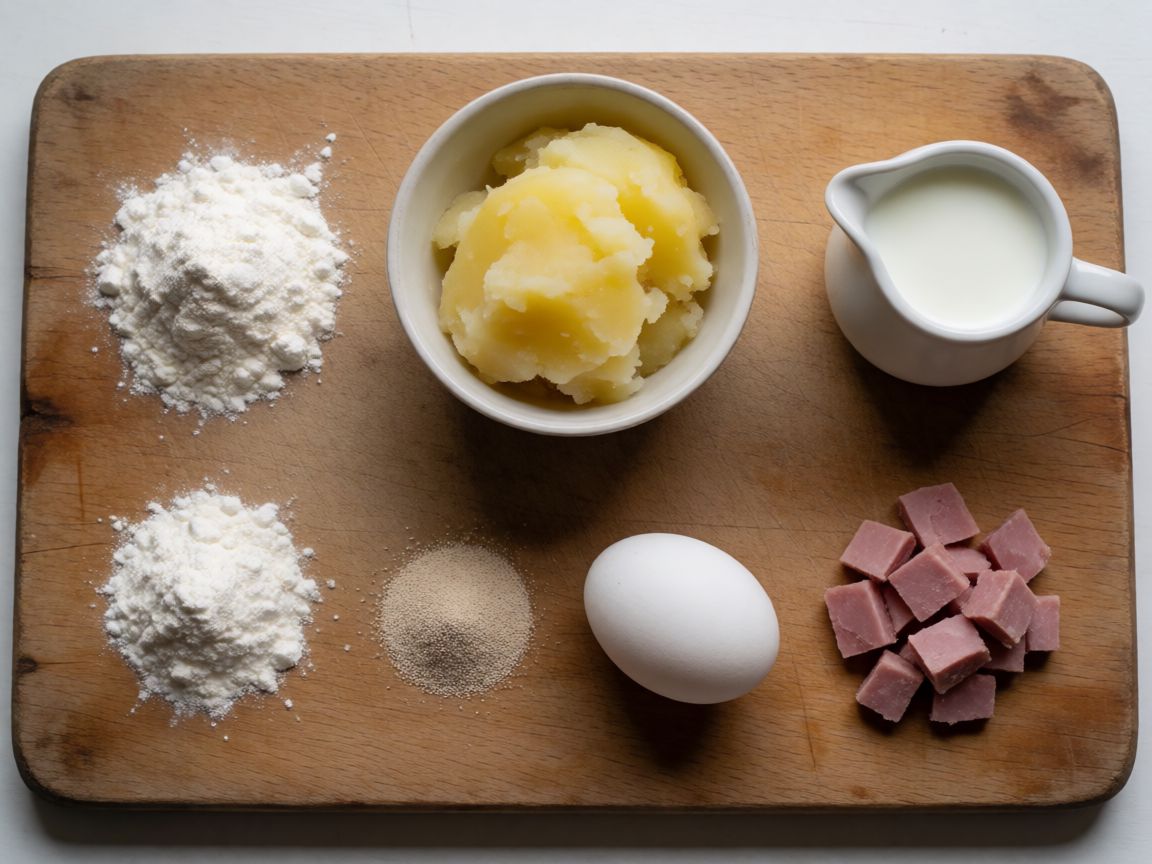
- 200 g Plain flour
- 200 g Strong white bread flour
- 200 g Cooked potato mashed
- 100 g Milk
- 1 pcs Eggs
- 40 g Vegetable oil
- 12 g Yeast
- 1 tsp Sugar
- 12 g Salt
- 200 g Ham diced or chopped
- 200 g Provolone diced or chopped
- 1 pcs Egg yolk
- 1 tbsp Milk









Steps
Boil the potato until tender and let it cool.
Sift the plain flour and the strong white bread flour into the bowl of a mixer, and add the milk.
Add the egg, the crumbled yeast and the sugar.
Pour in the vegetable oil, then add the cooled cooked potato, roughly mashed beforehand.
Knead the dough by hand or in a mixer with a dough hook until smooth and no longer sticky.
Add the salt and knead for a few more minutes.
Shape into a ball, place in a large bowl and leave to rise until doubled in size.
120 minDivide the risen dough into pieces weighing about 50 g each.
Stretch each piece slightly with your hands and place a tablespoon of chopped or diced ham and provolone in the centre.
Pinch the edges together and shape into a ball, turning the seam downwards.
Arrange all the balls in a round 26 cm tin lined with baking paper, leaving a few centimetres between them.
Cover with cling film and leave to rise again for 1 hour, or until the balls have doubled in size.
60 minBrush the buns with the egg yolk beaten with milk, and bake in an oven preheated to 180°C.
23 minRemove from the oven and let rest briefly before serving.
A potato bun is a trick played on gluten. Potato starch sits in the dough and gets in the way of the long elastic chains that flour alone would build — the result is a crumb that's softer and stays softer for longer, because starch holds water better than flour does and doesn't let the bread dry out the way a plain white roll does by Monday morning. That's the whole mechanism of this dough: it's not about potato flavour, it's about potato as a humectant. You won't taste it. You'll feel it, two days later, when the bun hasn't gone to cardboard.
What decides whether this works isn't the filling, it's the seam. You pinch the edges of each ball shut and turn the join face-down — not for looks, but because an open seam is where steam escapes during baking, and steam that escapes takes the puff of the bun with it. A badly sealed bun bakes flat and split, with the cheese leaking out onto the paper and burning into a lace of char. Pinch it properly, weight it down with its own gravity, and the bun rises round.
Some say you need a kazan-deep pan or proper bakery kit for stuffed buns like this. No — a round 26 cm cake tin from your cupboard does the job precisely because the buns need to lean on each other slightly as they rise. That contact is what keeps them growing up instead of out sideways; it's a cheat that a domestic kitchen, with its ordinary tins, actually does better than a wide open tray.
Start with the flour split — plain and strong bread flour together, not one or the other. Strong flour alone, with all that potato starch diluting the gluten, risks a crumb too soft to hold its own shape once filled; all plain flour and the dough never gets the chew a bun needs to survive a pocket of melted provolone without collapsing. Half and half is a compromise, and a sensible one for a filled bun rather than a plain loaf.
The potato itself: boil it properly through, no bite left in it, and let it go cold before it meets the yeast. Hot potato into a yeasted dough is how you kill the yeast outright — heat above body temperature and the cells that need to be alive to produce gas are just dead weight. Mash it roughly rather than pass it through a ricer; a few small lumps do nothing to the final bread, and you save yourself a job.
Yeast and sugar are a pairing, not two separate additions — the sugar is there to give the yeast something quick to feed on early, which gets fermentation moving faster in a cold British kitchen where the top of the fridge or the airing cupboard is the usual "warm place," not an oven with a proper proving setting. Salt comes in after the first knead, not before, because salt tightens gluten structure and slows yeast activity — add it too early and you fight the dough instead of building it. This is standard bread logic, not a potato-bun quirk, but it matters more here because the starch is already competing for structure.
For the oil, the rule is simple: anything with no smell of its own — sunflower, a light rapeseed, a neutral vegetable oil. Olive oil will work structurally but it brings its own flavour into a dough that's meant to carry ham and cheese, not compete with them.
Ham and provolone are a classic pairing because they're both salty-savoury without clashing, but the filling is really a criterion, not a fixed list: a firm meltable cheese and a cured meat that won't weep too much liquid as it heats. Too wet a filling — a very fresh mozzarella, say — and you risk steam building inside the bun with nowhere to go, pushing the seam open from the inside regardless of how well you pinched it.
The two rises are not the same rise, and don't treat them as interchangeable. The first, as a single mass, is about developing flavour and structure before you ever shape anything — this is where the dough does its slow chemical work, and rushing it with a warmer spot just to save time gives you volume without the flavour that slow fermentation builds. The second rise, once shaped and filled, is shorter because the dough is already primed and the yeast is active; you're waiting for visible doubling, not a clock. Press a ball gently — it should spring back slowly, not instantly (too tight, needs longer) and not stay dented (overproved, and it'll collapse in the oven).
On the oven: 180°C is a temperature where the crust sets and browns at roughly the same pace that the inside finishes cooking through — go hotter in a hurry and you'll colour the outside before the cheese inside has properly melted, which defeats the point of a stuffed bun. Every domestic oven runs slightly differently, so treat the time as a floor, not a target, and trust the colour — deep gold, not pale, not approaching dark — over the clock.
Patience, here, is simply an ingredient you haven't bought yet if you skip it. Two rises totalling nearly three hours isn't dead time for the cook, it's the actual process by which flour and potato starch and yeast become bread instead of a dense potato cake with cheese in it. Four people, served warm alongside a Sunday roast or on their own with a cup of tea, is a reasonable portion from this batch — though stuffed buns this size are rarely eaten in moderation, so don't be surprised if four turns into fewer servings in practice.