
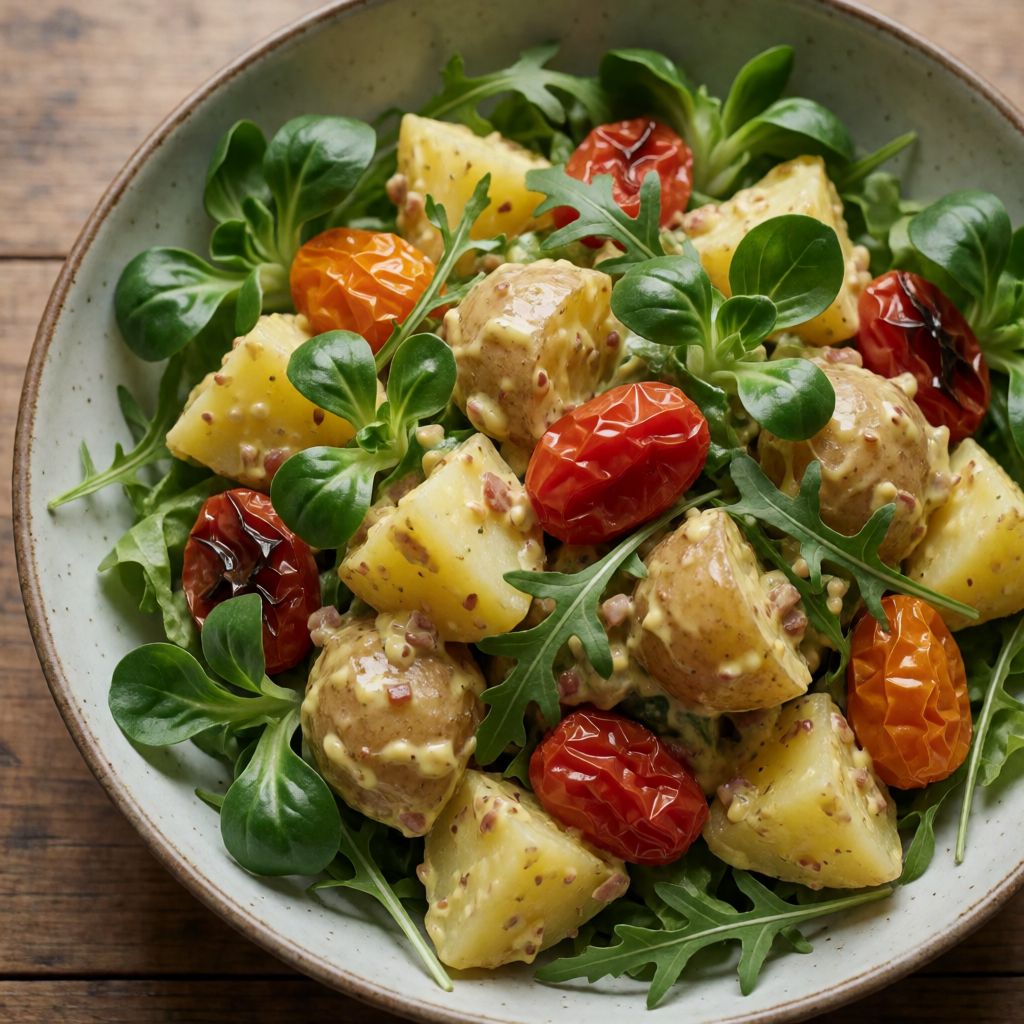
 AI photo
Potato Salad with Mustard Dressing and Roasted Tomatoes
A warm potato salad with crispy bacon, roasted tomatoes and a honey-mustard dressing.
Ingredients
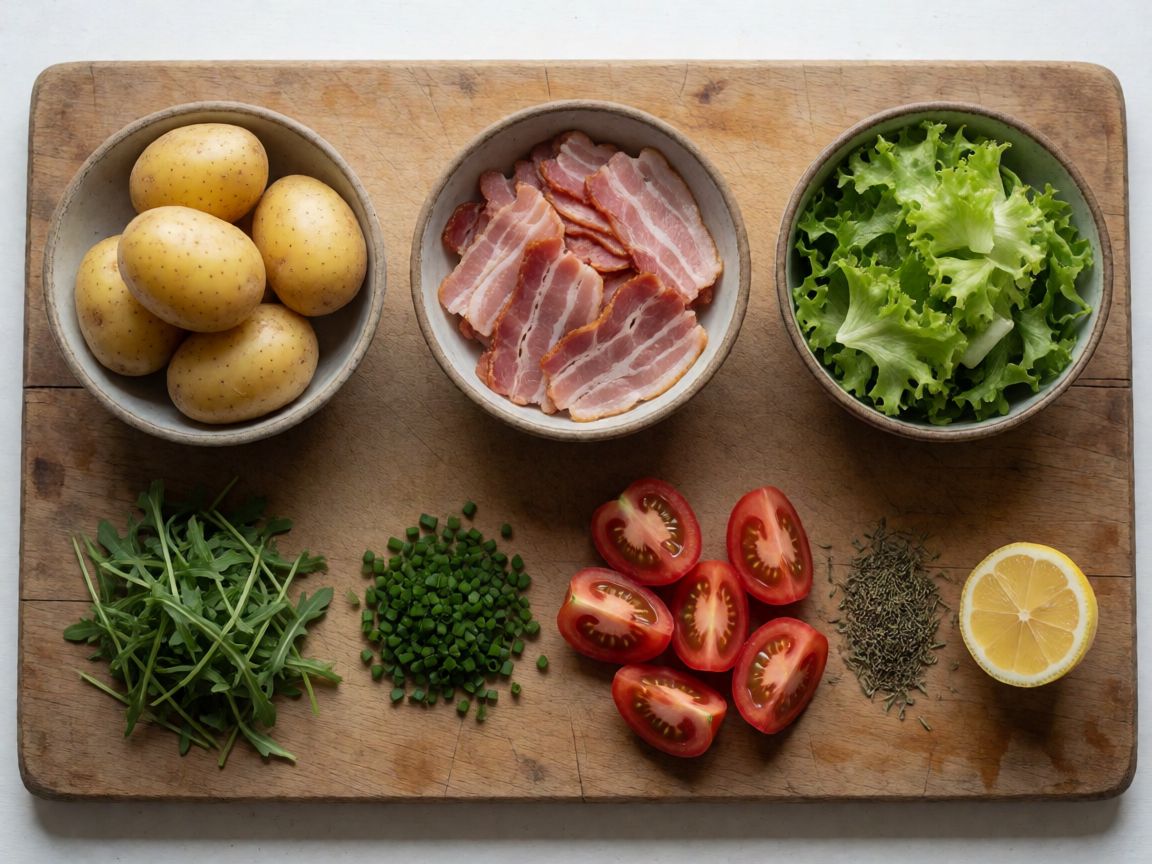
- 1 kg Potato
- 150 g Bacon sliced
- 75 g Lamb's Lettuce
- 25 g Rocket
- 3 tbsp Chives finely chopped
- Salt
- Black Pepper freshly ground
- 300 g Tomato halved or quartered
- 1 tbsp Olive Oil
- Salt
- Black Pepper freshly ground
- 1 tsp Dried Thyme
- 4 tbsp Olive Oil
- 0.5 pcs Lemon juice and finely grated zest
- 2 tbsp Mustard
- 2 tsp Honey
- Salt
- Black Pepper freshly ground











Steps
Whisk the mustard dressing and season to taste. Leave it to rest while you prepare the rest of the salad.
Scrub the potatoes and boil them until tender in a pan of lightly salted water. Drain.
Leave the potatoes to cool to room temperature. Halve them if you like.
Place the tomatoes on a baking tray lined with parchment paper, toss with the oil and sprinkle with thyme, salt and pepper.
Roast the tomatoes in a preheated oven at 200°C for 20 minutes.
Leave the tomatoes to cool on the tray to room temperature.
Fry the bacon in a pan until crisp, then drain on a plate lined with paper towel.
Crumble or finely chop the bacon.
Toss the potatoes with the mustard dressing and arrange in a bowl or on a platter with the lamb's lettuce and rocket.
Scatter the roasted tomatoes on top, then sprinkle with the crispy crumbled bacon and chives.
This is a salad built on a lie we tell ourselves about potato salad — that it needs to be cold and drowned in mayonnaise to earn the name. Here the potato is warm, or at least not fridge-cold, dressed while it can still drink, and everything else — roasted tomato, crisp bacon, peppery leaves — is there to argue with its softness. Mustard dressing is the spine. Get that wrong and you just have boiled potatoes with garnish.
What decides whether it works is timing, not seasoning. The potato has to go into the dressing while it's warm — not hot enough to split an emulsion, not cold enough to seal itself shut. A boiled potato is a sponge with a closing door: warm, it's porous and takes dressing into its flesh; cooled all the way down, the starch firms up and the surface turns waterproof, so the mustard and lemon just sit on top like rain on a car bonnet. That's the whole reason step 3 says cool to room temperature, not to fridge temperature — nobody tells you why, so people over-chill it and wonder why the salad tastes bland in the middle.
Potato: 1 kg, waxy, not floury. This matters more than any other choice in the dish. A floury potato — your Maris Piper, your King Edward, the ones that fall apart into fluff for a roast — breaks down at the edges when boiled and turns the dressing cloudy and starchy instead of coating it clean. A waxy one — Charlotte, Jersey Royal when they're in, anything sold as "salad potato" — holds its shape, keeps a slight bite at the centre, and takes dressing on its surface instead of absorbing it into mush. Scrubbing rather than peeling isn't rustic virtue, it's practical: the skin holds the potato together through boiling and gives the fork something to grip.
Bacon: 150 g, sliced, fried hard until it's properly crisp — not just cooked through. The point of frying it separately and draining it on paper is to pull the rendered fat away before it reaches the salad; left in, that fat coats the leaves and dulls them flat instead of leaving the bacon as a sharp, salty, crunchy interruption. If you don't eat pork, a hard cheese — a salty, crumbly one, feta or an aged cheddar broken into shards — gives you the same job: salt and texture against the soft potato, though you lose the smoke.
Lamb's lettuce and rocket: these aren't interchangeable with a bag of mixed leaves from habit — they're chosen for bite. Lamb's lettuce (mâche, if you've seen it under that name) is soft and faintly nutty, rocket is peppery and sharp, and together they do what the mustard alone can't: cut through a plate that's otherwise all potato-soft and bacon-fat. Any peppery leaf — watercress, if you want more bite — will stand in for the rocket; for the lamb's lettuce, a mild soft leaf like baby spinach is the nearest cousin.
Mustard dressing: olive oil, lemon juice and zest, mustard, honey, salt, pepper — whisked and left to rest before anything else happens. Resting it isn't fussiness, it's so the honey and mustard actually marry into the oil and acid instead of sitting as separate flavours that hit your tongue one after another. Use an olive oil here that actually tastes of something — this is a dressing eaten mostly raw, so a flat, flavourless oil leaves it thin. Dijon-style mustard gives you heat with no sweetness of its own, so the honey is doing real work, not just rounding something that was already sweet.
Tomato: 300 g, roasted at 200°C — a domestic oven running properly hot, not the gentle warmth some recipes mean by "roast." At that heat the water in the tomato flashes off fast enough to concentrate sugar before the flesh collapses into sauce; much lower and you just steam them slowly into something soft and wet with none of the caramelised edge. Twenty minutes is the lower bound, not a deadline — you're watching for the skin to blister and split and the cut edges to catch a little colour, not watching a clock.
Chives, for the last scatter, are there for a clean oniony top note without the sharp raw bite a sliced onion would bring to a dish that's already carrying mustard and rocket. If you haven't got chives, the green top of a spring onion, finely sliced, does the same job.
On patience: don't rush the cooling. Both the potato and the tomato need to come down to room temperature on their own time, not under a cold tap and not in the fridge. A shortcut here doesn't save you minutes you'll miss — it changes the texture of the thing you're making, and that's not a trade worth making for a salad that feeds four and takes under an hour anyway.