
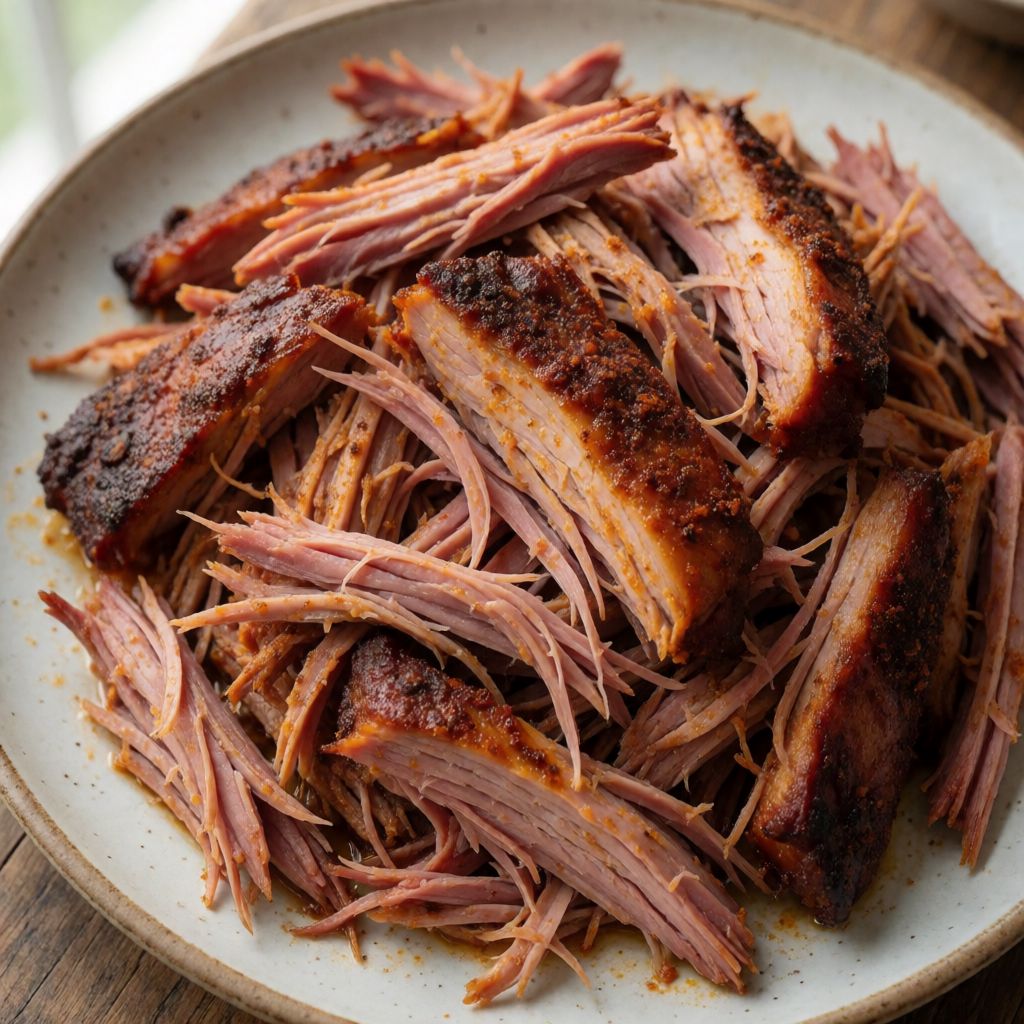
 AI photo
Pulled Pork in the Oven
Slow-roasted pork shoulder, rubbed with a smoky spice mix and oven-cooked until tender enough to pull apart with two forks.
Ingredients
- 1.5 kg Pork Neck
- 2 tbsp Sugar
- 1.5 tbsp Paprika
- 1 tbsp Smoked Paprika
- 1 pinch Cayenne Pepper
- 2 tsp Cumin ground
- 1 tsp Mustard Seed Powder ground to a powder
- 2 tbsp Brown Sugar
- 1 tsp Garlic Powder
- 1 tsp Onion Powder
- 1 tsp Chilli Flakes
- Salt to taste
- Black Pepper freshly ground, to taste











Steps
Trim the pork neck, removing only the visible sinew and fat.
10 minMix the dry spice rub; set aside 2 tbsp to sprinkle before serving.
Rub the whole neck joint generously with the spice mix, coating all sides.
Place the meat in a sealable bag and refrigerate for 12-24 hours.
Soak the clay roasting dish in water for half an hour before use.
30 minPlace the pork neck in a roasting bag or a covered roasting dish, such as a Römertopf.
2 minPut the covered dish with the meat into a cold oven and set the temperature to 110°C.
Cook the pork at 110°C for 9-11 hours.
600 minRemove the meat from the oven and pull the hot, steaming pork into shreds with two forks – it should be tender and fall apart easily.
10 min
Pulled pork is not a recipe for a cut, it's a recipe for a problem: pork neck has enough fat and connective tissue running through it to be chewy as a boot if you treat it like a quick Sunday joint, or dry as cardboard if you push it too hard trying to fix that. The whole mechanism here is collagen. At low heat, held for a long time, the tough collagen that laces through the muscle slowly turns to gelatin and the fat renders and seeps back through the meat instead of running out. That's why this takes nine, ten, eleven hours at a temperature your oven dial probably calls "barely on." You're not cooking the pork so much as dissolving its structure from the inside.
What decides success is almost entirely about not rushing the two long waits. The first is the 12–24 hours in the fridge with the dry rub on — that's not marinating in the wine-and-herbs sense, since there's no liquid to carry flavour in fast. The salt and sugar in the rub pull moisture to the surface, dissolve into it, and slowly work back into the meat, seasoning it through rather than just coating the outside. Skip this and you get a pork joint with a tasty crust and a bland middle — a crust is not seasoning, it's a coat of paint.
The cut is the whole decision. Pork neck (sometimes called pork shoulder or Boston butt, depending which counter you're at) is chosen because it's seamed through with fat and connective tissue — exactly the stuff that's a liability in a quick-cooked chop but an asset here, since it's what melts into succulence over the long hours. Don't trim it hard. The recipe says remove only the visible sinew and surface fat, and that's deliberate: strip the fat out and you've removed the self-basting system the whole method relies on. If your butcher only has a leaner leg joint, this isn't the dish for it — you'd need to baste constantly and you'd still end up drier.
The rub is doing two separate jobs and it helps to know which spice is doing what. Salt and the two sugars (white and brown) are the seasoning-and-moisture engine described above — the sugars also help the surface caramelise and darken over the long cook, giving you that deep mahogany "bark" people associate with proper barbecue, without needing actual fire. The paprika, smoked paprika, cumin, mustard powder, garlic and onion powder, chilli flakes and cayenne are flavour and colour, not function — smoked paprika in particular is standing in for the smoke flavour you'd get from an actual smoker or barbecue pit, since a British kitchen oven obviously doesn't produce any. If you don't have smoked paprika, you lose that specific woodsmoke note, but regular paprika plus a very small pinch of something like chipotle powder gets you closer than nothing.
Setting aside 2 tablespoons of the rub to sprinkle at the end isn't decoration, it's about contrast: eleven hours in a sealed dish mellows and blends spices into the meat, so the raw-ish hit of fresh rub on top at serving brings back some of the brightness that slow cooking quietly smooths away.
The clay dish soaking is about physics, not reverence. Unglazed clay (a Römertopf is the common UK brand name, but any unglazed clay roaster works the same way) is porous. Soak it and the clay itself holds water, which then releases slowly as steam inside the sealed pot during cooking — effectively building humidity around the meat for free, which helps keep it from drying over such a long stretch. If you don't own one, a heavy casserole with a tight lid, or a proper oven roasting bag inside a tray, does the equivalent job: the point is sealing moisture in, not the specific vessel. A loosely covered tray with foil "roughly over it" will let steam escape and work against you — this is one place where a plate-as-a-lid substitute genuinely won't cut it, because the whole mechanism depends on the seal.
Starting the covered dish in a cold oven, rather than a preheated one, matters more than it looks: it means the meat and the dish warm up together, gently, rather than the outside of the joint getting hit with full heat before the inside has started moving at all. It's a small insurance policy against the surface overcooking relative to the centre over such a long haul.
The finish — pulling it apart with two forks while it's still hot and steaming — isn't just presentation. Collagen that's turned to gelatin stays soft while hot and starts to firm up again as it cools, the same reason gravy thickens in the fridge. Pull it while it's hot and it falls into strands easily; let it sit and cool first and you're fighting the meat to get the same result. If you've got time pressure at the other end instead — serving a crowd, say — it holds and reheats far better pulled and in its juices than it does as a cooled, un-pulled joint you try to shred later.