
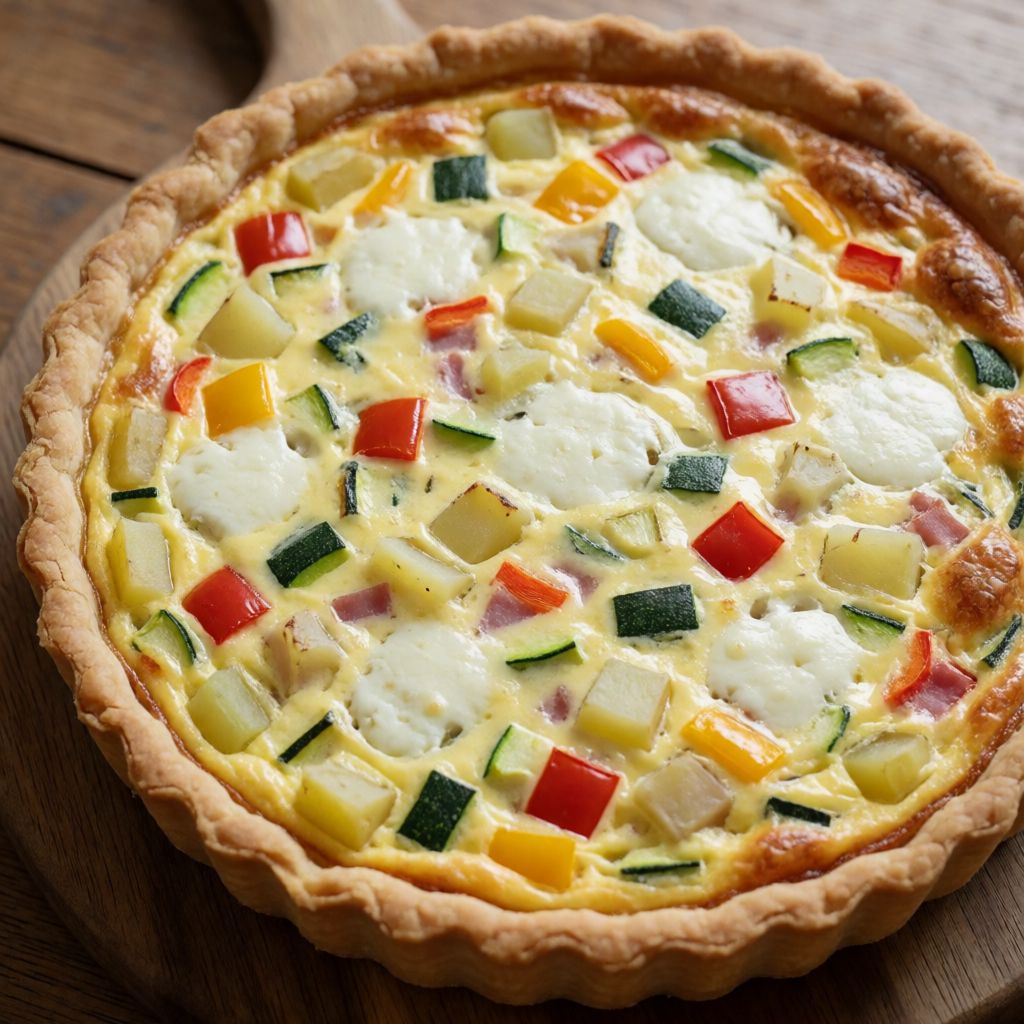
 AI photo
Vegetable and Ham Quiche
A savoury puff pastry quiche with potato, courgette, pepper, mozzarella and ham.
Labels are worked out automatically from the ingredients and can be wrong. Check the packaging if it matters to you.
Ingredients
- 1 pcs Puff pastry or shortcrust pastry
- 1 pcs Potato
- 1 pcs Courgette
- 1 pcs Bell pepper
- 1 pcs Mozzarella (fior di latte)
- 3 pcs Eggs
- 1 tbsp Parmesan
- 200 ml Double cream
- Salt to taste
- Black pepper to taste
- 1 tbsp Parsley
- 1 tbsp Breadcrumbs
- Olive oil to taste
- 120 g Ham










Steps
In a bowl, mix the potato, courgette, bell pepper, ham and mozzarella, and drizzle with olive oil.
Line a tin with baking paper, lay in the puff pastry, prick the base with a fork and sprinkle with breadcrumbs.
Spread the vegetable mixture together with the mozzarella and ham over the pastry.
Beat the eggs with the Parmesan, parsley, double cream, salt and black pepper, and pour over the vegetables.
Trim the pastry edges and bake the quiche at 200°C until the filling is set.
25 min
What was changed
Double cream Double cream was used instead, as it suits local kitchens for baking a quiche.
A quiche is really just a custard held up by a crust — everything else is decoration. The crust is there to give the custard walls to set inside, and the vegetables and ham are there so the custard has something to cling to besides itself. Whether it works comes down to one thing: does the egg-and-cream mix set into a soft, barely-wobbling slab, or does it split into curds and a puddle of fat. That's the whole game.
The breadcrumbs under the filling aren't decoration, they're insurance. Potato and courgette weep water as they cook, puff pastry goes soggy the moment water sits on it, and a soggy base is the single most common way this dish disappoints. A thin layer of crumbs soaks up that moisture before it reaches the pastry — cheap trick, works every time.
Some say you must blind-bake the pastry first, or it'll never cook through. No — because at 200°C in a thin tin, with a wet custard on top conducting heat down into the base as it sets, the pastry gets cooked from both directions at once. Blind-baking is for a shortcrust holding something dry and heavy; here the filling itself does the work.
Don't chase a timer on this. Fifteen minutes in, the custard is still a loose pond. Twenty-five, and the centre should have stopped sloshing when you nudge the tin — it should wobble like a set jelly, not ripple like water. If it's still liquid in the middle, give it more time regardless of what the clock says; the oven doesn't know your recipe card.
Puff pastry or shortcrust — either is a container, the choice is about texture, not correctness. Puff gives you shatter and layers, which looks handsome but can collapse under a wet filling if you skip the breadcrumb trick. Shortcrust is sturdier, more forgiving, closer to what a British hand is already used to from pies. If you've only got one in the freezer, use it — this isn't a dish where the pastry earns its own applause.
The vegetables — potato, courgette, bell pepper — go in raw-ish and finish cooking inside the custard, so cut them thin. A potato chunk the size of a dice will still be hard when the egg around it has set; cut it more like a coin, a few millimetres, and the oven's heat has time to soften it before the custard locks solid. Courgette and pepper are quicker and more forgiving, but match them to the potato's thickness so nothing lags behind.
Mozzarella here is for pull and moisture, not flavour — fior di latte has almost none of its own, which is the point: it melts into the gaps between vegetables and holds things together without shouting over the ham. If you're out of it, any mild melting cheese with no strong character of its own does the same job — a block mozzarella from the fridge aisle, even a mild cheddar in a pinch, though that nudges the flavour toward sharper territory.
Double cream plus eggs is the custard ratio, and it's worth understanding why it's not just eggs, or just milk: eggs alone scramble into curds under high heat, cream alone never sets at all. The fat in the cream slows the proteins in the egg down, giving you a window where it's gone from liquid to soft-set without tipping into rubbery curds. Parmesan in there isn't melting cheese, it's seasoning — salt and savour stirred straight into the custard rather than sitting as a layer.
Ham is already cooked and salted, so it's doing two jobs — flavour, and a check on how much salt you add elsewhere, since a heavy hand with the salt pot on top of ham and Parmesan tips the whole thing too far. If you don't eat ham, cooked bacon lardons or nothing at all both work; the custard doesn't need meat to set, it's purely a flavour choice.
Patience here is less about watching a clock and more about resisting the urge to pull the quiche the moment it looks "done" on top — the centre is always the last to firm, and cutting in too early gives you a lovely crust around a puddle. Let it sit a few minutes out of the oven too; the custard keeps firming as it cools, the same way a poached egg keeps setting on the plate.