
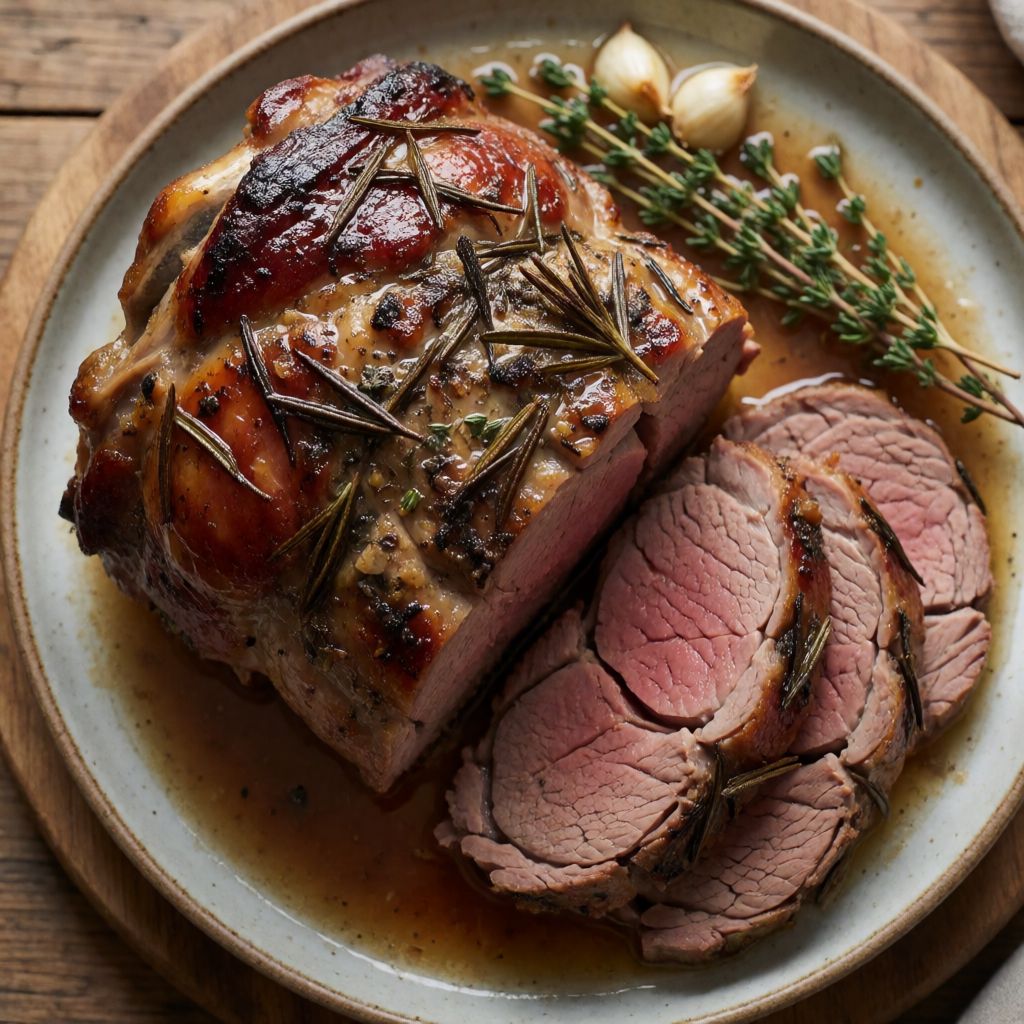
 AI photo
Herb-Roasted Lamb
A herb-crusted lamb joint, marinated in wine and slow-roasted until tender.
Ingredients
- 1.5 kg Lamb Shoulder or lamb ribs
- 50 ml Olive Oil
- 600 ml White Wine
- 2 clove Garlic
- Rosemary to taste
- Thyme to taste
- Parsley to taste
- Marjoram to taste
- Salt to taste
- Black Pepper to taste






Steps
Place the lamb shoulder or ribs in a roasting tray.
Prepare an emulsion from the olive oil and 400 ml of the white wine, pour it over the meat and massage thoroughly.
Finely chop the rosemary, thyme, parsley and marjoram.
Make vertical cuts in the meat about 4 cm apart.
Peel the garlic and cut it into slices; insert a slice into each cut.
Sprinkle the meat with the chopped herbs and massage so they stick well.
Leave the meat to marinate for at least 12 hours, turning occasionally.
720 minRemove the meat from the marinade, keeping the chopped herbs; the liquid can be strained through a sieve.
Rub the meat with the herbs, salt and black pepper and place it in a non-stick roasting tray.
Preheat the oven to 190°C and roast for 15 minutes.
15 minReduce the temperature to 180°C and roast for a further 45 minutes, turning the meat 3–4 times. Doneness: 63°C at the centre (medium).
45 minWhile roasting, baste the meat with the remaining white wine (about 200 ml).
Serve the herb-crusted lamb with duchess potatoes or oven-roasted potatoes on the side.
What was changed
Lamb Shoulder was corrected from beef to lamb shoulder, since the dish title and steps describe a lamb roast.
This is a Sunday roast in a Mediterranean accent: a big cut of lamb, something with fat and connective tissue in it, wearing a jacket of garlic and chopped herbs instead of just rosemary sprigs thrown on top for show. What makes it work isn't the oven at all — it's everything that happens before the oven. The marinade is the engine. Oil and wine whipped into one liquid, massaged into cuts you make on purpose, is how flavour gets past the surface and into the muscle instead of sitting on it like a hat.
Some say wine in a marinade tenderises the meat — no, because acid at this concentration, over twelve hours, barely touches collagen. What tenderises lamb shoulder is heat and time in the oven, full stop. What the wine actually does is carry aroma and a little sweetness into the cuts, and keep the surface from drying while the garlic sits inside doing its slow, quiet work. The emulsion matters because oil and wine don't want to mix — you force them to, so the fat can carry the wine's aromatics in through the cut, instead of the wine running off the meat and puddling in the tray.
The oven does two different jobs, which is why the temperature drops partway through. The first quarter-hour at the higher heat is there to set the herb crust and start rendering the surface fat before it can turn rubbery — skip that stage or run it too hot too long and you get burnt herb dust instead of a crust. The lower heat after that is for the inside: slow enough that the centre comes up gently without the outside turning to shoe leather first.
Shoulder or ribs, and it matters which you pick for reasons of economics as much as texture. Shoulder has fat marbled through muscle and a web of connective tissue that needs the full hour to soften into something you can pull apart with a fork — it's a cheaper cut precisely because it demands patience, and patience is the ingredient you're not allowed to skip. Ribs cook the same way but give you more surface area relative to meat, so more crust, less interior — pick them if you want that trade.
The olive oil wants to taste of something — this isn't a neutral-oil job, you want the fruitiness of it in the emulsion, so don't reach for the cheapest bottle on the shelf. If all you have is a flavourless oil, fine, the mechanics still work, you just lose one layer of character and nobody will accuse you of ruining dinner.
White wine needs two things: enough acid to be worth using, enough aroma to be worth tasting. A basic dry white does both. If you've genuinely got none in the house, water with a splash of vinegar will give you the acid half of the job but none of the aroma — it's a stopgap, not an equivalent, and the dish will taste thinner for it.
Garlic goes into the cuts rather than being scattered on top because garlic laid on the surface just burns and turns bitter under heat; buried inside the meat it roasts gently in its own shelter and turns sweet instead. This is also why you cut the meat at intervals rather than once — more pockets, more even spread of flavour, instead of one lucky bite near the single clove.
Rosemary, thyme, parsley, marjoram — this quartet is really a Mediterranean habit, herbs that happened to be growing on the same hillside as the sheep, not a magic combination that must never be altered. If marjoram isn't in your cupboard, oregano is close kin and will not let you down. What matters is chopping them fine enough that they cling to the oiled surface instead of sliding off into the tray.
Salt and pepper go on after the marinade, not before, and that's not fussiness — salt rubbed in twelve hours ahead would pull moisture out of the meat for the entire length of that soak, diluting everything you were trying to achieve with the emulsion. Season right before it goes in the oven, when the job of seasoning is to build a crust, not to argue with the marinade over water.
Basting with the reserved wine while it roasts does the ordinary, unglamorous thing basting always does: keeps the surface from drying out before the inside has caught up, and feeds a bit more moisture into the herb crust so it stays a crust and not ash. Duchess potatoes or roast potatoes on the side are there for exactly the same reason the Sunday roast is a British institution in the first place — fat renders off the lamb into the tray, and starch loves nothing more than sitting in rendered fat.