
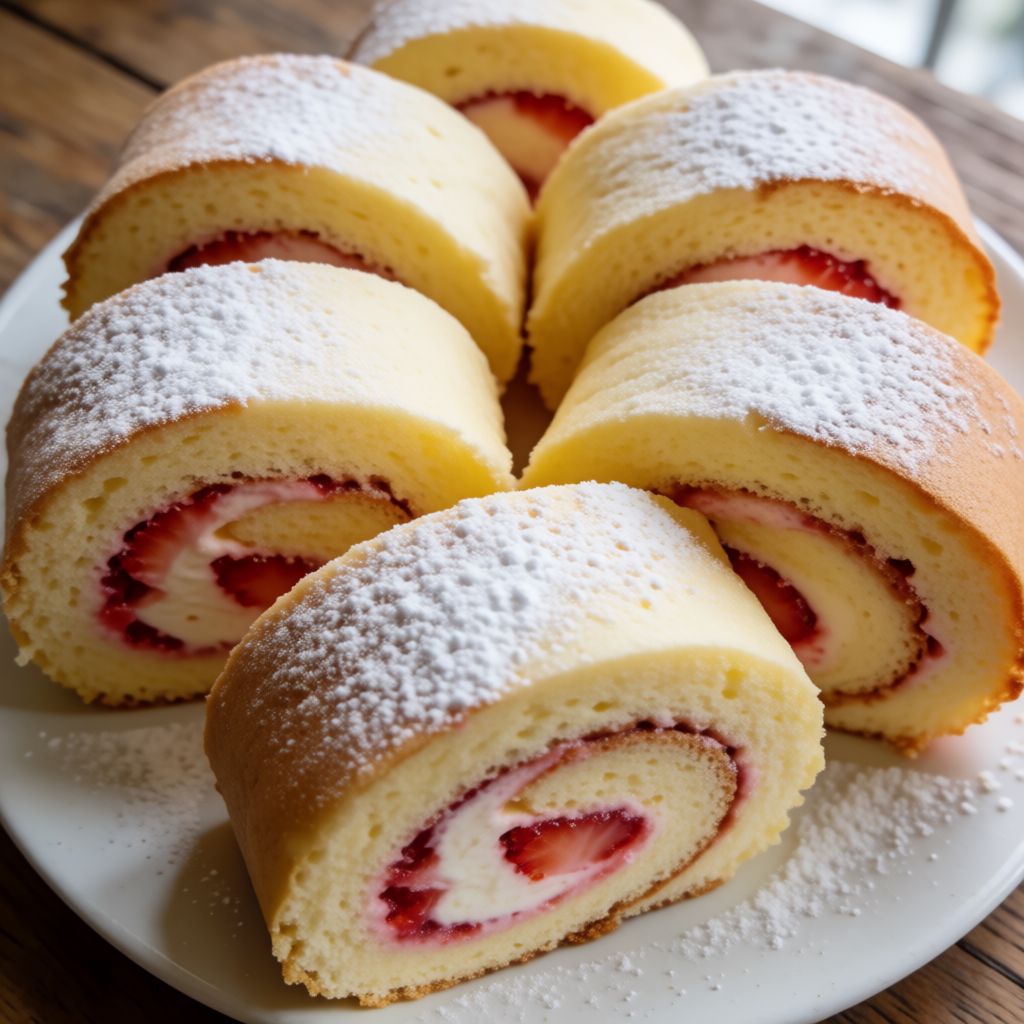
 AI photo
Swiss Roll with Strawberry Jam
A light sponge roll filled with strawberry jam, dusted with icing sugar.
Labels are worked out automatically from the ingredients and can be wrong. Check the packaging if it matters to you.
Ingredients
- 75 g Plain flour
- 45 g Potato starch
- 3 pcs Eggs
- 120 g Caster sugar
- 35 g Vegetable oil
- 1 pcs Lemon zest
- 8 g Baking powder
- 1 tsp Vanilla extract
- pinch Salt a pinch
- Icing sugar to taste, for dusting
- Strawberry jam to taste










Steps
In a stand mixer or with an electric whisk, whisk the eggs with a pinch of salt and the caster sugar for several minutes until light and thick.
Flavour the mixture with the lemon zest.
Gradually pour in the vegetable oil, continuing to whisk.
Stir the potato starch, baking powder and vanilla extract into the flour.
Fold the dry mixture into the batter in batches, gently mixing with a hand whisk.
Line a tin with baking parchment and pour in the batter.
Level the batter with a spatula.
Bake in a preheated oven at 200°C.
15 minDampen a clean kitchen cloth, wring it out and lay it on the surface, then sprinkle with sugar.
Take the tin out of the oven and turn the sponge out onto the cloth.
Carefully peel off the baking parchment.
Spread an even layer of strawberry jam over the sponge.
Starting from the longer side, carefully roll up the sponge.
Let the surface dry completely.
Dust with icing sugar through a fine sieve.
Transfer the roll to a dessert plate and slice just before serving.
What was changed
Vanilla extract is used in the batter instead of vanillin, since vanilla sachets are not common here.
A Swiss roll is a sponge that has to bend without cracking — and everything in the recipe exists to buy you that bend. It's a thin sheet, baked hot and fast, rolled while it's still warm and flexible, then unrolled, filled, and rolled again for good. Six slices come off one tray, more if you cut them mean.
The mechanism is this: starch and air. Potato starch replaces some of the flour so the crumb sets tender rather than tough — flour alone gives you gluten, gluten gives you stretch resistance, and stretch resistance is exactly what cracks a sponge when you roll it round a jam filling. The air comes from whisking eggs and sugar until they're pale and thick, not from the baking powder, which is only there as a safety net. That ribbon stage — where the batter falls off the whisk in a slow, thick trail and holds its shape for a second — is what gives you lift without a thick, bready crumb. Rush that stage and the sponge bakes flat and stiff, and a flat stiff sponge is the one that splits.
Some say you need a rolling pin and a tea towel ritual passed down for generations to get this right. No — you need a damp cloth, because a dry one would stick to the warm sponge and tear it, and a cloth with sugar on it so the surface doesn't glue itself shut as it cools. That's the whole secret, and it's plumbing, not folklore.
Watch for doneness, not the clock: the sponge should spring back when you press it lightly in the centre, and the edges pull very slightly away from the tin. Fifteen minutes is a floor, not a promise — ovens lie, especially small domestic ones with hot spots, so check a minute or two either side. Pulling it out underdone means it collapses as it cools; overdone and it's already too dry to roll, and no amount of jam saves a cracked sponge.
The rolling itself happens the moment it comes out, onto that sugared damp cloth, while the crumb is still hot and pliable — not because of ceremony, but because a cooled sponge has set its shape and will only crack if you try to bend it afterwards. Roll it up bare first, with the parchment peeled off, let it sit a few minutes to learn that curled shape, then unroll, spread the jam, and roll again. That first "training roll" is the part people skip and then wonder why the filled roll splits along the top.
On the eggs: three whole eggs whisked with sugar is what gives you structure here, no separate whipped whites, no folding drama — simpler, and forgiving in a home kitchen without a stand mixer's patience. If you're doing it by hand with an electric whisk, give it the full several minutes; this is the one step where rushing shows up later as a sponge that won't bend.
The oil matters more than people think. Thirty-five grams of a vegetable oil with no flavour of its own — sunflower, rapeseed, whatever's cheap and clean — keeps the crumb soft once it cools, because oil stays liquid at room temperature while butter firms up and stiffens the sponge exactly when you need it flexible. Use butter if that's what's in, melted and cooled, but know you're trading some suppleness for flavour.
Lemon zest and vanilla aren't decoration, they're there because a plain eggy sponge needs a background note or it tastes of nothing much once it's rolled round sweet jam — any citrus zest does the same job, orange works fine if that's what's to hand.
Strawberry jam is the traditional filling because it's cheap, keeps all year, and spreads without weeping too much liquid into the crumb — a jam with a loose, runny set will soak the sponge and make it harder to roll cleanly, so if yours is thin, warm it slightly and let any excess water cook off first, or just spread a thinner layer.
Icing sugar dusted through a sieve at the end does two jobs: it looks finished, and a fine, even layer doesn't clump the way spooning sugar straight on would — patience here is five seconds with a sieve, not a skill. Slice just before serving, because a cut roll sitting out dries at the edges and the jam starts seeping into the exposed crumb — not a disaster with tea and milk alongside, but it's better fresh-cut.