
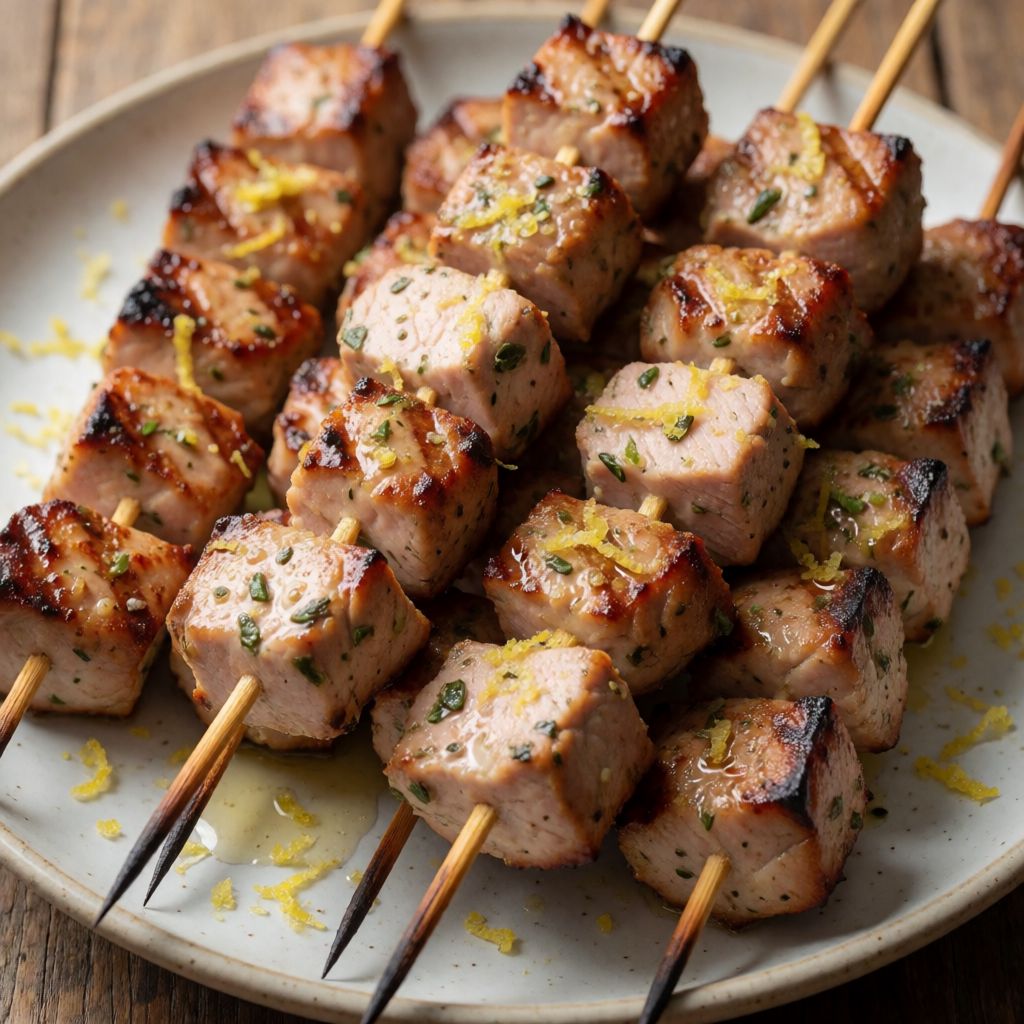
 AI photo
Souvlaki – Greek Kebab
Greek-style pork souvlaki wrapped in homemade flatbread with tzatziki, red onion and fresh mint.
Labels are worked out automatically from the ingredients and can be wrong. Check the packaging if it matters to you.
Ingredients
- 1 bunch Mint fresh

Kebab
- 300 g Pork chop pork
- ½ pcs Lemon juice of
- 1 tbsp Mint dried
- 1 tbsp Oregano dried
- 2 clove Garlic crushed
- 3 tbsp Olive oil for frying
- Salt
- Black pepper freshly ground







Flatbreads
- 200 g Plain flour
- 100 g Wholemeal flour
- 200 ml Water
- 1 tsp Salt
- 3 tbsp Olive oil plus extra for rolling



Tzatziki
- 1 pcs Cucumber coarsely grated
- 1 clove Garlic crushed
- 100 ml Greek yoghurt 10%
- Salt
- Black pepper freshly ground

Steps
Cut the chops into bite-sized pieces and place them in a bowl.
5 minMake a marinade from olive oil, lemon juice, mint, oregano, garlic, salt and black pepper, mixing it all in a bowl, and pour it over the meat.
3 minCover and refrigerate for a few hours, ideally from morning to evening.
120 minThread the meat onto skewers and grill over a hot grill — or quickly fry the meat together with the marinade in a very hot pan.
6 minPour the oil and water into a bowl, add the wholemeal flour, plain flour and salt, and knead well into a dough.
2 minLet the dough rest for half an hour.
30 minDivide the dough into 10 equal balls and roll them into very thin flatbreads, using olive oil on the work surface instead of flour.
Heat a frying pan over medium heat and cook the flatbreads on it.
Put the grated cucumber in a bowl, sprinkle with salt, mix well and leave for a quarter of an hour.
15 minSqueeze the liquid out of the cucumber (or let it drain through a sieve), mix the cucumber, garlic and Greek yoghurt, and season with pepper to taste.
3 minWrap the kebab meat, tzatziki, red onion and fresh mint leaves in the flatbreads.
2 min
Souvlaki is a street-food logic: cheap cut, fast fire, bread to carry it. In Athens it's pork shoulder off a charcoal grill, wrapped in pitta thin enough to fold without cracking. In your flat you won't get the charcoal smoke — that particular bitterness-and-sweetness only comes from fat dripping onto hot coals — but you can get the two things that actually matter: a marinade that's been given real time, and a pan hot enough to sear, not stew, the meat.
The marinade isn't there to make pork taste like lemon and oregano. It's there to break down the toughness of a cheap cut and let salt work its way in before heat ever touches it. A few hours does something; overnight does more — the acid and salt need time to move past the surface, not just sit on it. If you cut the pork small (bite-sized, as the recipe says) you shorten that journey, which is exactly why small pieces work for a quick marinade and a whole chop doesn't.
The flatbread is the other half of the engineering. Shop pitta is leavened and puffs into a pocket — fine for stuffing, wrong for wrapping, because a wrapped flatbread needs to bend, not burst. This dough has no yeast and barely any rest, so it stays flat and pliable, closer to a chapati than a pitta. That's not a shortcut; that's the correct bread for this job.
Tzatziki's only enemy is water. Cucumber is mostly water, and if you skip salting and draining it, you get yoghurt soup, not a sauce that clings to meat. Everything else in this dish is forgiving. The sauce is not.
Pork shoulder or a chop like this one works because it has enough fat and connective tissue to survive quick, hot cooking without drying into cardboard — a lean loin would seize up in the same pan. If you're swapping in chicken thigh (also traditional in Greece, cheaper than pork in some places), treat it the same way: skin removed, cut small, same marinade time. Chicken breast is the one cut to avoid here; it has no fat reserve to protect it from a hot pan.
The marinade itself is just acid, oil, salt, and two herbs doing three separate jobs. Lemon juice is the acid that starts loosening muscle fibre — not "cooking" the meat as ceviche myths would have you believe, just softening it at the surface. Olive oil carries the dried herbs' flavour into the meat and stops the lemon drying it out. Oregano and mint are the Greek signature; if you're out of dried mint, use more oregano rather than fresh mint, because fresh herbs burn and turn bitter in a screaming-hot pan, while dried ones are already past that stage. Any oil with no smell of its own will do the carrying job — a flavourless vegetable oil at a pinch — but olive oil is doing double duty here as both marinade and frying fat, so don't swap it out for frying and keep it for the marinade only; that's a false economy.
On the dough: wholemeal flour alongside plain isn't nostalgia, it's structure. Wholemeal brings bran, which is sharp enough to tear gluten strands if it's the only flour you use — that's why it's cut with plain flour rather than used alone. Water and a short knead build just enough gluten to roll thin without tearing; the half-hour rest lets that gluten relax so it doesn't spring back fighting you with the rolling pin. Rolling in oil instead of flour matters for one plain reason: flour on the surface would scorch in the dry pan before the dough underneath has cooked, leaving black specks and a raw centre. Oil doesn't scorch at the same temperature, and it won't toughen the dough the way a floured surface can.
Cooking the flatbread is a dry pan, hot enough that a drop of water sizzles off instantly — too cool and the dough stiffens before it browns, drying into a cracker instead of staying soft. You're looking for small brown blisters and a bread that still bends in your hand once off the heat. Stack them under a tea towel as they come off the pan; the steam they trade with each other is what keeps the whole batch pliable instead of letting the first one go leathery while you cook the ninth.
The yoghurt: Greek-style at 10% fat isn't a style choice, it's a structural one — it's already been strained of whey, so it holds its shape around the cucumber instead of running off the bread. A lower-fat yoghurt will work if you strain it yourself through a sieve lined with kitchen roll for an hour first; skip that and you're back to the same water problem the cucumber causes.
This feeds four as a proper meal — allow two or three wraps a head, more if people are hungry and you've made the full ten flatbreads. The patience here isn't dramatic: it's the marinating hours you can't see and shouldn't rush, and the fifteen minutes the cucumber needs to give up its water. Neither step looks like cooking. Both are the reason the dish holds together when you finally roll it.