
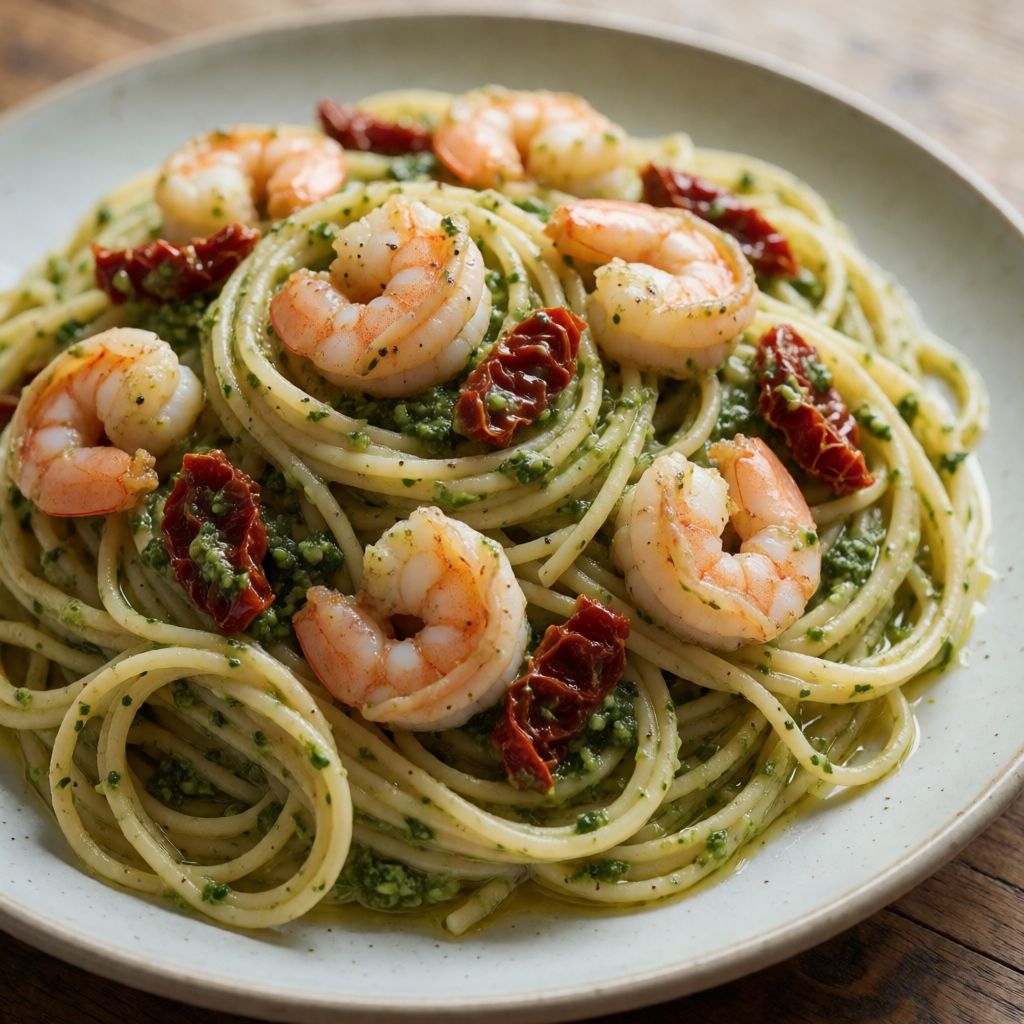
 AI photo
Spaghettini with Prawns, Mint Pesto and Sun-Dried Tomatoes
A quick pasta dish with prawns, fresh mint pesto and sun-dried tomatoes.
Labels are worked out automatically from the ingredients and can be wrong. Check the packaging if it matters to you.
Ingredients
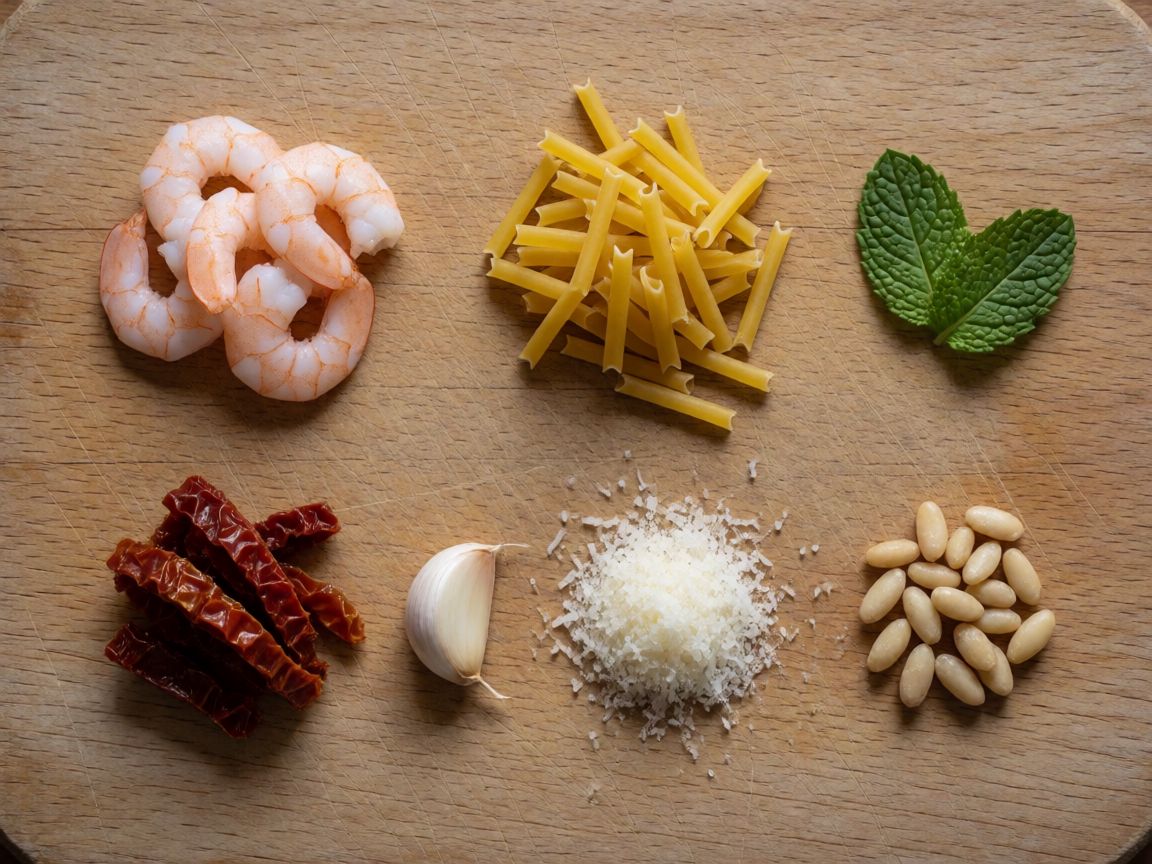
- 200 g Prawns
- Olive oil to taste
- Salt to taste
- Black pepper to taste
- 400 g Spaghettini
- 2 pcs Mint
- 1 package Sun-dried tomatoes
- 1 clove Garlic
- 1 tbsp Parmesan
- 40 g Pine nuts










Steps
In a blender, blitz the mint leaves with a pinch of salt.
Turn on the blender and add the sun-dried tomatoes, pine nuts, garlic, Parmesan and olive oil; blend until smooth.
Cook the spaghettini in plenty of salted boiling water until al dente.
Heat olive oil in a frying pan and quickly sear the prawns, seasoning with salt and black pepper. Doneness: 63°C at the thickest point.
Drain the pasta al dente and transfer it to the pan with the pesto.
Mix well, warm through for a few minutes and serve immediately.
This is two small jobs wearing one name. One pan does a fast sear on prawns — fifty grams a head, so they're an accent, not the meal. The blender does the other job: a paste that calls itself pesto but isn't the Genovese kind — mint stands in for basil, sun-dried tomato brings a sweet, leathery chew that fresh tomato could never hold onto. Pesto means "pounded" — traditionally a mortar job, slow, cool, done by hand so the oils never get hot enough to turn the leaf bitter. You're using a blender because that's what a flat kitchen has, and that's fine, as long as you respect why the mortar was slow in the first place.
What decides whether this works is two failures happening on opposite sides of the stove, and you have to watch both. The pesto fails by going khaki and sour-tasting instead of green and sharp. The prawns fail by turning into little grey erasers.
The pesto: you blitz the mint with salt before anything else, and that's not seasoning for its own sake — salt crystals act like sandpaper against the blade, tearing the leaf cell walls open fast, so you get a short sharp burst of chlorophyll and oil instead of a long grind. Long grinding is what heats the blade, and heat is what turns green herbs to brown mush with a bitter edge. Pulse, don't run it continuously, and only add the oil and everything else once the mint's already broken down — the oil's job from there is to cool and carry, not to help you chop.
Mint instead of basil isn't a twist for its own sake — it's a sharper, cooler-tasting leaf, and it needs something to lean against, which is exactly what the sun-dried tomato gives it: concentrated sweetness and a bit of leathery bite, a texture no fresh tomato has because fresh tomato is mostly water. Drying tomatoes in the sun was never a style choice to begin with — it was what you did with a glut before refrigeration existed, Mediterranean summers producing more tomatoes than any household could eat fresh. The dried, oil-packed jar you buy now is that same economics, just packaged. If yours came dry rather than in oil, soak it in warm water or warm oil first — straight into a blender it'll just shred instead of blending smooth.
Pine nuts are there for fat and a mild, almost creamy flavour that doesn't argue with the mint or the garlic. They're also the most expensive thing in the list, especially in a UK supermarket, and there's no shame in swapping them — the criterion is a mild, oily nut or seed that blends to a cream rather than a grit. Cashews do this well. Blanched almonds, slightly less creamy but close enough. Sunflower seeds if someone at the table can't have nuts at all.
Garlic goes in raw here, one clove, which means its bite stays — raw garlic is sharper and more volatile than cooked, and this sauce is built to be sharp. If that's too much for you, you can take the raw edge off by crushing it with the flat of a knife rather than mincing it fine, which limits how much surface area hits the air and the blade. Parmesan does the savoury, salty backbone that pesto always needs — any hard, aged grating cheese works on the same principle, pecorino being the obvious one, just saltier, so taste before you add more salt elsewhere.
For the oil in the sauce, the rule is simple: anything with no smell of its own, so the mint and tomato stay the flavour you taste, not the oil. A decent olive oil is traditional and fine, but a neutral one — sunflower, say — will do the job if that's what's in the cupboard; what you lose is a faint grassy background note, not the structure of the sauce.
Spaghettini is chosen for being thin — it cooks fast and carries a loose, blended sauce without needing to trap it the way a ridged or tubular pasta would. Four hundred grams for four people is the ordinary Italian ratio, a hundred grams each, so don't be tempted to stretch it further; this dish is built light, prawns included at fifty grams a head, which tells you it's meant to taste of sauce and prawn together, not to be a prawn dish padded out with pasta. Once the pasta's drained, it goes into the pan with the sauce over low heat for a couple of minutes, no more — this is to let starch and sauce marry and cling to the strands, not to cook the mint a second time. If it looks tight and won't coat evenly, a splash of the pasta's own cooking water loosens it; that water's cloudy with starch, and starch is what makes a sauce grip pasta instead of sliding off into a puddle at the bottom of the bowl. A wide pan earns its keep here too — wide enough that pasta and sauce can be tossed and turned rather than stirred in a crowded pile, which is the only way the coating ends up even.