
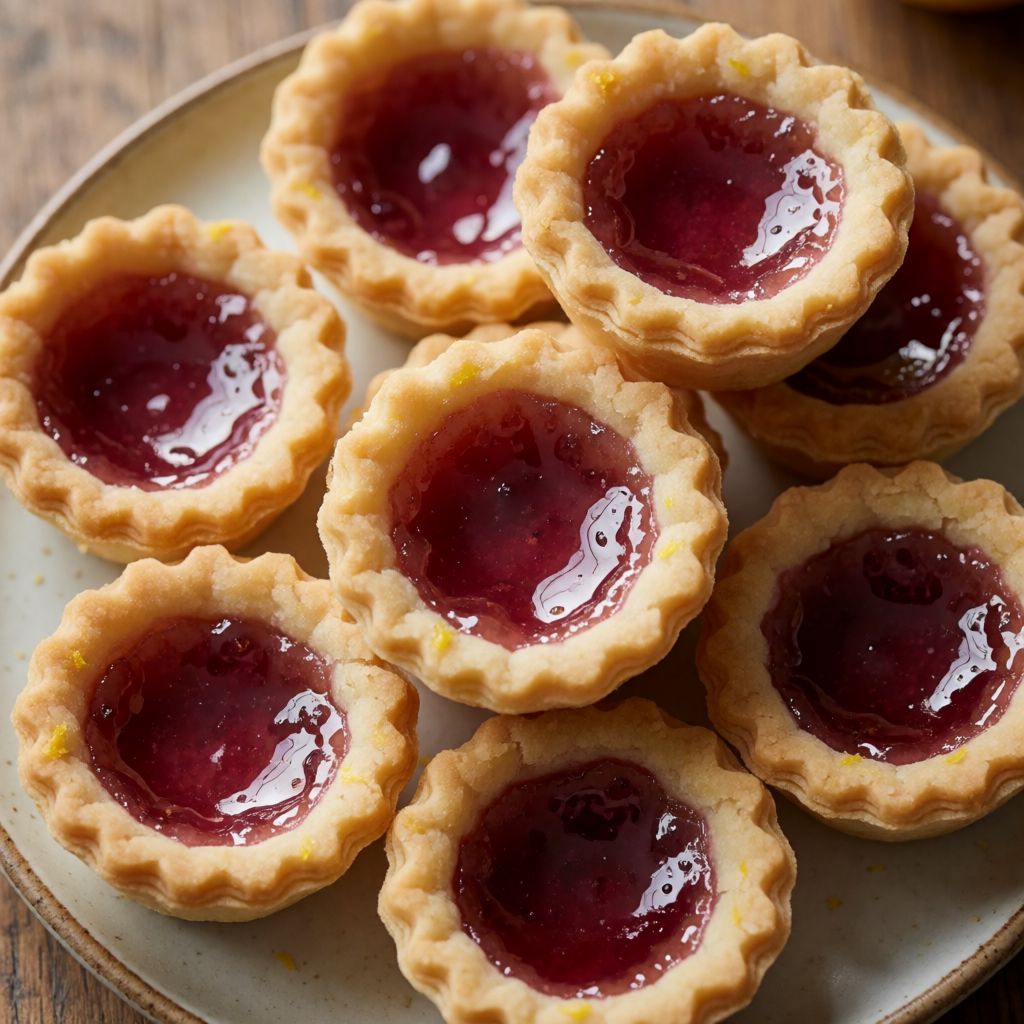
 AI photo
Jam Tartlets
Buttery shortcrust tartlets filled with jam, finished with a lattice of pastry on top.
Labels are worked out automatically from the ingredients and can be wrong. Check the packaging if it matters to you.
Ingredients
- 200 g Plain flour
- 1 pinch Salt
- 80 g Caster sugar
- 120 g Butter chilled, straight from the fridge
- 2 pcs Egg yolks
- 1 pcs Lemon zest from half a lemon
- 1 tsp Vanilla extract
- 180-200 g Jam








Steps
On a work surface, heap the flour, add the sugar and a pinch of salt, then flavour with lemon zest and vanilla extract.
In the centre add the cold butter and the egg yolks and begin bringing all the ingredients together.
Knead the dough firmly by hand until it becomes smooth and firm.
Wrap the dough in cling film and leave it in the fridge.
40 minRoll out the dough to a thickness of about half a centimetre.
Using a cutter, cut out circles about 10 cm in diameter.
Transfer the dough into the tartlet tins, gently pressing the edges and trimming off any excess.
Fill each tartlet with jam (about 45-50 g).
Decorate the tartlets with the leftover dough, forming a classic lattice or another pattern.
Brush the surface with a lightly beaten egg yolk and bake in a preheated fan oven at 180°C.
38 minLet the tartlets cool slightly before serving.
What was changed
Replaced Butter with butter, which is what British kitchens use for this pastry.
This is pasta frolla, the shortcrust that Italians built an entire family of jam tarts on — crostata in a single tin, or here, four little ones. The whole dish is a contest between two forces: fat and flour. Butter coats flour particles and blocks them from forming long gluten strands, which is exactly what you want, because gluten is chewiness, and chewiness is the enemy of a tart shell. You're not making bread. You're making something that should break, not stretch.
What decides whether it works is temperature discipline, not skill. Cold butter, straight from the fridge, cut into the flour before it has any chance to soften — that's the whole trick. Some say you need ice water or a food processor to keep pastry cold; no, because the real danger isn't your hands, it's time. Warm butter melts into the flour instead of staying as separate flecks, and those flecks are what create the flaky, sandy crumb. Once it melts in, you've made a dense biscuit, not a tart.
The 40 minutes in the fridge after kneading isn't optional resting for the sake of ritual — it relaxes the gluten you did form (some always forms, however gently you handle it) so the dough doesn't shrink back and fight you when you roll it, and it re-firms the butter so it holds shape in the oven instead of slumping before it sets. Skip this and your circles will spring back smaller than you cut them, and your edges will slide down the tin walls as they bake.
Flour is just the structure, nothing clever about it — a plain flour, not strong bread flour, because you don't want the elasticity that bread flour's extra protein gives you. If a recipe for pastry is fighting you on the roll, too-strong flour is usually why.
Butter is the one ingredient where quality actually matters, because it's doing a textural job, not just a flavour one. Chilled, unsalted is standard (you've added your own pinch of salt, so you control it) — and straight from the fridge is a requirement, not a suggestion. If you've only got salted butter, drop the added pinch of salt, don't double up. There's no good substitute here: margarine or any spreadable fat with added water will steam instead of flaking, and you'll get a tough, pale crust. This isn't a dish for compromise fats.
Egg yolks bind the dough and add richness without adding the water that whole eggs would — water is what you're trying to minimise, because water plus flour is what builds gluten, and gluten is what makes pastry tough instead of short. That's also why there's no liquid anywhere else in this list. The extra yolk you'll want for brushing the lattice at the end isn't in the ingredient count above but it's standard practice — a thin wash gives you shine and colour, not moisture, because by then the yolk is going on the outside, not into the structure.
Sugar here is doing more than sweetening: caster sugar's fine grain dissolves evenly through the dough, giving a tender, almost sandy bite rather than the dense snap you'd get if sugar crystals sat undissolved. Lemon zest and vanilla are there to cut the flatness of a plain butter-flour base — zest from half a lemon is enough; more and the pastry turns bitter from the pith oils, so keep the zester shallow.
Jam is the one place where you can play. Use whatever jam you like, but one with real fruit body rather than thin syrup — a loose jam will run before it sets and leak through the lattice gaps. If your jam is runny, you can reduce it gently in a pan for a few minutes first to thicken it, and let it cool before filling, which also stops it blistering the raw pastry underneath with heat it hasn't earned yet.
On an ordinary British hob and oven: a fan oven at 180°C is a genuinely hot, fast environment for small tartlets, so don't walk away — 38 minutes is the floor, not a fixed point, and you're watching for the pastry edges turning an even gold-biscuit colour, not pale, not dark brown, and the jam setting from glossy-wet to a slightly thickened sheen, not bubbling violently. If your oven runs hot or doesn't distribute evenly — many flat ovens have a hot back corner — turn the tray halfway rather than trust the timer blindly.
And give the dough its fridge time without shortcuts. You can't rush cold butter into being cold, and you can't rush relaxed gluten into relaxing. Patience here isn't virtue for its own sake — it's the difference between a shell that holds its shape and one that slides down the tin while you watch, slightly heartbroken, through the oven door.