
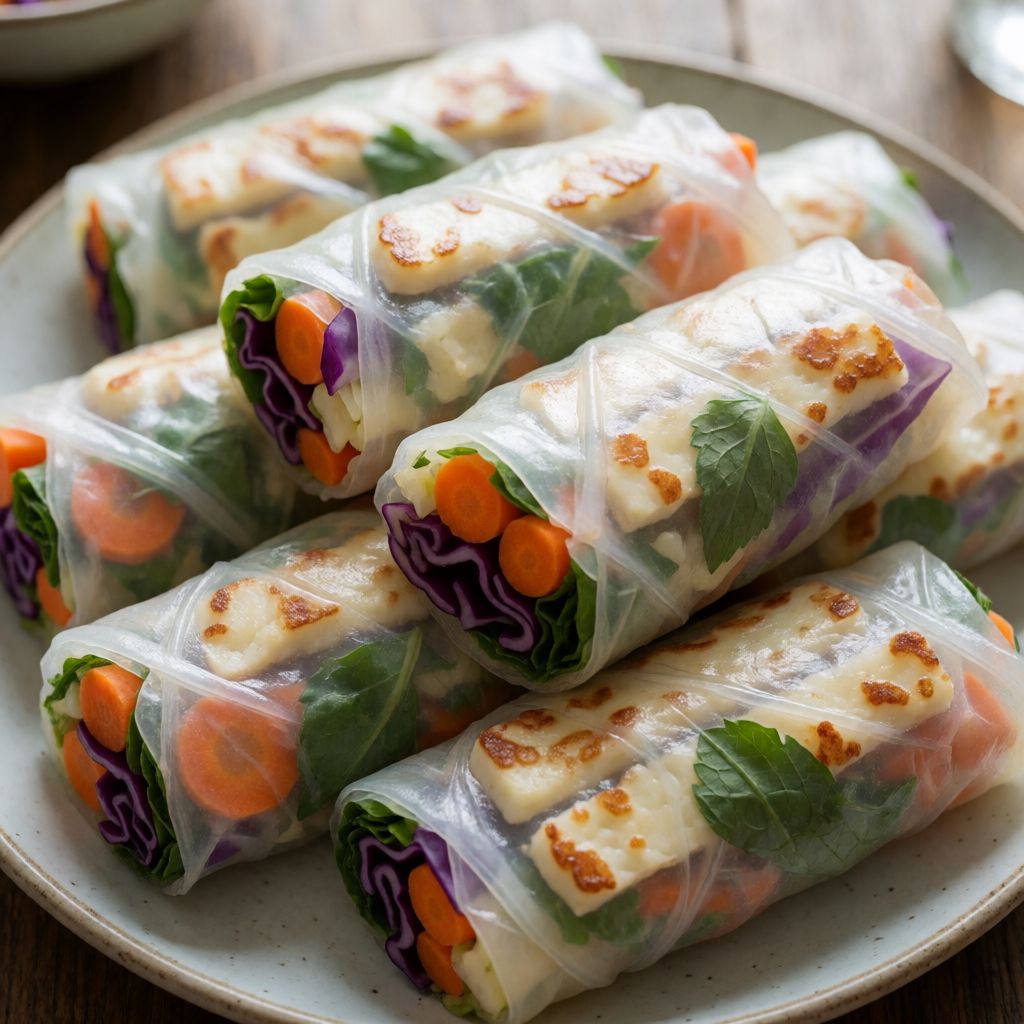
 AI photo
Summer Rolls with Vegetables and Halloumi
Fresh summer rolls filled with crisp vegetables, strawberries and golden halloumi, served with a peanut dip.
Labels are worked out automatically from the ingredients and can be wrong. Check the packaging if it matters to you.
Ingredients
- 100 ml Peanut butter
- 3 tbsp Soy sauce
- 100 ml Coconut milk
- 3 tbsp Hoisin sauce
- 3 pcs Lime juice of
- 1 tbsp Ginger finely grated
- 1 tbsp Sesame seeds
- 250 g Halloumi
- 2 pcs Avocado
- 1 pcs Cucumber cut into thin strips
- 125 g Spinach
- 0.5 pcs Pointed cabbage shredded
- 3 pcs Carrot cut into thin strips
- 1 bunch Coriander fresh
- 1 bunch Basil fresh
- 1 package Strawberries cut into quarters
- 16 pcs Rice paper
- 2 tbsp Sesame oil or another oil for frying












Steps
For the peanut dip: mix the peanut butter, soy sauce, coconut milk, hoisin sauce, lime juice and finely grated ginger. Adjust the consistency with coconut milk and season to taste.
5 minSlice the halloumi, then cut into strips. Fry in sesame oil in a pan until crisp.
4 minPrepare all the vegetables: cut the cucumber and carrot into strips, shred the cabbage, cut the avocado and the berries.
10 minPour water into a large bowl, dip a sheet of rice paper in it, then lay the softened sheet on the kitchen worktop.
Arrange the vegetables, berries and halloumi on the rice paper in a strip through the middle, fold the sides over the filling and roll into a tight fresh roll.
15 minServe with the peanut dip, and if any vegetables are left over, serve them as a side garnish.
This isn't a cooked dish, it's an assembly job, and that changes what "going wrong" means. Nothing here needs heat to become safe or digestible — the carrot stays raw, the cabbage stays raw, the only thing that touches a pan is the halloumi. So the whole recipe lives or dies on two things: whether your rice paper rolls without tearing, and whether the dip is thick enough to actually coat something instead of running off it.
Some say rice paper is temperamental and will punish you. No — it's forgiving, you're just overshooting the water. It needs to go from brittle to pliable, not to fully hydrated and slack. Dip it, lay it down, and by the time you've placed the first strip of carrot it's already softened further just sitting there — rice paper keeps absorbing moisture off the worktop. Pull it out too late and you're rolling with wet tissue paper that splits the second you apply tension. Pull it out while it still has a faint resistance, almost like a contact lens, and it tightens around the filling as it finishes softening on the counter. That's the whole trick, and it's a timing trick, not a soaking-length trick — you're reading the sheet, not counting seconds.
Halloumi: the brining is why it fries instead of melting into the pan — that firmness is the entire point of the cheese, and it's the reason it survived centuries as a travelling, keepable protein in hot climates with no fridge. Buy the block, not pre-sliced strips if you can avoid it — pre-cut dries at the edges before it ever sees oil. If you can't get halloumi, you want another salty, high-melting-point cheese — paneer is the honest substitute, same brining logic, same reason it holds a fry.
The oil for frying it needs to do one job only: carry heat to the cheese without adding its own flavour on top of soy, hoisin and ginger that are already busy. Sesame oil here is for its own taste, so use it, but if you don't have it, "any oil with no smell of its own" is the rule — sunflower, groundnut, a flavourless rapeseed. Olive oil fights the dish; it has an opinion.
The dip is where most people under-season without noticing, because peanut butter and coconut milk both taste "finished" on their own and mute everything you add after. Taste it only once it's fully mixed, never mid-stir — soy, lime and hoisin need a minute to actually distribute through a fat-heavy base, and judging it too early means you oversalt trying to fix a flavour that was never missing, just not yet spread through. If it seizes up thick as paste, that's not a mistake, that's what peanut butter does in contact with acid and salt — loosen it with more coconut milk, a spoon at a time, not water, or you dilute the flavour instead of just the texture.
Carrot and cucumber in strips, not grated — grated vegetables weep water into the roll and that water goes straight into the rice paper from the inside, turning a sheet that's already damp from dipping into something that disintegrates. Cut with a knife or a julienne peeler, something with a flat edge, so the strip has a cut face rather than a torn one — torn vegetable edges release juice faster.
Spinach and the herb bunches are there for a smell, not a crunch, so they go in loosely, not packed — a tight wad of basil in a roll just becomes one solid flavour note instead of something you taste in passing. Strawberries are the one unexpected ingredient on the list and they're doing what pickled or acidic fruit usually does in a dish like this: cutting the richness of peanut and coconut with something sharp and cold. If strawberries aren't in season or you can't find decent ones, a sharp fruit with real acid does the same job — a few slices of unripe mango, or even apple, though it won't carry the same scent.
On the "medium heat" question for the halloumi: there isn't one you can rely on here because every hob is different, so don't look for a number. Watch the oil — it should shimmer, not smoke, before the cheese goes in. Smoke means the outside will scorch before the middle's warmed through, and a scorched edge on halloumi doesn't crisp, it bitters.
And patience is genuinely the scarce ingredient in this one, more than any item on the list. Sixteen sheets of rice paper rolled one at a time, each needing its own dip, its own wait, its own careful fold — that's real time at the counter, not active cooking time, and the recipe's "45 min cook" undersells how much of this is standing there with wet hands. Rushing the roll is the single most common reason these fall apart on the plate rather than in the kitchen.