
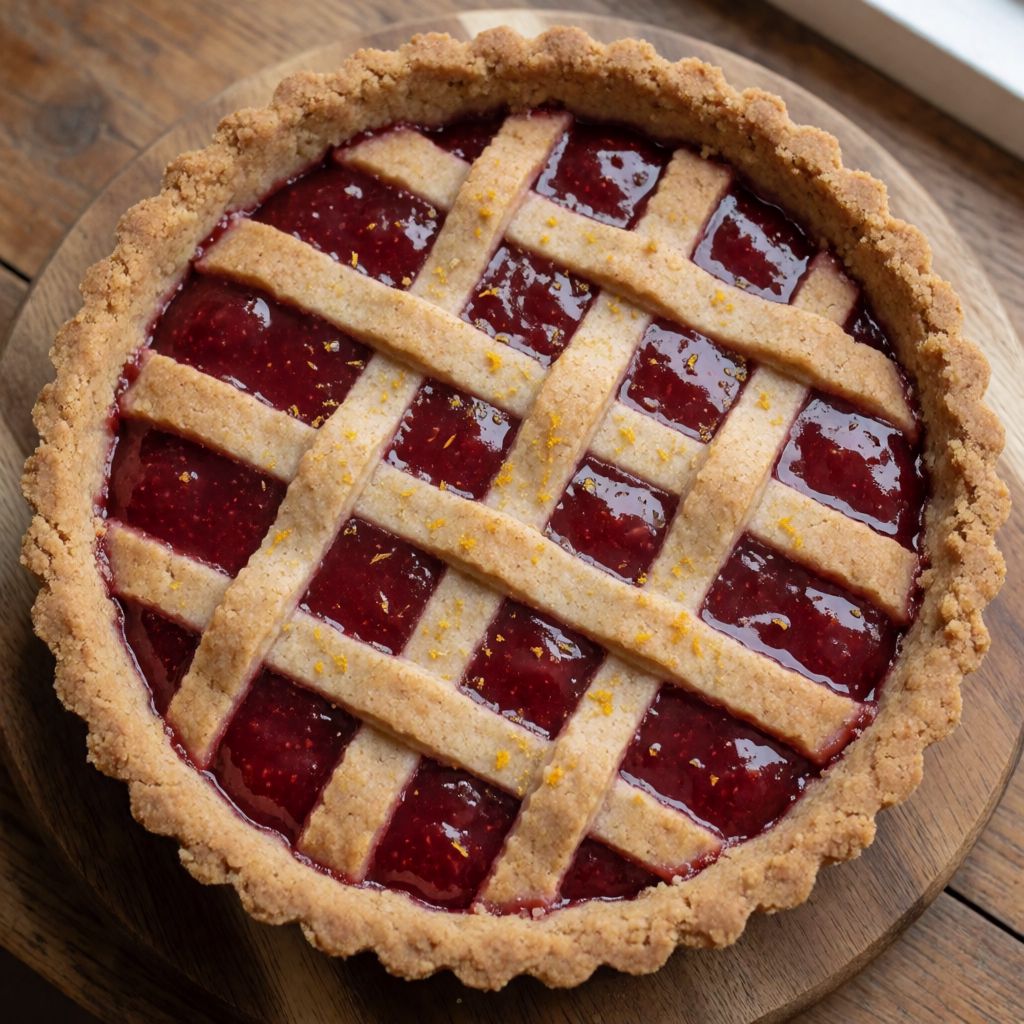
 AI photo
Vegan Strawberry Jam Tart
A vegan lattice tart filled with strawberry jam, scented with orange and lemon zest.
Labels are worked out automatically from the ingredients and can be wrong. Check the packaging if it matters to you.
Ingredients
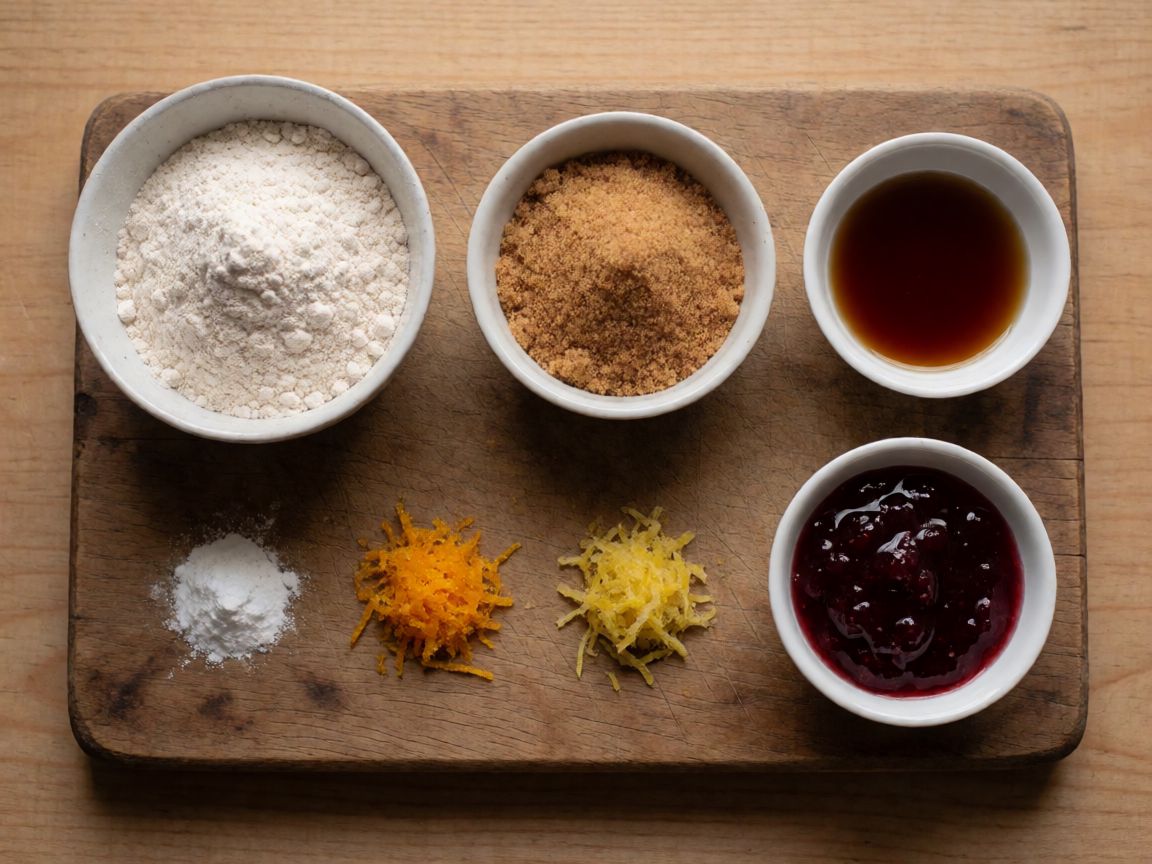
- 500 g Wholemeal flour or wholemeal
- 200 g Brown sugar
- 1 pinch Salt
- 8 g Baking powder
- 1 pcs orange zest
- 1 pcs lemon zest
- 125 ml Water
- 1 tsp Vanilla extract
- 80 g Vegetable oil
- 60 g Olive oil
- 250 g strawberry jam










Steps
In a large bowl mix the water, vegetable oil, olive oil, vanilla extract and orange and lemon zest. Add the brown sugar and stir with a fork.
Add the flour, baking powder and salt and start mixing with a wooden spoon, bringing all the ingredients together into a firm dough.
Turn the dough onto a lightly floured surface and knead for a few more minutes until smooth.
Wrap the dough in cling film and leave it in the fridge.
60 minRoll out two-thirds of the dough with a rolling pin and line a greased 24 cm tin.
Prick the base with the tines of a fork and put it in the fridge.
35 minTake the tin out of the fridge and spread the strawberry jam evenly over the base.
Roll out the remaining dough, cut it into strips and lay them crosswise over the filling in a lattice pattern.
Preheat a conventional oven (no fan) to 180°C.
Finish the lattice and trim off the excess dough around the edges of the tin.
Bake the tart at 180°C.
35 minRemove from the oven, let it cool and serve.
This is crostata — the Italian jam tart — wearing a vegan coat and a wholemeal jumper. No butter, no eggs, and the dough still holds a lattice without weeping or cracking. That's the whole trick of the recipe: oil-based pastry behaves differently from butter pastry, and once you stop fighting that, the tart gets easy.
What decides whether it works is the dough's structure, not its flavour. Butter pastry is flaky because solid fat sits in layers and melts in the oven, pushing steam between sheets of gluten. Oil doesn't do that — it's liquid at room temperature, so it coats the flour instead of layering it. The result is a short, sandy, almost biscuit-like crust rather than a flaky one. Some say a tart without butter can't be "proper" pastry — no, it's a different pastry, built on a different mechanism, and wholemeal flour suits it better than white would, because the bran needs a forgiving fat, not a laminating one.
The second thing that decides success is the fridge rest, twice. First the whole dough, then the lined base. This isn't fussiness — gluten in wholemeal flour, kneaded until smooth, is tight and elastic; it will shrink back the moment you stop rolling unless it's given time, cold, to relax. Skip that and your base pulls in at the edges while baking, and the jam runs over the rim instead of staying inside it.
The dough's liquid side — water, two oils, zest, vanilla — goes in first and gets the sugar stirred through it before any flour arrives. That order matters: sugar dissolves into liquid, not into dry flour, and dissolved sugar won't leave gritty pockets in the baked crust. Add flour too early and you're stirring sugar crystals through dust; they stay crystals.
Two oils, not one, and this isn't a flourish. Vegetable oil (sunflower, rapeseed — whatever has no smell of its own) is the workhorse: it coats the flour, shortens the gluten, gives you that sandy bite. Olive oil adds its own flavour and a slightly firmer set once cool, because it has more saturated fat than sunflower oil and stiffens a touch as it cools. If you only have one oil in the cupboard, use it alone rather than hunting for a substitute — the tart will still work, just slightly plainer. What you shouldn't reach for is a strong, grassy extra-virgin olive oil for the whole 60g; it will out-shout the jam.
Wholemeal flour is named twice in the ingredient list as if hedging its bets — "or wholemeal" — which tells you the dish began as a white-flour crostata and got converted. Wholemeal absorbs more liquid and builds a tighter gluten web than white flour does, which is exactly why the resting step matters more here than in a classic version: give it less than that hour in the fridge and the base will fight you when you roll it, snapping back narrower than you left it. If you want a softer, more forgiving crust, cut the wholemeal with plain white flour — half and half is a fair swap, and the lattice will still hold.
Citrus zest is there to cut through the brown sugar's dense, caramel sweetness, not to make the tart taste of orange. Use the zest only — none of the white pith, which is bitter — and if you've only got one citrus fruit in the bowl, use that one; the tart won't collapse without both.
Baking powder is doing a small, quiet job: this is a short pastry, not a cake, so you want it barely risen, just enough to stop the base tasting flat and dense under the weight of the jam. Don't double it hoping for more lift — too much and the base puffs and cracks, breaking the seal that's meant to hold the jam in.
On jam: 250g of a firm, well-set jam is what the lattice is built to contain. If yours is runny — shop jams vary a lot — tip it into a small pan first and reduce it for a few minutes over gentle heat until it sits thick on a spoon rather than sliding off. That's not optional polish; a thin jam will boil and bubble through every gap in the lattice and scorch on the tin, which is the actual cause of the "burnt edges, raw middle" tart people blame on their oven.
On the oven: 180°C with no fan is specified because fan ovens push hot air and dry the surface faster — if yours only has fan, drop to about 160–165°C and keep an eye on colour rather than the clock. Doneness here isn't a timer going off; it's the crust turning from pale sand to the colour of a digestive biscuit, and the jam visible through the lattice gone from glossy-wet to set and slightly caramelised at the edges. Thirty-five minutes is where to start checking, not where to stop.
For a British kitchen: a 24cm loose-bottomed flan tin is the easiest tin for this, because the lattice and the thin wholemeal base are fragile and you don't want to be wrestling the tart out of a fixed tin with a fish slice. And give it real time to cool before cutting — jam filling stays molten-hot and loose well past the point the crust looks set; cut it warm and the lattice drags the jam with it.