
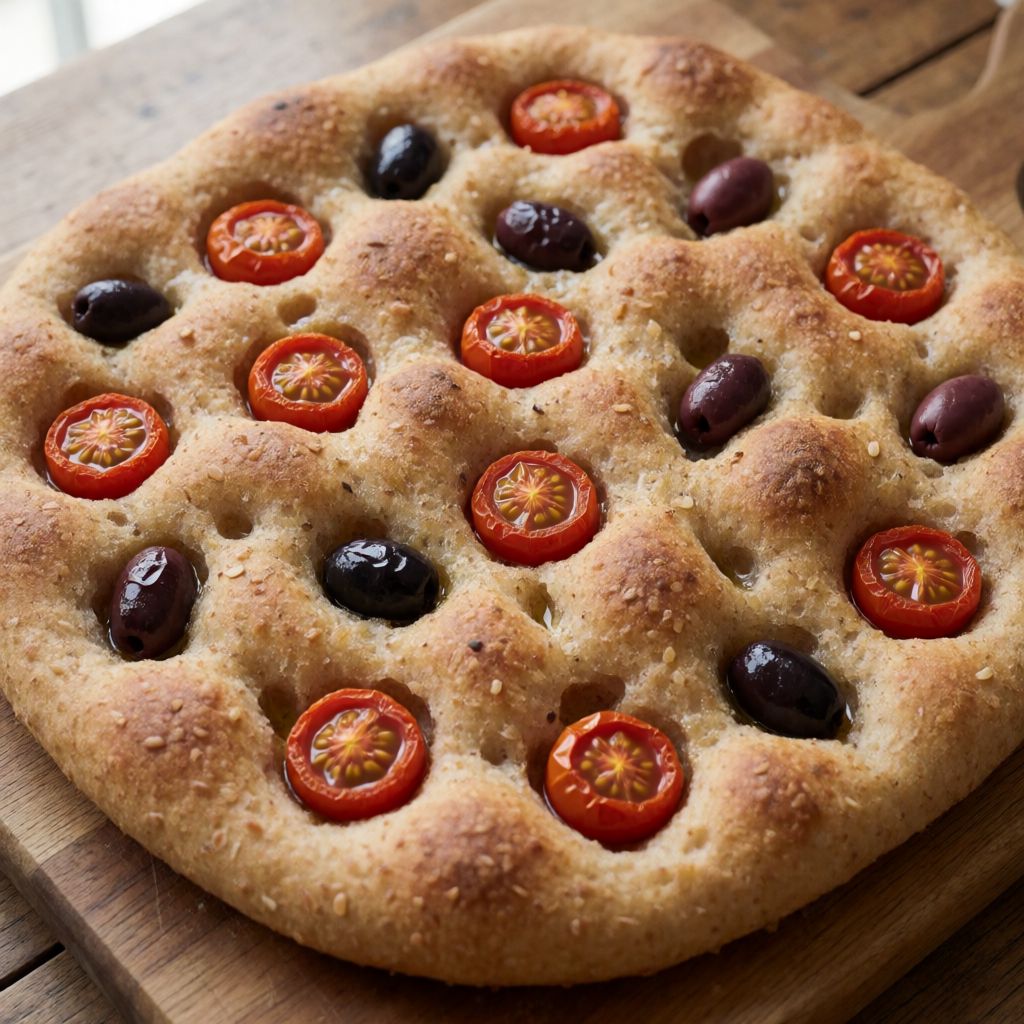
 AI photo
Wholemeal Focaccia with Cherry Tomatoes
A simple wholemeal focaccia topped with cherry tomatoes and olives, finished with fresh thyme.
Labels are worked out automatically from the ingredients and can be wrong. Check the packaging if it matters to you.
Ingredients
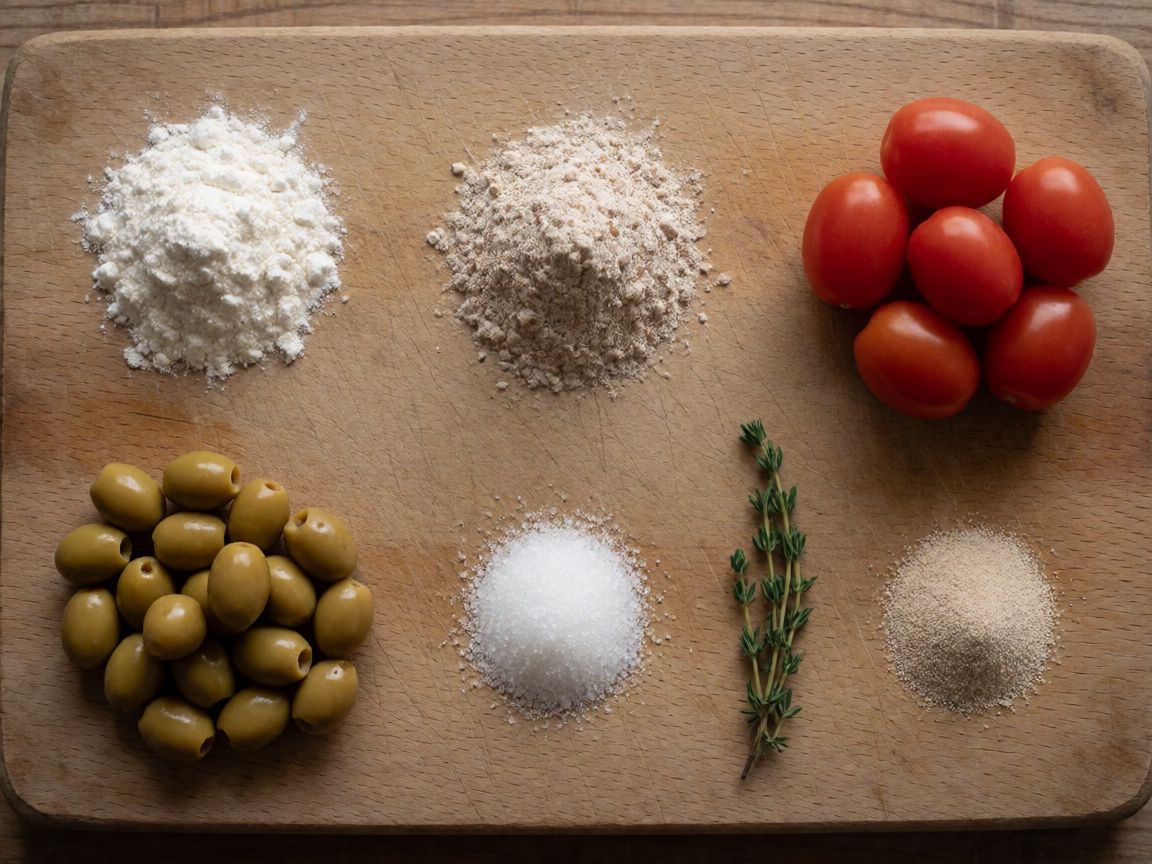
- 300 g Plain flour
- 200 g Wholemeal flour
- 270 ml Water
- 280 g Cherry tomatoes
- 70 g Olive oil
- 20 pcs Olives pitted
- 2 tsp Salt
- 1 tsp Caster sugar
- 8 g Yeast
- 1 bunch Thyme







Steps
Sift both types of flour into a large bowl and mix with two teaspoons of salt.
In a separate bowl, pour a little warm water, add a teaspoon of sugar and dissolve the yeast.
Add the yeast mixture to the flour and start kneading the dough by hand, gradually pouring in the rest of the warm water.
Add the olive oil and continue kneading until a smooth ball forms.
Return the dough to the bowl, cover with cling film and leave to rise.
60 minRoll out the dough with a rolling pin onto a baking tray lined with baking parchment.
Leave the rolled-out dough to rise again.
60 minWash the cherry tomatoes, cut them in half, and slice the olives into thin rings.
Arrange the cherry tomatoes and olive rings on the focaccia, spreading them evenly over the surface.
Add a few fresh thyme leaves and drizzle the surface with olive oil.
Bake the focaccia at 220°C.
30 minRemove from the oven and serve while still warm.
Focaccia is not bread pretending to be fancy — it's bread that got rolled flat, drowned in oil, and poked full of holes so the oven can't turn it into a loaf. Flat and wet is the whole trick. A loaf wants height and a tight crumb; focaccia wants the opposite — spread wide, soaked in oil, so it bakes into something closer to a savoury flatbread with a crisp underside and a soft, almost custardy middle.
Here half the flour is wholemeal, which changes the game more than people expect. Wholemeal bran is sharp — it slices through the gluten strands as you knead, so the dough never gets as stretchy as a white one. Some say wholemeal focaccia is automatically "heavier" — no, it's not heavier, it just can't trap gas the same way, so you get a denser, more honest crumb rather than a failed one.
What decides whether this works is the two rises, not the oven. First rise, in the bowl: the yeast is building gas pockets inside a dough that still has shape. Second rise, after you've flattened it onto the tray: this is the one people rush, and it's the one that matters most, because a dough that's just been rolled and stabbed by a rolling pin has had its gas knocked half out of it. Give it the second hour and it puffs back up into the open, bubbly texture that makes focaccia what it is. Skip it and you've baked a tomato-topped cracker.
The tomatoes and olives aren't decoration — they're there because the dough underneath is quite plain, carrying only oil and salt for flavour, and it needs something wet and something salty sitting on top to do the rest of the work.
Flour: the split between plain and wholemeal is doing a job, not just adding virtue. Plain flour brings the gluten that gives the dough stretch and the eventual open crumb; wholemeal brings flavour, a nuttiness, and the bran that — as said — cuts the gluten network short. All-wholemeal would give you a flatbread with no lift at all; all-plain would taste of not much. If you've only got plain flour in the cupboard, use it all and don't panic — you lose the nuttiness, not the dish.
Water, warm not hot: yeast is a living thing, and like you in a Sunday-roast kitchen full of steam, it works best somewhere comfortable — blood-warm, nothing that stings your wrist. Hot water doesn't make it work faster, it kills it, and then no amount of waiting brings a dead yeast back.
Yeast and sugar together in their own little bowl before anything else happens: this is you checking the yeast is alive, and also feeding it something fast to wake up on. Some bakers skip this and throw yeast straight into the flour — fine with instant yeast, risky with the ordinary dried kind, because you won't know it's dead until the dough sits there flat for two hours doing nothing.
Olive oil goes in twice — once kneaded through the dough, once poured over the top before baking. Inside the dough it's tenderising the crumb, getting between gluten strands so the bread stays soft rather than chewy. On top it's what gives focaccia its signature — a crust that's almost fried rather than baked, because oil pooling in the dimples conducts heat differently to dry dough. Use an oil with a flavour you actually like, because at this quantity you will taste it; if you've only got a flavourless vegetable oil, use that inside the dough and save a little good olive oil just for the top drizzle.
Salt in the dough controls the yeast as much as the taste — too much salt too early slows fermentation right down, which is why it goes in with the flour, mixed through evenly, rather than dumped straight onto the yeast.
Cherry tomatoes, cut side up, are chosen because they're small enough to sit in the dimples without sinking the dough, and because halving them exposes the flesh to the oven's heat so they blister and give up a little of their liquid onto the crust rather than staying raw and wet. Any firm, small tomato works; a large tomato sliced thin will do the job but weeps more water and can leave soggy patches.
Olives sliced thin rather than left whole: thin rings spread the saltiness across more of the surface so you're not biting round a whole olive in one corner of a slice. Any pitted olive will do — green, black, it's salt and oil flavour you're after, not a particular variety.
Thyme at the end, not baked in from the start, because its oils are delicate — bake it the full thirty minutes mixed into the dough and it turns bitter and grey; scattered on top near the end of shaping it just toasts gently and stays fragrant. Rosemary is the obvious stand-in if that's what's growing on the windowsill.
On an ordinary UK hob and oven, with a tray instead of a stone and parchment instead of a proper peel, 220°C simply means hot enough that the water in the dough turns to steam fast and lifts the crumb before the crust sets hard — this is the one number in the recipe you shouldn't fudge downward, because a cooler oven gives you time to dry the focaccia out before it's had its lift. And the two hours of rising between steps — that's not dead time to rush through while the kettle's on for tea. That's the actual recipe. The oven just finishes what the waiting started.