
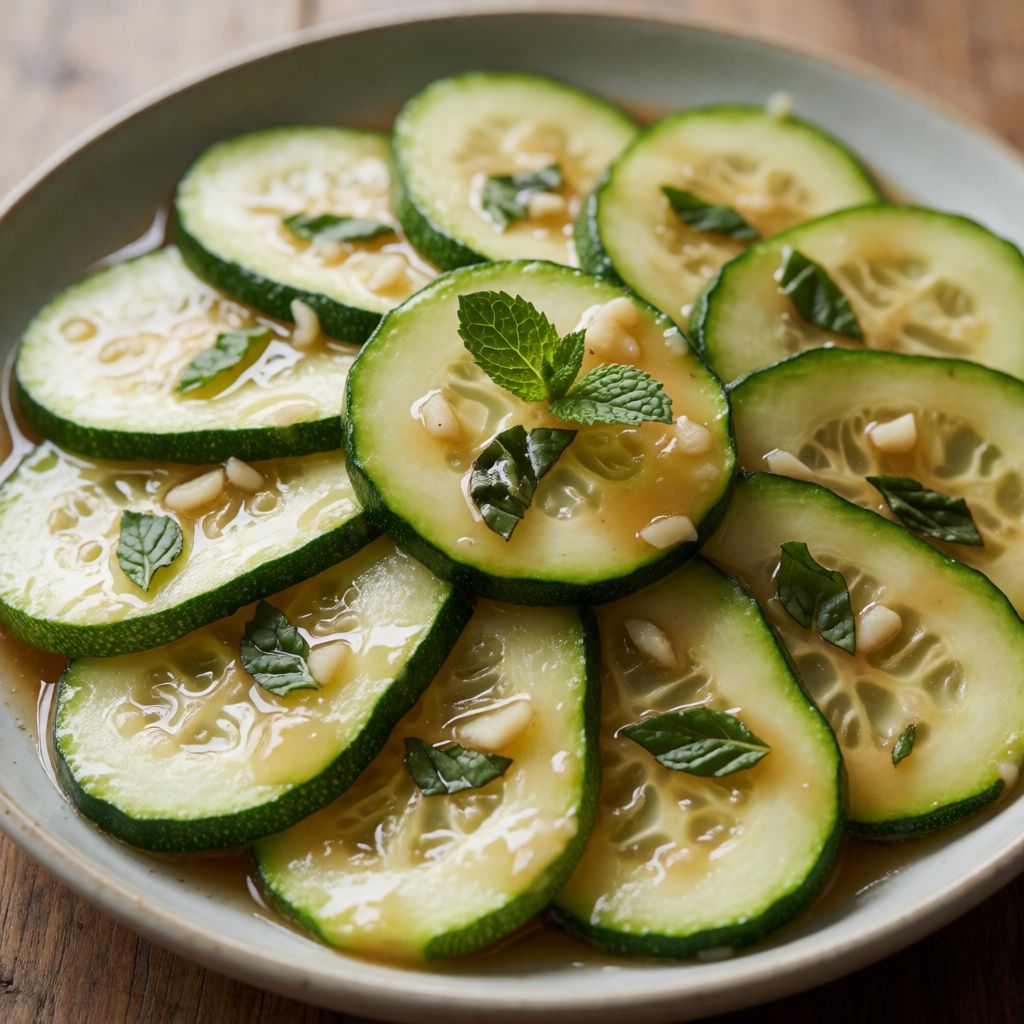
 AI photo
Courgettes in Sweet and Sour Sauce
A quick sweet-and-sour courgette antipasto, lightly spiced with mint and basil.
Labels are worked out automatically from the ingredients and can be wrong. Check the packaging if it matters to you.
Ingredients
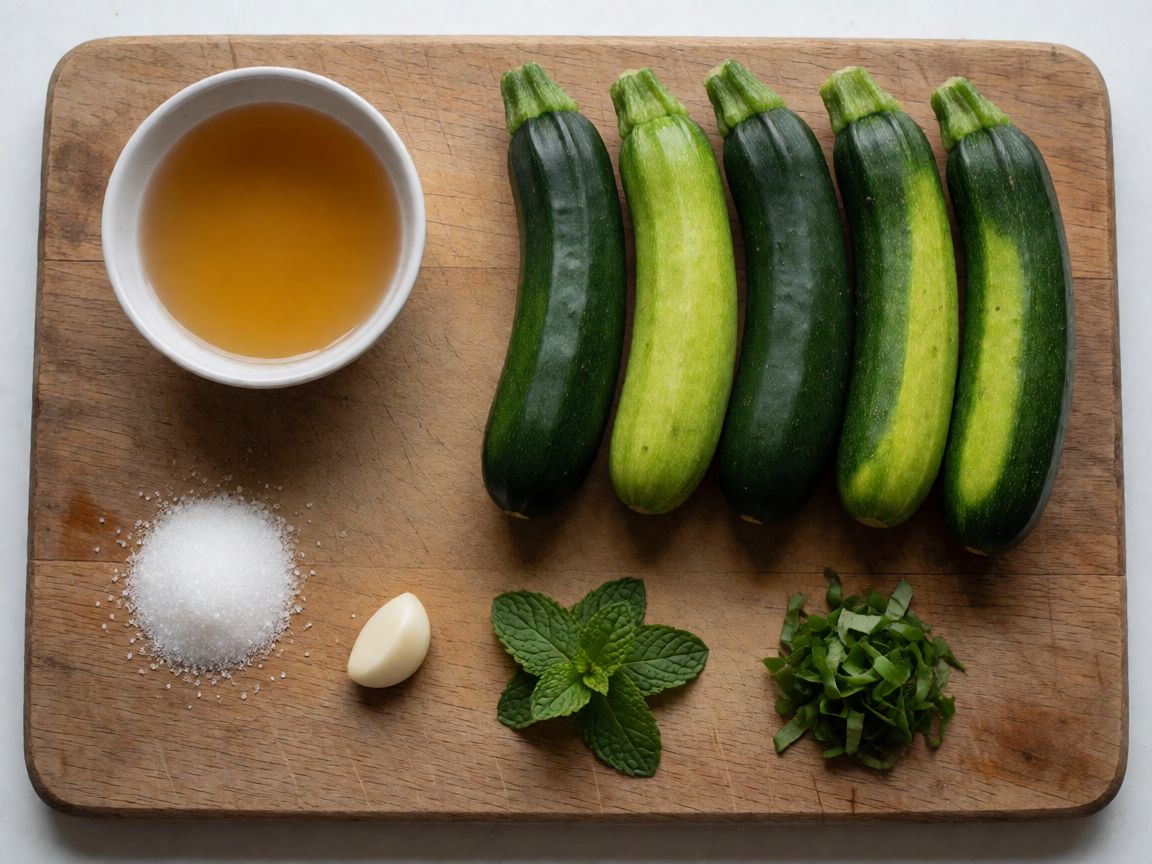
- 6 pcs Courgette
- 60 ml Apple cider vinegar
- 50 g Sugar
- 1 clove Garlic optional
- 1 bunch Mint to taste
- 1 bunch Basil to taste
- tbsp Olive oil to taste
- pinch Salt to taste
- pinch Black pepper to taste









Steps
Wash the courgettes under running water to remove any dirt, trim the ends and cut into small cubes or thin rounds.
Peel a clove of garlic and lightly crush it to release its aroma.
Pour a little olive oil into a frying pan and sauté the garlic over medium heat for a few minutes.
Add the diced courgettes and stir well.
Season the courgettes with salt and black pepper, cover the pan with a lid and cook for 10 minutes, stirring occasionally.
10 minGently rinse the basil and mint leaves under running water, pat dry with a paper towel and set aside.
Pour the apple cider vinegar into a small saucepan, add the sugar and dissolve over low heat, stirring with a spoon.
Once the sugar has fully dissolved, add the basil and mint leaves to the sweet-and-sour mixture, then season with salt and pepper.
Check that the courgettes are well cooked but still crisp; remove from the heat and let cool.
Dress the cooled courgettes with the sweet-and-sour sauce, stirring gently.
Serve with toasted bread as a side dish or as an antipasto starter.
This is marinated courgette, not stewed courgette — the whole dish turns on keeping those two things separate until the end. You cook the courgette in oil until it submits just enough, you build a vinegar-sugar syrup in a different pot, and only when both have cooled do you let them meet. Mix them hot and you get soup. Mix them right and you get something that tastes brighter on day two than day one, which is the whole point of agrodolce — it's not a dressing, it's a short pickle.
Some say courgette has no flavour of its own, so you can cook it any way and dress it any way. No — because courgette is mostly water held in a loose cell structure, and heat is the thing that decides whether that water stays in or leaves. Cook it too long in the pan and the cells rupture, the water floods out, and you're left with pale, flabby cubes swimming in their own juice, which then dilutes your sweet-and-sour sauce into nothing. The lid in step 5 isn't there to speed things up — it traps steam so the courgette cooks through gently rather than frying dry at the edges while staying raw in the middle. You're aiming for a fork that meets slight resistance, not one that slides through. That's "well cooked but still crisp" — not a time, a bite.
Courgette: six of them for four people, which sounds like a lot until you remember they're almost entirely water and shrink hard in the pan. Buy them firm, with no give when you press — a soft courgette has already started breaking down and will turn to mush faster than you can compensate for. Cube or round, it doesn't matter structurally; smaller pieces take up sauce faster, rounds look nicer on toasted bread. If you can only get big marrow-sized ones, scrape the seedy centre out first — it's mostly water and contributes nothing but dilution.
Apple cider vinegar does two jobs: acid for the "sour" half of sweet-and-sour, and a mild fruity background that red or white wine vinegar doesn't give you. The criterion for substitution is "a vinegar without a heavy flavour signature of its own" — white wine vinegar is the closest stand-in; malt vinegar will work but drags the whole thing toward chip-shop territory, which isn't wrong, just a different dish. Sugar here isn't for sweetness as a taste experience, it's there to balance the vinegar's sharpness into something rounder — caster sugar dissolves fastest, but any granulated sugar gets there with slightly more stirring.
Garlic is marked optional because its job is background warmth in the oil, not a garlic flavour you're meant to taste directly — crush it rather than mince it, so you can fish it out before it burns and turns bitter. Burnt garlic is the one mistake in this dish you can't fix downstream; bitterness from scorched garlic doesn't get masked by sugar, it gets amplified by it. Mint and basil together is less common than basil alone, and that's deliberate here — basil gives you the warm, slightly peppery top note, mint gives a cold, clean counter-note that cuts through the sugar. If you've only got one, use more of it rather than trying to replace the other with something like parsley, which has none of the volatile oils doing the actual work.
Olive oil: use one with "no strong flavour of its own" is the wrong advice for this particular dish, actually — a decent extra virgin earns its place here because the courgette is barely seasoned otherwise, and the oil is one of the only fat-carried flavours in the pan. Any neutral vegetable oil will cook the courgette fine; you'll just lose a layer of taste you didn't know was doing work.
On a UK hob: a wide, shallow pan beats a deep saucepan for step 5 — you want surface area so the courgette sits mostly in one layer and cooks evenly rather than steaming in a pile at the bottom while the top stays raw. If your pan lid doesn't fit well, a plate on top does the same job of trapping steam; it's not about which lid, it's about sealing the vapour in. This keeps for a day or two in the fridge, covered, and if anything improves — the courgette has time to actually absorb the syrup rather than just wear it. Patience here isn't a virtue tacked on at the end; it's the difference between a dressed vegetable and a marinated one.