
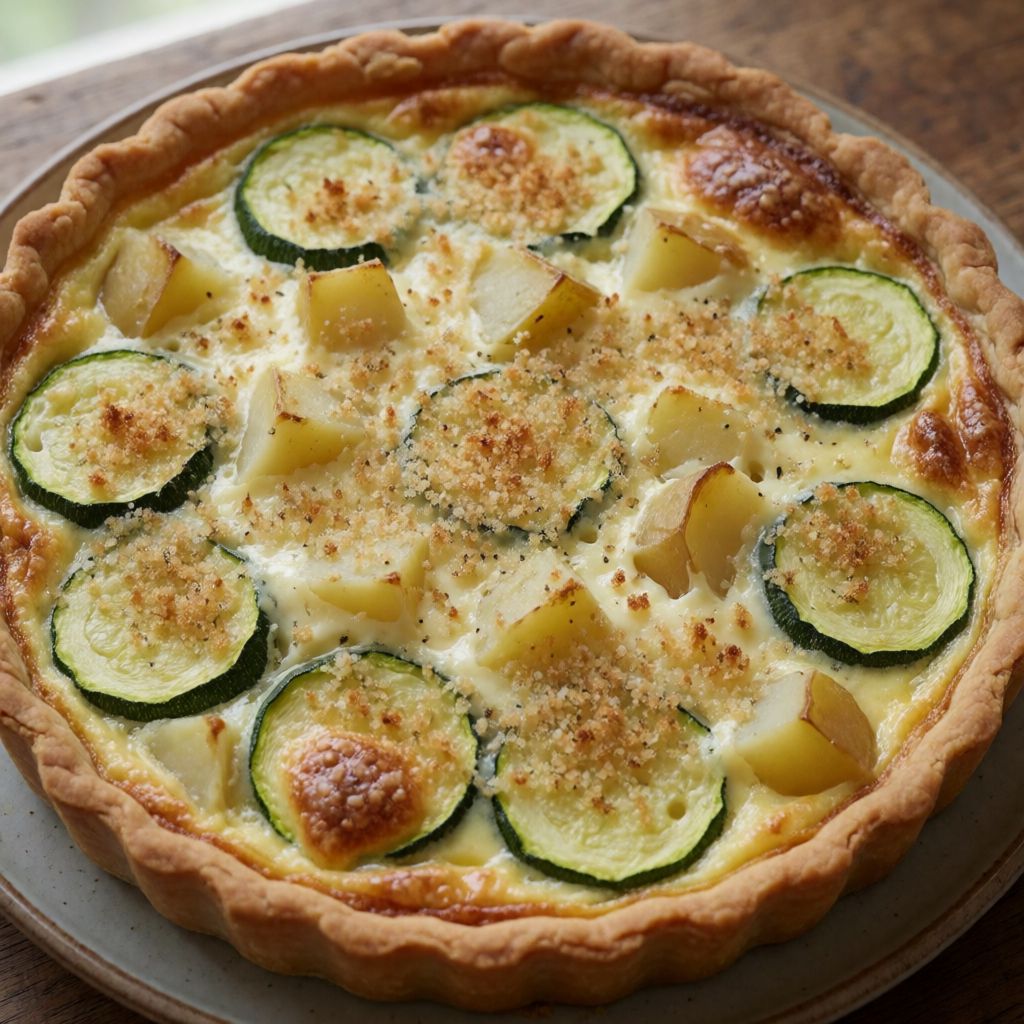
 AI photo
Courgette, Potato and Spicy Provolone Quiche
A savoury quiche with courgette, potato and spicy provolone in a shortcrust pastry case.
Labels are worked out automatically from the ingredients and can be wrong. Check the packaging if it matters to you.
Ingredients
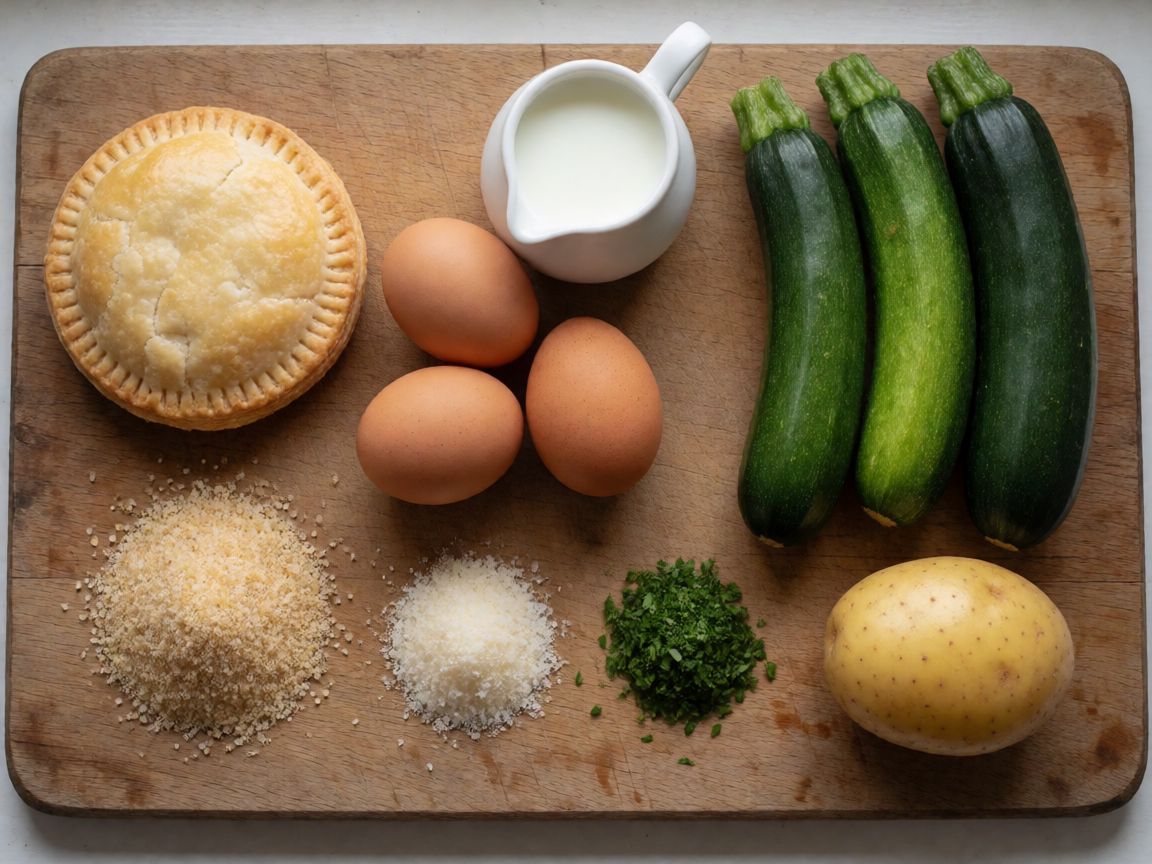
- 1 pcs Shortcrust pastry
- 3 pcs Eggs
- Milk to taste
- 1 tbsp Breadcrumbs
- 50 g Parmesan
- Salt to taste
- Black pepper to taste
- 1 tbsp Parsley
- 3 pcs Courgette
- 1 pcs Potato
- 1 pcs Shallot
- 2 tbsp Olive oil
- 150 g Spicy provolone











Steps
Heat 2 tbsp olive oil in a pan, fry the shallot, add the diced potato, then the courgette.
Cook for a few minutes, season with salt and black pepper to taste.
In a bowl, beat the eggs with milk (to taste), 1 tbsp parsley and the Parmesan.
Line a tin with the shortcrust pastry and baking paper, prick the base with a fork and sprinkle with breadcrumbs.
Arrange the cubes of spicy provolone on the pastry, top with the prepared courgette and potato, then pour over the egg and milk mixture.
Bake in an oven preheated to 180°C until the filling is fully cooked through.
25 minServe warm.
A quiche is a custard tart that happens to have a crust around it, and that's the whole mechanism you need in your head before you start. The eggs and milk aren't filler — they're the binder. Get the ratio wrong and you either get scrambled egg with vegetables sitting in it, or a wet tart that never sets. Roughly three eggs to enough milk that the mixture pours like single cream, no more — that's your target, not a number from a measuring jug.
What decides whether this works is moisture, not flavour. Courgette is mostly water held in a cell structure, and if you don't drive some of that water off in the pan first, it weeps into the custard while baking and you get a soggy middle under a set top — the classic quiche failure, and it's not the oven's fault, it's the vegetable's. Frying the courgette and potato with the shallot before they ever meet the egg isn't a flavour step, it's a drainage step: you're pre-cooking and reducing so the custard sets instead of swimming.
The breadcrumbs under the filling do a similar quiet job — they're a barrier, soaking up whatever liquid still escapes the vegetables before it can turn the pastry base soft. Some people skip this because it sounds like a fussy extra. Don't skip it if you've ever had a quiche with a bottom like wet cardboard; that's exactly the problem it exists to stop.
Spicy provolone, cubed and sitting at the bottom rather than stirred into the custard, is there to melt into pockets rather than disappear evenly through the filling — you want to meet it as a surprise, not as background seasoning.
On the eggs: three is the structural minimum for a tart this size — four servings, one average pastry case. Eggs are what set the custard through heat; too few and it stays loose no matter how long you bake it, which is a protein problem, not a time problem. Some say add more eggs if it won't set — no, because the usual reason it won't set is too much milk or too much vegetable water, not too few eggs. Fix the liquid, not the protein count.
Milk "to taste" sounds vague, but there's a real rule under it: enough to loosen the beaten egg to a pourable custard, not a drinkable one. Too much milk and the custard needs longer in the oven to set, by which time your pastry has gone past golden into dry. If you want a richer set with less risk of weeping, you can use a splash of double cream in with the milk — it has less water, more fat, sets more cleanly. Full-fat milk works fine on its own; skimmed will make a thinner, wetter custard, so if that's what's in the fridge, use less of it.
Parmesan goes into the custard itself, not on top — it's there for salt and savoury depth, seasoning the egg from within rather than sitting as a garnish. Any hard, dry grating cheese with a similar bite does the same job — a mature Cheddar grated fine is the obvious British stand-in, and nobody will mind.
The potato should go in diced small and genuinely cooked through in the pan before it goes anywhere near the pastry — raw potato in a quiche is a betrayal, because the oven heat here is set by the custard, not by what a hard vegetable needs, and potato left underdone will still be underdone when the eggs are perfectly set. Dice it, fry it with the shallot until a piece bends soft under the back of a spoon rather than resisting, and only then let it join the courgette.
Spicy provolone is a semi-hard cheese that holds its shape in cubes and melts without turning to liquid — that's why it's cut into pieces rather than grated into the mix. If you can't get it, any semi-hard cheese with some heat or bite to it will do the job — a mature spicy Cheddar, or a plain provolone with a pinch of chilli flakes scattered alongside it, keeps the same effect: pockets of melted cheese rather than cheese smoothed invisibly through the custard.
On the oven: 180°C is a temperature chosen for custard, not for pastry browning speed — it's hot enough to set egg protein steadily without the outside firming before the centre has caught up. A domestic oven running a touch hot or cold off true is normal; don't trust the dial, trust the filling. Twenty-five minutes is where to start checking, not where to stop — the quiche is done when the centre has lost its wobble and springs back rather than rippling like a shaken plate. Give it that look, not the clock, the final word.