
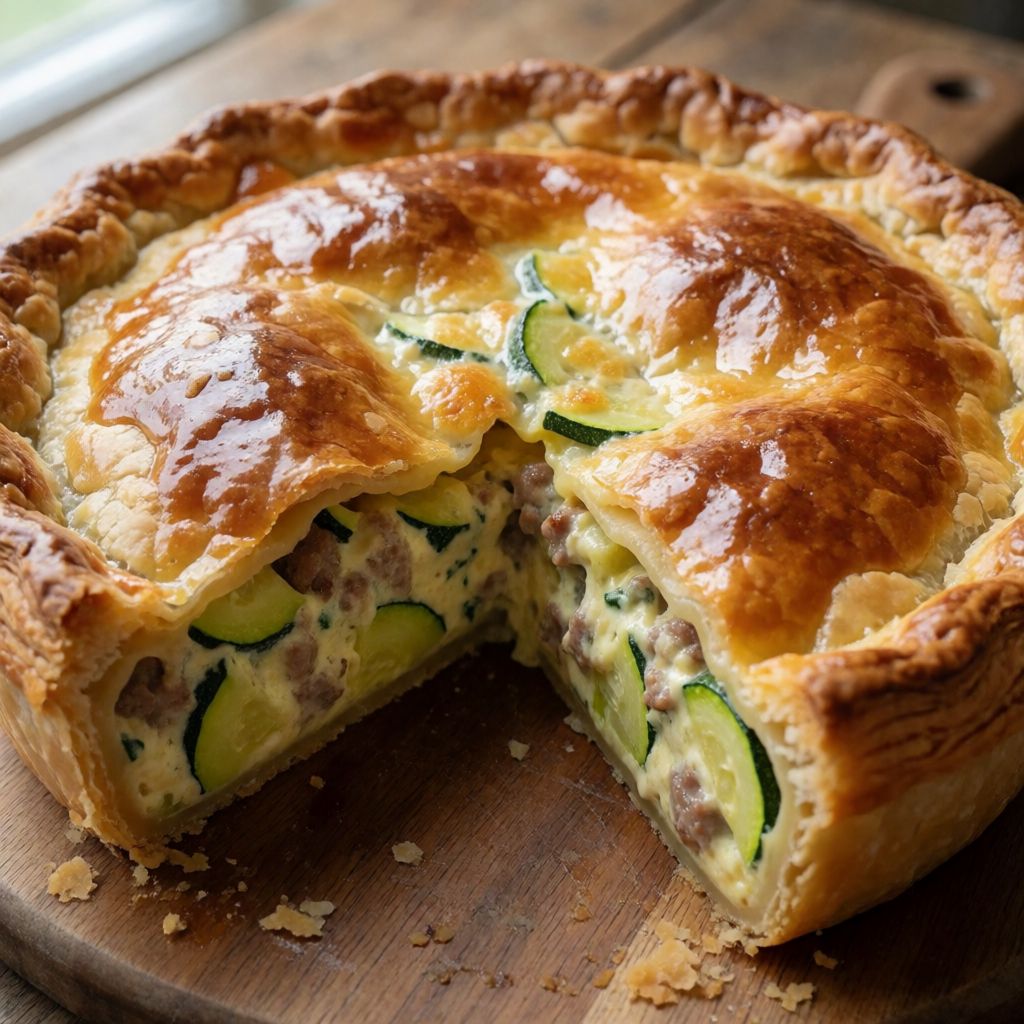
 AI photo
Savoury Courgette and Sausage Pie
A savoury puff pastry pie filled with courgettes, ricotta, cream, cheese, eggs and frankfurters.
Labels are worked out automatically from the ingredients and can be wrong. Check the packaging if it matters to you.
Ingredients
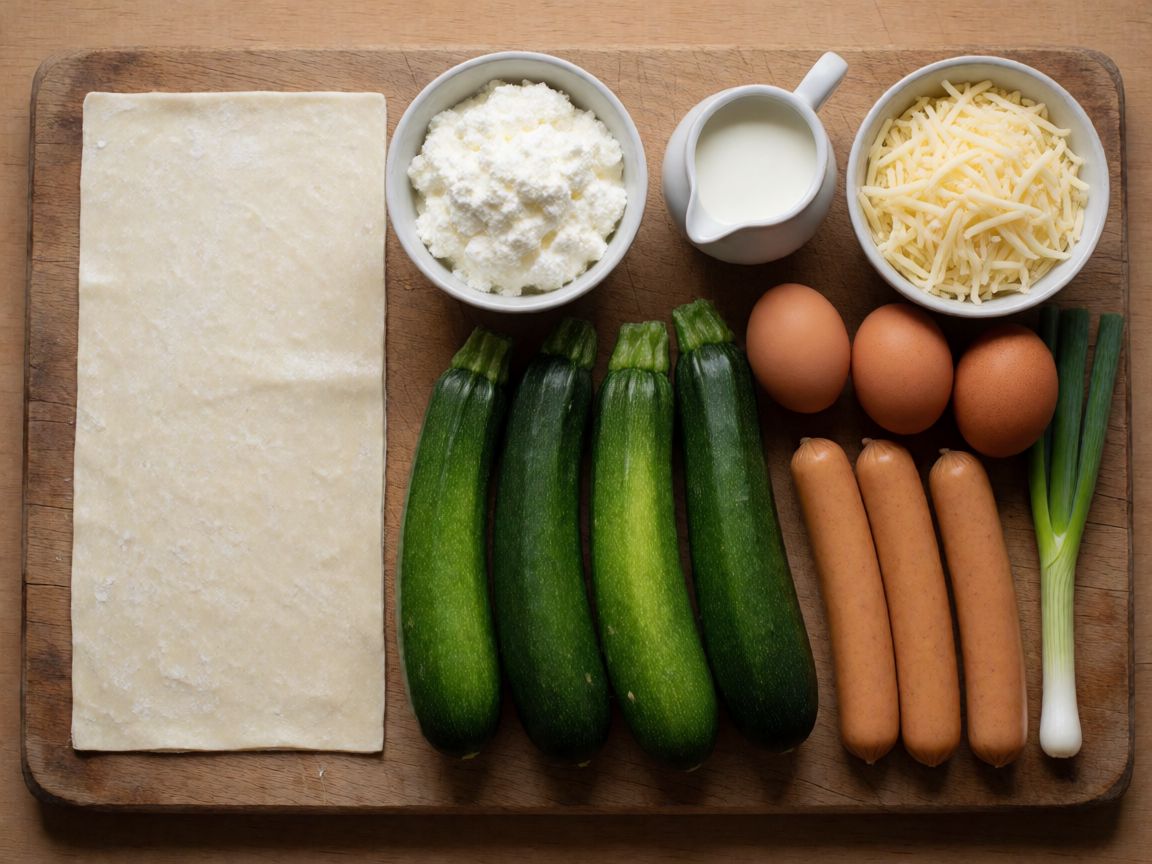
- 1 pcs Ready-rolled puff pastry
- 4 pcs Courgette
- 250 g Ricotta
- 150 ml Double cream
- 200 g Provolone
- 3 pcs Eggs
- 3 pcs Frankfurters
- 0.5 pcs Spring onion
- Olive oil To taste
- Salt To taste
- Black pepper To taste











Steps
Wash four courgettes, trim the ends and slice into rounds about 3 millimetres thick.
Slice half a spring onion.
Heat a little olive oil in a pan and fry the spring onion until golden.
Add the sliced courgettes and cook over medium heat, stirring.
Slice the frankfurters into rounds, and cut the provolone into small cubes.
Let the ingredients cool, then move on to the filling.
In a bowl, mix the ricotta, double cream and eggs.
Add a pinch of salt and a pinch of black pepper, and whisk well until smooth.
Add the provolone and frankfurters, stirring through.
Add the cooled courgettes and mix.
Line a tin with baking paper and lay in the puff pastry.
Prick the pastry with a fork, pour in the filling and seal the edges.
Prick the surface of the pie with a fork and brush with egg yolk.
Bake in an oven preheated to 180°C for 35-40 minutes.
37 minCheck that the pie has reached 70°C at its thickest point.
Remove the pie from the oven and serve warm.
This is a quiche wearing a puff-pastry coat and pretending to be something more casual. Underneath the fancy name — savoury pie — you've got the same family as a French tart or an Italian torta salata: a custard of eggs, cream and soft cheese, poured into a shell, baked until it sets. The courgette and frankfurter are just what's in the fridge, dressed up. Nothing wrong with that. Most good kitchen traditions are exactly this — whatever's cheap and at hand, given a shape and a name.
What decides whether it works is water, mostly. Courgette is almost all water held in a loose green scaffold. If you tip raw slices straight into the egg mixture, that water comes out slowly in the oven, right where you don't want it — into a custard that's trying to set, and into a pastry that's trying to crisp. So you fry the courgette first, hard enough that it visibly shrinks and the liquid it gives off hisses away in the pan rather than pooling. That's not a flavour step dressed up as a technique — it's the one thing standing between you and a wet, slumping filling.
Some say you must salt courgette slices and squeeze them before cooking, the way you would for a salad or a fritter. Not here — because you're frying them anyway, and heat does the same job as salt, only faster and without the washing-up. Salting-and-squeezing is for raw courgette going into something that won't see a flame. This one will. Let the pan do the work.
Courgette: buy them firm, glossy, no soft spots near the stalk — a soft courgette has already started turning its structure back into water, which is exactly your enemy here. Slice to about 3mm; much thicker and the slices won't cook through in the pan before the onion catches; much thinner and they disappear into the custard with nothing left to bite. If courgette's out of season or pricey, use any vegetable that's mostly water and benefits from a hard fry first — marrow, or even thinly sliced leek cooked down properly, though leek brings its own sweetness and you'd drop the spring onion.
Spring onion, only half of one: it's there to sweeten the pan before the courgette goes in, not to announce itself. A whole onion, even a mild one, would out-shout the eggy custard. Any allium that turns sweet rather than sharp when fried works — a shallot, or the white part of a leek, in the same small quantity.
Ricotta, double cream, eggs — this trio is your custard, and the ratio between them is what gives a savoury pie its particular job: not too stiff like a terrine, not too loose like a soup. Ricotta carries body without the heaviness cream cheese would bring; whisk it properly with the eggs and cream until it's smooth, because any lumps left now are lumps you'll be chewing later. No ricotta in the fridge — cottage cheese blitzed smooth, or curd cheese, does the same job: something soft, mild, with enough fat to carry flavour but not so much it turns the custard oily.
Provolone, cut into small cubes rather than grated: grated cheese melts into the custard and vanishes, cubed cheese melts into little pockets you actually find when you cut the slice. The criterion for a substitute is simple — any semi-hard cheese that melts cleanly without weeping grease or turning stringy and rubbery. A mild Lancashire or a block mozzarella (not the wet ball kind, which brings water you've just fought to get rid of) will do.
Frankfurters are the shortcut version of sausage — already cooked, already cured, so all they need from the pan is colour and warmth, no worry about raw meat in the middle. That's the whole appeal, and the reason people reach for them on a weekday rather than making proper sausage filling from scratch. Swap in anything pre-cooked that holds a slice without crumbling — chorizo if you want more bite, or leftover sausages from a Sunday roast, chopped up instead of wasted.
Puff pastry, ready-rolled: this is the one ingredient in the list that exists for pure convenience, not flavour. Laminating your own butter-and-flour pastry takes a morning and a cool kitchen; buying it ready-rolled is why this pie gets made on a Tuesday rather than reserved for a special occasion. Prick it before filling and prick the top again before baking — both punctures exist to let steam escape through the layers rather than ballooning them, which would otherwise lift the filling unevenly or tear the shell. The one honest limit of a domestic oven here: it won't give you the fierce, even bottom heat of a stone deck oven, so don't expect a shatteringly crisp base — expect a good one, crisp enough, if you don't let the filling sit on raw pastry any longer than it takes to get into the oven.
And let the cooked courgette and the fried onion cool before they meet the eggs. This costs you real minutes you can't skip — pour hot vegetables into raw egg and cream and the heat starts setting the eggs on contact, unevenly, before the whole thing ever sees the oven. Patience here isn't a virtue for its own sake; it's what keeps your custard a custard instead of a scramble with vegetables in it.