
 AI photo
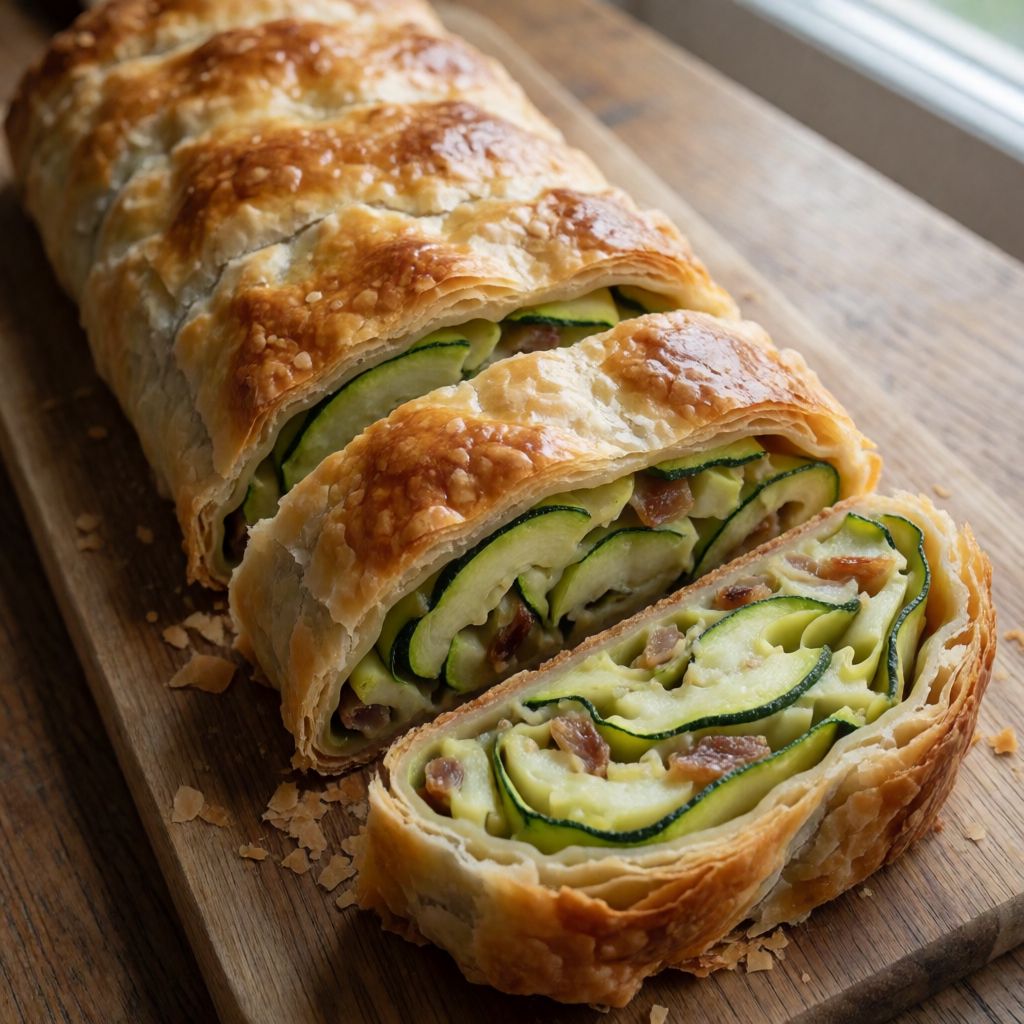
Courgette Strudel
A savoury strudel filled with grated courgette, smoky bacon and melted cheese, wrapped in a thin homemade dough.
Labels are worked out automatically from the ingredients and can be wrong. Check the packaging if it matters to you.
Ingredients
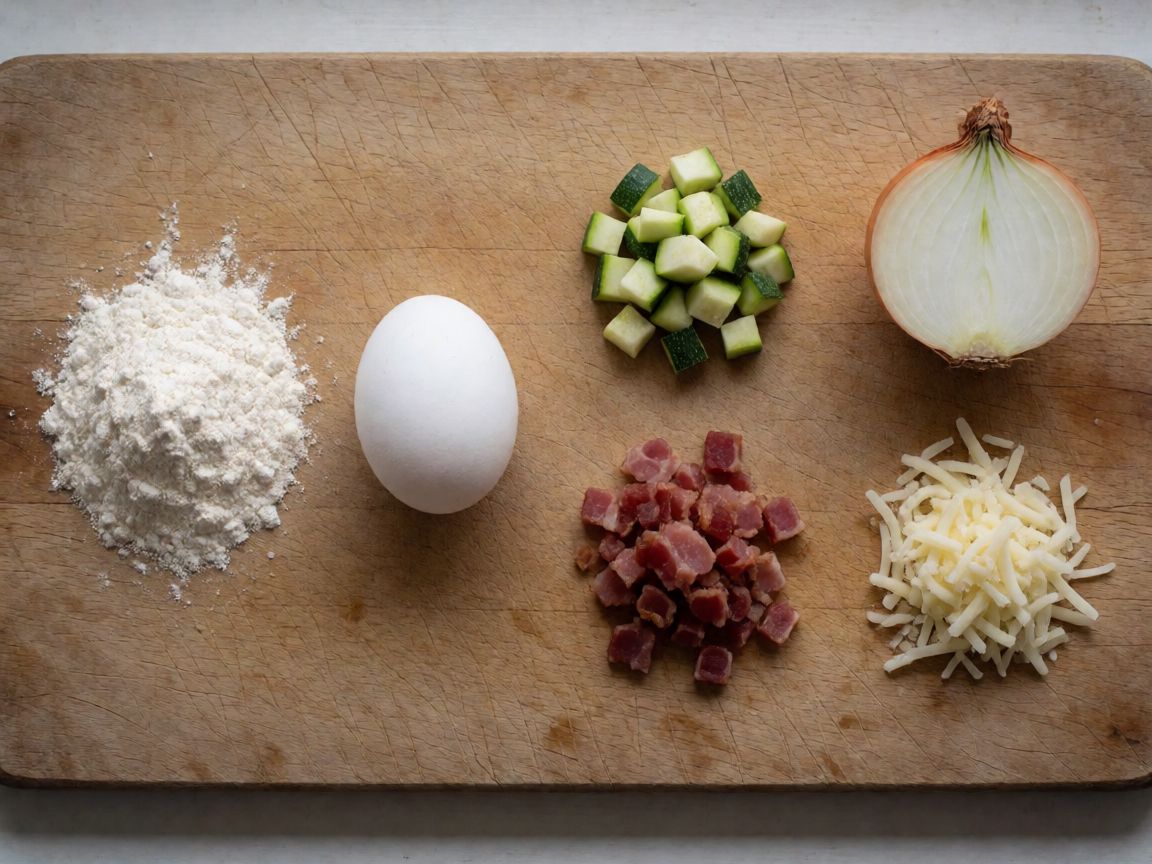
- 125 g Strong flour or Manitoba flour
- 15 g Vegetable oil
- 75 ml Water warm
- 1 pcs Eggs
- 350 g Courgette
- 200 g Smoked bacon pancetta
- 100 g Provolone dolce
- 0.5 pcs Onion
- Salt to taste
- Black pepper to taste
- Olive oil to taste









Steps
Pile the flour on the worktop, make a well in the centre, pour in the oil, add a pinch of salt and start kneading, gradually adding warm water until the dough is smooth.
Shape the dough into a ball, wrap it in cling film and leave it in the fridge.
60 minWhile the dough rests, wash and dry the courgettes, then grate them on the coarse side of a grater.
Finely chop half the onion and put it in a pan with the bacon and olive oil. Fry over high heat.
Add the courgette and cook until the ingredients are browned; the bacon should reach 70°C.
Remove the pan from the heat and stir in the grated provolone, black pepper and salt.
Roll out the dough with a rolling pin into a rectangle about 2mm thick.
Spread the filling evenly over the dough, leaving about 4cm clear at the edge.
Roll the dough into a log, sealing the edges well.
Transfer the strudel to a baking tray lined with parchment and brush with egg yolk.
Bake at 180°C in a preheated oven.
42 minTake the finished courgette strudel out of the oven and serve.
Forget the apple strudel in your head — this one owes nothing to it except the shape. "Strudel" is German for whirlpool, nothing more; it describes the swirl you get when you roll a filling inside a sheet of dough, and that swirl has been used for sweet and savoury fillings for centuries, because a roll holds more filling per square inch of dough than a flat pie and uses less pastry to do it. So no, it doesn't have to be apples and cinnamon — this one is courgette, bacon and cheese, which is really just Italian thrift: use up the glut of courgettes with a bit of smoked pork for flavour and a scrap of cheese to bind it all, wrapped in the cheapest possible pastry.
What decides whether this works is water. Courgette is mostly water held in cells that rupture the second you grate them, and if that water goes into the dough, you get a soggy log that never crisps — you get steamed bread, not baked. The fix isn't salting and squeezing for an hour, which some recipes insist on; frying the grated courgette hard, uncovered, with the onion and bacon does the same job faster, because high heat drives the water off as steam instead of leaving it to pool. You'll see it happening — the pile in the pan shrinks and starts to catch colour at the edges instead of just sweating. That browning is also your actual doneness marker for the bacon, backed up by a number you can check with a thermometer if you own one: 70°C, which is where cured pork is safely cooked through, not a guess based on how pink it looks.
On the flour: strong or Manitoba flour is just flour with a higher protein content, which means more gluten once you knead it, which means more stretch before it tears. If you've only got plain flour in the cupboard, it will still make a dough, but it will be shorter and more prone to splitting as you roll past a millimetre or two — you can get away with it if you roll a touch thicker and accept the pastry will be a bit less supple, not a disaster, just a different texture. Bread flour sold for loaves works as a straight substitute; it's doing the same job.
The oil in the dough is there for suppleness, not flavour, so use anything with no taste of its own — a neutral vegetable or sunflower oil, not your good olive oil, which you want to save for the pan where its flavour actually matters. The warm water speeds the gluten along as you knead; cold water works too, you'll just need a minute or two longer at it.
Courgette: pick ones that feel heavy and firm for their size — a soft, give-y courgette has already started breaking down and will dump even more water into your pan. There's no real substitute that behaves the same; marrow or pattypan squash will work on the same principle (grate, fry hard, watch it shrink) but carries more water still, so give it longer in the pan before you call it done, judging by colour and smell rather than a clock.
Smoked bacon or pancetta is both the fat you fry in and most of the savoury backbone of the filling — the smoke is what carries, so if you swap it for plain unsmoked bacon you lose a layer the courgette can't replace. Guanciale is the richer Italian cousin if you want to go further that way; either way, cook it to where the fat has visibly rendered out into the pan, which is also roughly when it crosses that 70°C mark.
Provolone dolce is the mild, young version of the cheese — melts easily, doesn't fight the courgette for attention. If you can't find it, reach for anything semi-hard that melts smoothly and doesn't announce itself: a mild Cheddar will do, though it'll nudge the whole thing in a more British direction, which isn't a crime. Avoid anything too sharp or too oily (mature Cheddar, strong provolone piccante) — it'll either overpower the courgette or split under heat the same way provolone does if you're not careful.
On the oven: 180°C is the figure given, but domestic ovens lie to you more than kazans or restaurant ovens do — a fan oven runs hotter and more even than a conventional one at the same dial setting, so if yours is a fan, you may want to knock it down by about 20°C or just watch the strudel rather than the clock. The 42 minutes is a floor, not a verdict — the real sign it's done is the crust: deep gold, not pale, and firm enough that it doesn't give when you press it, because underneath that crust is raw dough, and raw dough at the centre of a log this thick doesn't forgive being rushed. The egg yolk brushed on before baking isn't for shine — it's protein and fat meeting heat, the Maillard reaction, which is what gives you that gold rather than a limp, pale crust.