
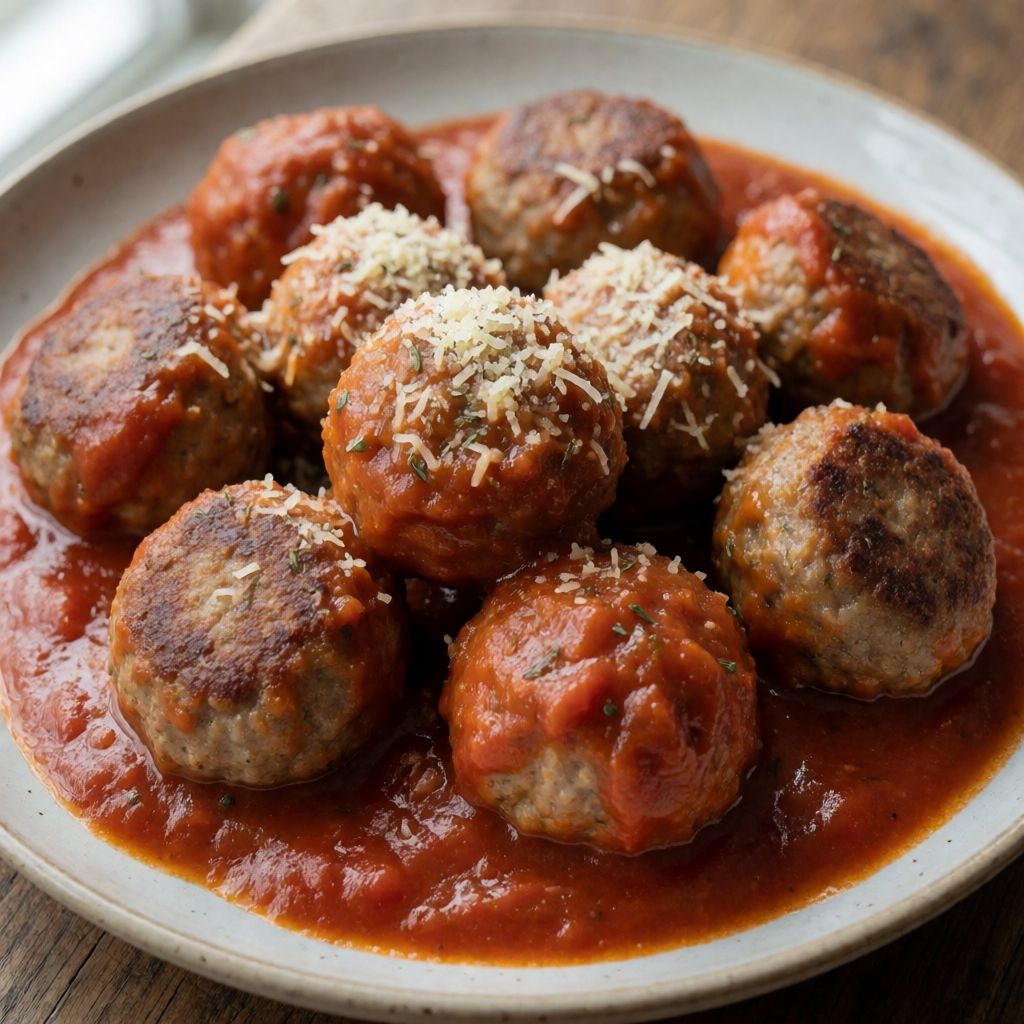
 AI photo
Italian Meatballs in Tomato Sauce, Oven-Baked
Italian-style meatballs baked in a rich tomato sauce with mozzarella, pesto and parmesan, served with pasta.
Labels are worked out automatically from the ingredients and can be wrong. Check the packaging if it matters to you.
Ingredients
- 400 g Minced beef
- 25 g Breadcrumbs dried
- 1 pcs Eggs
- 3 clove Garlic finely chopped
- 75 g Parmesan freshly grated
- 1 tbsp Rosemary finely chopped, fresh
- 1 bunch Basil roughly chopped, fresh
- 1 tbsp Sun-dried tomatoes finely chopped
- Salt
- Black pepper freshly ground
- 3 tbsp Olive oil for frying
- 2 pcs Onion finely chopped
- 2 clove Garlic finely chopped
- 800 g Canned chopped tomatoes
- 1 tbsp Rosemary finely chopped, fresh
- 2 tbsp Sun-dried tomatoes finely chopped
- 1 tsp Sugar
- 2 tbsp Olive oil
- 125 g Mozzarella
- 400 g Pasta
- 100 ml Pesto
- 50 g Parmesan freshly grated
- 0.5 bunch Basil fresh

















Steps
Mix the ingredients for the meatballs and let the mince rest in the fridge for half an hour.
30 minMeanwhile, prepare the tomato sauce.
5 minShape all the meatballs.
10 minFry them in a hot pan with oil until nicely golden-brown on all sides.
4 minThe meatballs should not be cooked through completely — just sear them quickly, as they will finish cooking in the oven.
Fry the onion and garlic in a large saucepan with olive oil over medium heat until the onion softens.
4 minAdd the chopped tomatoes, rosemary and sun-dried tomatoes in oil, stir and bring to the boil.
2 minSimmer the tomato sauce over low heat for 20 minutes.
20 minSeason the sauce to taste with sugar, salt and freshly ground pepper, mix well.
1 minSpread the tomato sauce on the bottom of a greased ovenproof dish, place the meatballs on the sauce, sprinkle evenly with mozzarella.
2 minBake in a preheated fan oven at 200°C for 15 minutes.
15 minRemove from the oven, drizzle pesto over the top and sprinkle with freshly grated parmesan.
2 minServe hot with pasta or bread, sprinkled with fresh basil leaves.
This is a two-stage dish pretending to be one step: first you commit the meat to a quick sear, then you hand it over to the oven to finish under sauce and cheese. The whole thing turns on that handover. If you cook the meatballs through in the pan, the oven does nothing but dry them out and melt the mozzarella into rubber. If you sear them too timidly, they fall apart in the sauce because the crust that holds them together never formed. The pan's job is one thing only: a crust, not doneness.
Some say — no, because — a meatball needs to be cooked all the way through before it goes anywhere near the oven, or it's "unsafe". It isn't. The centre finishes at 200°C surrounded by simmering tomato sauce for fifteen minutes, which is more than enough heat exposure, and the resting rule (half an hour in the fridge) is there precisely so the mince is cold and firm when it hits the hot pan — a loose, warm mix just smears across the surface instead of browning.
Beef mince: go for something with real fat in it, 15–20%, not the leanest pack on the shelf. Lean mince seems like the sensible choice until you taste a dry meatball — fat is what keeps it tender through two cooking stages instead of one. Breadcrumbs and egg are the binder pair: the crumbs soak up moisture and swell, the egg sets and glues everything together when heat hits it. Skip the egg and your meatballs crumble in the pan; skip the breadcrumbs and they turn dense, almost like a burger patty rather than something you associate with a meatball. No dried breadcrumbs in the cupboard — a stale slice of white bread, crust off, torn up, does exactly the same job.
Parmesan in the meat mix isn't there for cheese flavour as such — it's there for savoury depth and a little extra binding, since it melts and seizes slightly as it cooks. Any hard, aged grating cheese will stand in, though nothing sold as "parmesan-style" in a plastic tub does the job properly — it doesn't melt the same way, it just goes gluey.
Rosemary and basil split the work: rosemary's sharp, resinous note goes into both the meat and the sauce because it holds up to long cooking without disappearing; basil is added mostly at the end, fresh, because its flavour is volatile and cooks off fast — that's why a whole bunch is kept back for scattering at the table rather than going in the pot. Sun-dried tomatoes, chopped small, are a shortcut to concentrated tomato sweetness and a bit of chew — if you don't have them, a spoon of tomato purée fried briefly with the onion gets you most of the way there, though you lose the little pockets of texture.
The sugar in the sauce isn't about making it taste sweet — it's there to correct the acidity that tinned tomatoes always carry, especially out of season. A pinch, tasted and adjusted, is the point; it's balancing, not seasoning for sweetness.
Mozzarella: get a ball packed in its own liquid if you can, and pat it dry before tearing it over the meatballs — too much whey in the dish and your sauce goes thin and watery under the oven heat instead of clinging. Pre-grated "pizza mozzarella" in a bag is drier and more rubbery by design, meant to resist clumping, which is exactly the wrong texture here.
For a UK kitchen this is entirely a hob-and-oven dish, nothing more exotic required — a wide frying pan for the sear, any ovenproof dish that'll take a 200°C fan oven for the finish. No kazan, no lidded casserole needed; a plate over the pan while the meatballs rest after searing does fine if you want to keep them warm while the sauce finishes. This feeds four properly, with pasta or good bread alongside — and the half-hour chill for the mince, plus the slow twenty minutes on the sauce, aren't steps to rush past to get to the oven faster. That waiting is doing real work; treat it as part of the ingredient list, not dead time.