
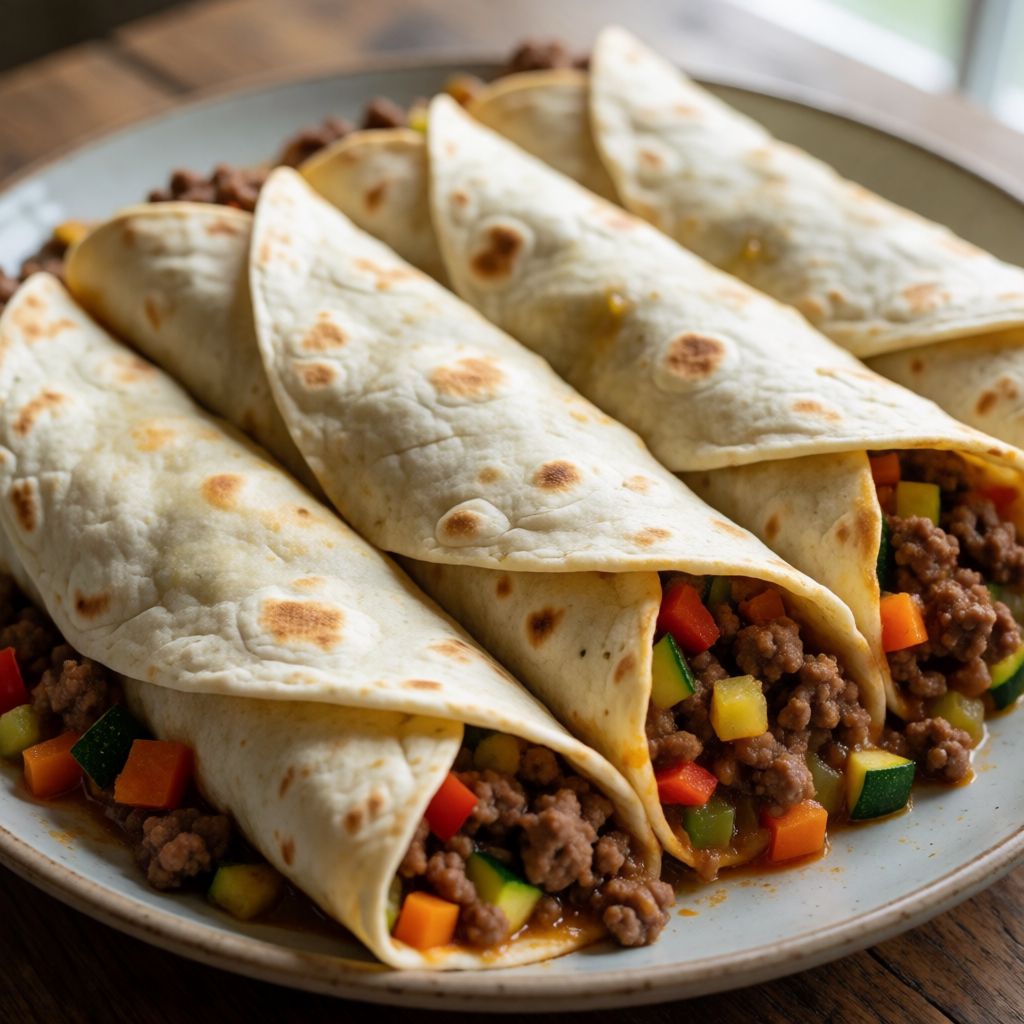
 AI photo
Simple Beef Mince Enchiladas
Easy beef mince enchiladas with vegetables, black beans and sweetcorn, rolled in tortillas and baked under melted cheddar.
Labels are worked out automatically from the ingredients and can be wrong. Check the packaging if it matters to you.
Ingredients
- 1 pcs Onion finely chopped
- 400 g Beef mince
- 2 pcs Carrot coarsely grated
- 200 g Courgette coarsely grated
- 1 pcs Bell pepper finely diced
- 2 clove Garlic crushed
- 2 tsp Cumin
- 1 tsp Ground coriander
- 0.5 tsp Cinnamon
- 1 tsp Smoked paprika
- 400 g Tinned chopped tomatoes
- 1 can Black beans
- 140 g Sweetcorn
- 8 pcs Tortilla wraps
- 100 g Mature cheddar coarsely grated
- 1 tbsp Olive oil
- Salt to taste
- Black pepper to taste, freshly ground
- 1 bunch Fresh coriander
- 1 tbsp Sriracha to taste


















Steps
Fry the onion in a saucepan with the oil until soft. Add the beef mince, turn up the heat and fry quickly, stirring constantly.
Add the carrot, courgette, pepper, garlic, spices and chopped tomatoes, and mix well.
Simmer uncovered for 5 minutes.
5 minAdd the black beans and sweetcorn and heat through.
Spoon the filling onto the tortillas and roll them up. Place seam-side down in a greased ovenproof dish.
Sprinkle with cheddar and bake in a preheated oven at 175°C (fan) for about 15 minutes, until the cheese has melted.
15 minSprinkle with fresh coriander and drizzle with a little sriracha.
This is a mince dish wearing a Mexican coat, and it's honest about it — nobody in Jalisco grates courgette into their picadillo. What you've really got is a British way of getting vegetables into children and tired adults alike, bound together with spice and cheese and rolled in a wrap because wraps are forgiving. The filling is a sofrito-and-braise logic: fry the aromatics first to build a base flavour that water alone can't give you, then let everything else soften in the tomato's acidity and the lid-less simmer's steam. Whether it works depends on one thing above all — did you let the mince actually fry, or did it boil in its own water the second it hit the pan?
That's the real fork in the road. Mince straight from the fridge, cold and packed tight, dumped into a pan that's merely warm — it drops its moisture before it drops its colour, and now you're not browning, you're stewing in grey liquid. You want the onion fully soft and sweet first, not just translucent, because that's your flavour foundation; a raw or half-cooked onion stays sharp and fights everything added after it. Then the heat goes up and the meat goes in loose, spread thin, and you leave it — don't stir it into a fine scramble immediately. Some say mince needs constant stirring from the start to cook evenly: no, because that's exactly what stops the browning, the crust that gives the whole dish its backbone of flavour. Let it sit, let a crust form, then break and turn.
Spice order matters more than spice choice. Cumin, coriander, cinnamon, smoked paprika — these go in with the vegetables and tomatoes, not before, not after. Raw spice dropped into hot dry oil before any liquid arrives can scorch in seconds on a domestic hob, where the heat under a wide pan is less even than in a proper kazan, and a scorched spice turns bitter, not fragrant. Adding them with the tomatoes gives them liquid to bloom in instead of bare metal to burn on. If you're missing cinnamon, don't panic and leave a hole — a pinch of allspice does the same warming job; if you've no smoked paprika, ordinary paprika plus a very small pinch of something smoky (even a drop of liquid smoke if you have it) gets you close enough that nobody at the table will file a complaint.
The beans and sweetcorn go in last and only need heating through, not cooking — they're already cooked in the tin, and boiling them again just breaks the beans down to mush and dulls the corn's snap. This is the opposite problem from the mince: here, the enemy is overcooking something that was already done.
On the beef itself: standard mince is fine, but if you want less grease pooling at the bottom of the dish, go for a leaner cut — the fat that renders out has nowhere useful to go once it's in a rolled tortilla, it just makes the bottom soggy. No beef mince in the house, turkey or pork mince both take the spice mix the same way; just know pork brings its own sweetness that nudges the cinnamon note forward.
The wraps are the architecture, and here's where the myth needs breaking: some say you must warm tortillas before rolling or they'll crack — true only if they're genuinely stiff and cold from the fridge. A fresh pack at room temperature rolls fine. But if yours have been in the fridge, a few seconds in a dry hot pan or a quick blast in the microwave under a damp cloth softens them enough that they bend instead of splitting at the fold — the same logic as the carrot bending rather than snapping when it's properly cooked. Seam-side down in the dish isn't fussiness — it's what stops them unrolling in the oven.
Cheddar on top is doing a job, not just decoration: it melts, browns slightly at the edges where it meets the dish, and seals the tops of the wraps so they don't dry out in fifteen minutes of 175°C fan heat — a temperature chosen because it's hot enough to melt cheese and warm the filling through without scorching the tortilla edges before the middle catches up. Any semi-hard melting cheese works if cheddar isn't to hand — the only real requirement is that it melts smoothly rather than turning rubbery, so avoid anything too lean or pre-shredded with anti-caking starch, which melts patchily.
A fat with no flavour of its own does the early onion-frying — a flavourless vegetable or light olive oil, nothing extra virgin and grassy that you'd rather taste in a salad. And patience is the one ingredient not on the list: five minutes feels like nothing to write in a method, but it's the difference between vegetables that have given up their water and a sauce that hasn't yet decided what it wants to be. Rushing that step is the single most common way this dish goes wrong — everything else is forgiving by comparison. This feeds four properly, or six if there's a side of rice and nobody's starving.