
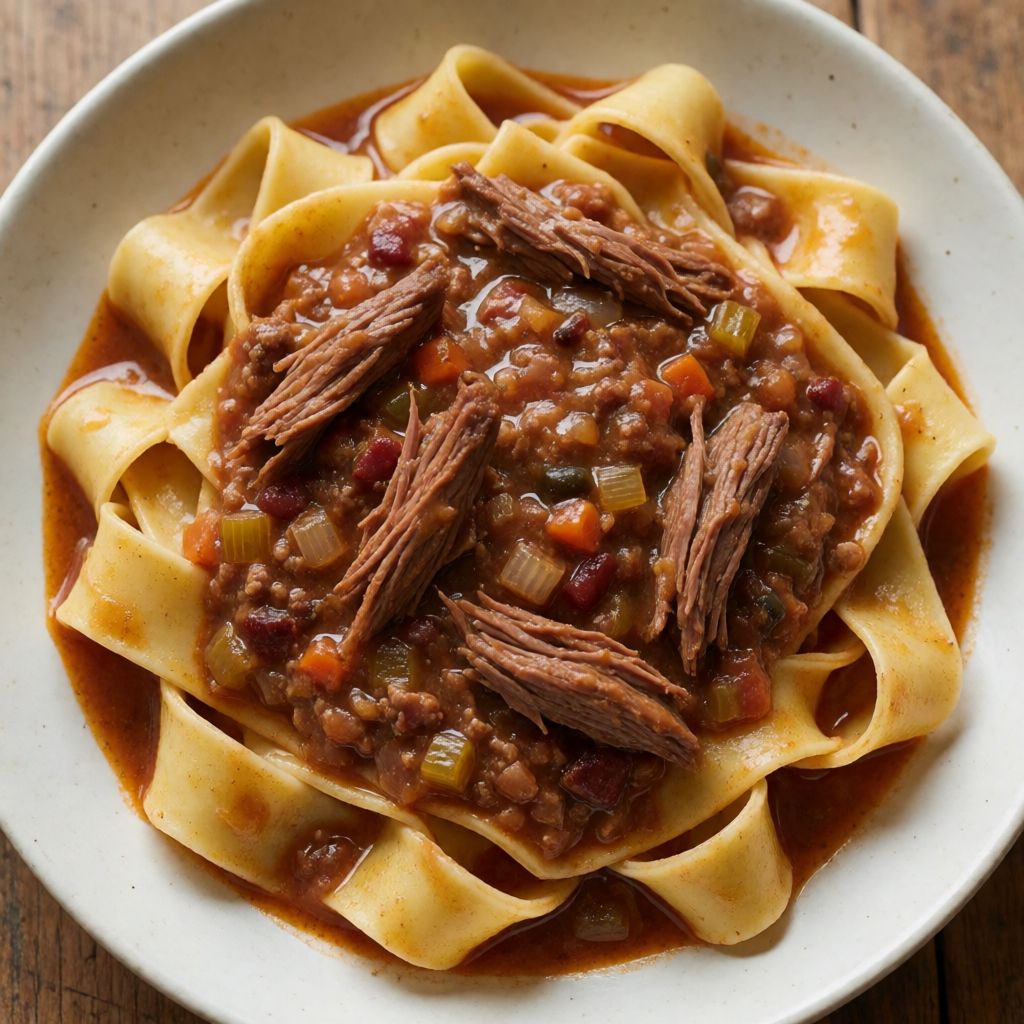
 AI photo
Beef Ragù with Pappardelle
A slow-braised beef ragù with bacon, wine and sun-dried tomatoes, served over pappardelle with fresh parmesan.
Labels are worked out automatically from the ingredients and can be wrong. Check the packaging if it matters to you.
Ingredients
- 1 kg Beef shoulder
- 80 g Bacon
- 2 pcs Onion finely chopped
- 2 clove Garlic finely chopped
- 2 pcs Celery sticks finely diced
- 3 pcs Carrot finely diced
- 200 ml Wine
- 400 ml Stock
- 50 g Sun-dried tomatoes finely chopped
- 2 pcs Bay leaf
- 1 tsp Dried thyme
- 400 g Chopped tomatoes canned
- 2 tbsp Olive oil for frying
- Salt
- Black pepper
- 350 g Pappardelle
- 75 g Parmesan freshly grated













Steps
Cut the meat into thick slices (an 800 g beef shoulder can be divided into 3-4 slices).
Heat a cast-iron pot with oil over high heat and brown the meat well on all sides.
8 minRemove the meat from the pot, set aside on a plate, and reduce the heat under the pot.
Fry the bacon until crisp in the pot, remove and set aside.
3 minSauté the onion in the same pot over medium heat until soft.
5 minAdd the garlic, celery and carrot and sauté for another 1 minute.
1 minPut the browned meat, finely chopped crispy bacon, celery, carrot, wine, stock, sun-dried tomatoes, chopped tomatoes, bay leaves and thyme into the pot.
Cover with a lid, slowly bring to the boil, then lower the heat so the dish only just simmers.
15 minSimmer for about 3-4 hours, until the meat is as tender as butter and starts to fall apart.
210 minRemove the bay leaves and the meat, shred the meat into strands. Discard the bay leaves.
5 minReturn the meat to the pot and season well with salt and pepper to taste.
1 minCover with a lid to keep the ragù warm, and meanwhile cook the pasta al dente.
10 minServe the pappardelle with the ragù and freshly grated parmesan.
2 min
A ragù is not a sauce you pour over pasta — it's what's left when a tough cut of meat has nowhere to go for four hours except soft. Beef shoulder works here precisely because it's bad meat for a quick fry: full of connective tissue, collagen threaded through the muscle like string through a parcel. Give it twenty minutes and it's rubber. Give it three hours at a bare simmer and that same collagen melts into gelatine, which is why the meat "falls apart" rather than falling to pieces — gelatine gives body, not just softness. You could braise a lean fillet instead, but you'd be paying more for something that ends up drier, because there's no collagen to melt and keep it moist from the inside.
What decides whether this works is heat control on an ordinary British hob, not the shopping list. Browning the meat at the start needs real heat — the pan hissing, almost angry — because that's a Maillard reaction, not cooking: you're building flavour on the crust, and if the pan's too cool the meat just steams and greys. But the moment the lid goes on and the liquid's in, you want the opposite: a simmer so gentle it barely breaks the surface, a lazy bubble every second or two, not a boil. Boil it hard for four hours and the proteins seize and toughen before they've had time to melt — the classic mistake of "more heat makes it cook faster." It doesn't. It just makes the meat fight back.
Beef shoulder (sometimes sold as chuck) is the right cut because it's worked muscle — the animal used it to walk and hold its own weight, so it's dense with connective tissue. That's a defect in a quick pan-fry and an asset in a long braise. If your butcher doesn't have shoulder, ask for chuck, shin, or brisket — anything described as needing "slow cooking," which is butcher's code for "lots of collagen." Avoid anything labelled for frying or grilling; it'll just dry out over four hours with nothing to melt and keep it moist.
The bacon isn't there for bulk — it's there for fat and smoke, laying down a second flavour underneath the beef before anything else goes in the pot. If you haven't got bacon, pancetta does the same job; a streaky cut with a decent fat seam works better than lean back bacon, because it's the rendered fat that carries flavour into the vegetables fried in it afterwards.
Onion, celery, carrot — the soffritto, Italy's answer to the same question every slow-cooked dish asks: how do you build a base flavour before the main ingredient even arrives. It's not aesthetic dicing you're after, just small enough that it melts into the sauce rather than sitting as identifiable chunks after four hours. Dice them unevenly and the small pieces burn before the big ones soften — that's the real reason "finely diced" matters, not neatness for its own sake.
Wine and stock together do a specific job: wine brings acidity, which cuts through all that meat fat and stops the ragù tasting flat and heavy; stock brings the volume of liquid needed to keep a low, slow simmer going without the pot drying out and the meat catching on the bottom. Any dry red you'd drink works — don't buy "cooking wine," it's usually worse wine at a worse price, and you'll taste that.
Sun-dried tomatoes and canned chopped tomatoes aren't doing the same thing despite both being tomato. The canned ones are your base, building body and acidity through the whole simmer. The sun-dried ones are concentrated — they've already lost their water — so they punch in deep savoury flavour without diluting the sauce further, a trick for intensity rather than bulk.
Pappardelle is wide for a reason, not for show: a ribbon that broad can carry shredded strands of meat clinging to it, where a thin spaghetti would just slide through the sauce and leave the meat behind on the plate. If you can't get pappardelle, tagliatelle is the nearest relative — anything flat and at least a centimetre wide will behave the same way. Cook it al dente, meaning with a little resistance left at the centre when you bite it, because it carries on cooking slightly in the heat of the sauce once tossed through, and pasta that's fully soft in the pot turns to mush by the time it reaches the table.
Parmesan at the end, freshly grated, not from a tub — the pre-grated stuff is dried and anti-caking agents stop it melting properly into the hot pasta, so it sits as sand rather than folding in. Grate it yourself and it clings and softens, finishing the dish rather than just decorating it.
Four hours sounds like a long time to stand over a pot, but you're not standing over it — that's the whole point of a braise. Once the lid's on and the simmer's gentle, the dish asks for almost nothing from you. The patience isn't effort, it's absence: leaving it alone is the ingredient, and the temptation to turn the heat up "to speed things along" is exactly what ruins it.