
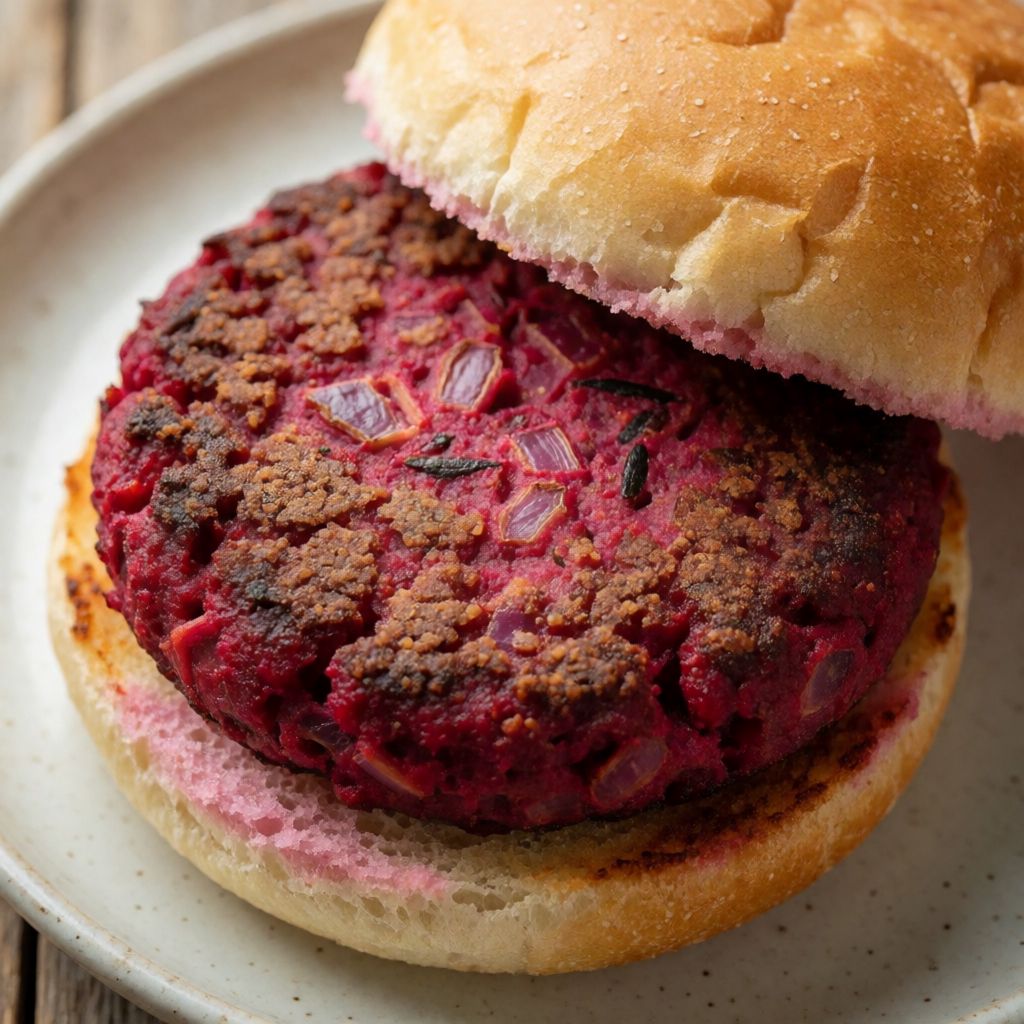
 AI photo
Veggie Burger with Beetroot Patties
A veggie burger with beetroot patties, topped with melted cheddar, avocado and fresh salad.
Labels are worked out automatically from the ingredients and can be wrong. Check the packaging if it matters to you.
Ingredients
- 250 g Beetroot coarsely grated
- 50 g Oats fine
- 25 g Plain flour
- 1 pcs Onion finely chopped
- 2 clove Garlic finely grated
- 2 pcs Eggs
- 1 tsp Dijon mustard
- Salt
- Black pepper freshly ground
- 1 tbsp Olive oil for frying
- 1 tbsp Butter for frying
- 4 pcs Mature cheddar slices
- 4 pcs Burger bun
- 2 tbsp Mayonnaise
- 125 g Salad mix
- 2 pcs Avocado sliced
- 1 pcs Red onion sliced into rings
- 0.5 pcs Cucumber sliced
















Steps
Put the beetroot, oats, flour, onion and garlic into a bowl with the eggs and Dijon mustard. Mix well, season with salt and pepper. If needed, adjust the consistency with a little more oats or flour so the patties are easy to shape.
Shape the mixture into patties and place on a lined baking tray. Drizzle with oil and bake in a preheated oven at 200°C (fan) for about 10 minutes.
10 minTurn the patties over and bake for a further 5 minutes on the other side.
5 minPlace a slice of cheddar on each patty and bake for a further 1 minute, just until the cheese melts.
1 minSlice the burger buns and warm them in the oven.
Spread with mayonnaise and assemble the veggie burger with salad, avocado, red onion, cucumber and the beetroot patties.
This is a burger built on a problem: beetroot is mostly water, and water is the enemy of anything you want to call a patty. Grate 250 g of it coarsely and it'll leak into a puddle the moment you add salt, because salt pulls moisture out of plant cells by osmosis — the same reason a salted cucumber weeps. So the oats and flour aren't filler for the sake of bulk, they're there to drink that water back up and hold the shape together while the egg does the actual glueing once heat sets its proteins. Skip either job and you get beetroot soup with ambitions.
What decides whether this works is restraint with moisture, not time in the oven. The recipe gives you an escape hatch — "adjust with more oats or flour" — because every beetroot is a different percentage water depending on how long it's sat in your veg drawer, and no fixed gram amount survives contact with a real vegetable. Mix it, then try to form one patty in your palm. If it slides rather than holds, it needs more dry binder. That's the test, not a timer.
Some say you must fry beetroot patties in a pan to get a crust — no, because a domestic hob gives you a hot ring under a cold centre, and a wet, sugar-heavy mix like this will catch and blacken outside while staying raw-tasting inside before the middle's even warm. The oven solves that by heating the patty evenly from all sides, which is also why you flip it rather than leave it — the tray-side face cooks faster than the air-side face, and swapping them evens things out.
Beetroot is the whole argument here, so choose it by feel: firm, heavy for its size, no give when you press it. A soft or wrinkled beetroot has already lost water to the air, which actually makes your job easier — less liquid to manage — but it also means less flavour, since what's evaporated is water, not sweetness. Coarse grating rather than fine matters too: fine shreds release their juice almost instantly on contact with salt and the bowl, coarse ones hold their cell walls a bit longer, buying you time to mix before everything turns pink and soupy.
Oats, fine-cut, are doing a specific job: starch granules that swell and absorb liquid when they meet moisture, same mechanism as oats in porridge, just without the simmering. Flour backs them up the same way but faster and more completely, which is why it's the one you reach for if the mix still won't hold after more oats — it's the stronger binder of the two. If you've got neither in the cupboard, any starchy dry thing that swells works on the same logic: breadcrumbs, crushed crackers, even a spoonful of rice flour. What you're buying is dry matter that locks up free water, not a particular taste.
The onion and garlic are there for savour, not texture — onion sweetens as it cooks down and garlic's sharp sulphur compounds mellow in the oven heat, rounding out a vegetable that on its own tastes mostly of earth and sugar. The egg is the one ingredient you can't easily swap and keep the same structure: its proteins are liquid at room temperature and set solid with heat, which is the actual glue holding grated veg, oats and onion into one piece rather than loose rubble. Two eggs for 250 g of beetroot is a fair ratio for a mix this wet; cut back and you'll feel it crumble when you try to lift a cooked patty with a spatula.
Dijon mustard is a small thing doing a real job: its acidity cuts through the sweetness of beetroot, and mustard's natural emulsifying property (the same one that holds mayonnaise together) helps keep egg, oil and grated veg from separating into layers while you mix. Leave it out and the burger isn't ruined, just flatter — one-note sweet instead of sweet-with-an-edge.
On buns, cheese and the rest: mature cheddar is picked for sharpness, because it's the one strong, savoury flavour standing against a filling that's otherwise sweet (beetroot), rich (avocado), cool (cucumber) and creamy (mayo) — without it the burger has no backbone. Warming the buns isn't ceremony, it's about the crumb: cold bread is firm and a bit dry against a hot patty, warmed bread softens and takes on a little steam, so it won't fight the filling when you bite through. And patience is the ingredient nobody lists: let the patties firm up for even a minute or two out of the oven before you handle them, because hot, just-set egg protein is still fragile, and a patty that falls apart on the spatula isn't a cooking failure, it's a timing one.